CAC payback period
CAC payback period is the number of months of gross profit a new customer takes to repay what you spent to acquire them. Shorter means faster cash recovery.
The CAC payback period (also called months to recover CAC) tells you how long it takes a new customer to pay back what you spent to win them. It is a cash metric. While you wait for payback, you have already spent the money and cannot use it elsewhere, so a long payback ties up your bank balance as you grow.
How to calculate CAC payback
Use monthly revenue per account times gross margin, because you recover CAC from gross profit, not from revenue. David Sacks uses the same idea: sales and marketing spend divided by new MRR multiplied by gross margin.
Example: CAC is $300, customers pay $50 per month, and gross margin is 80%, so each customer yields $40 of gross profit per month.
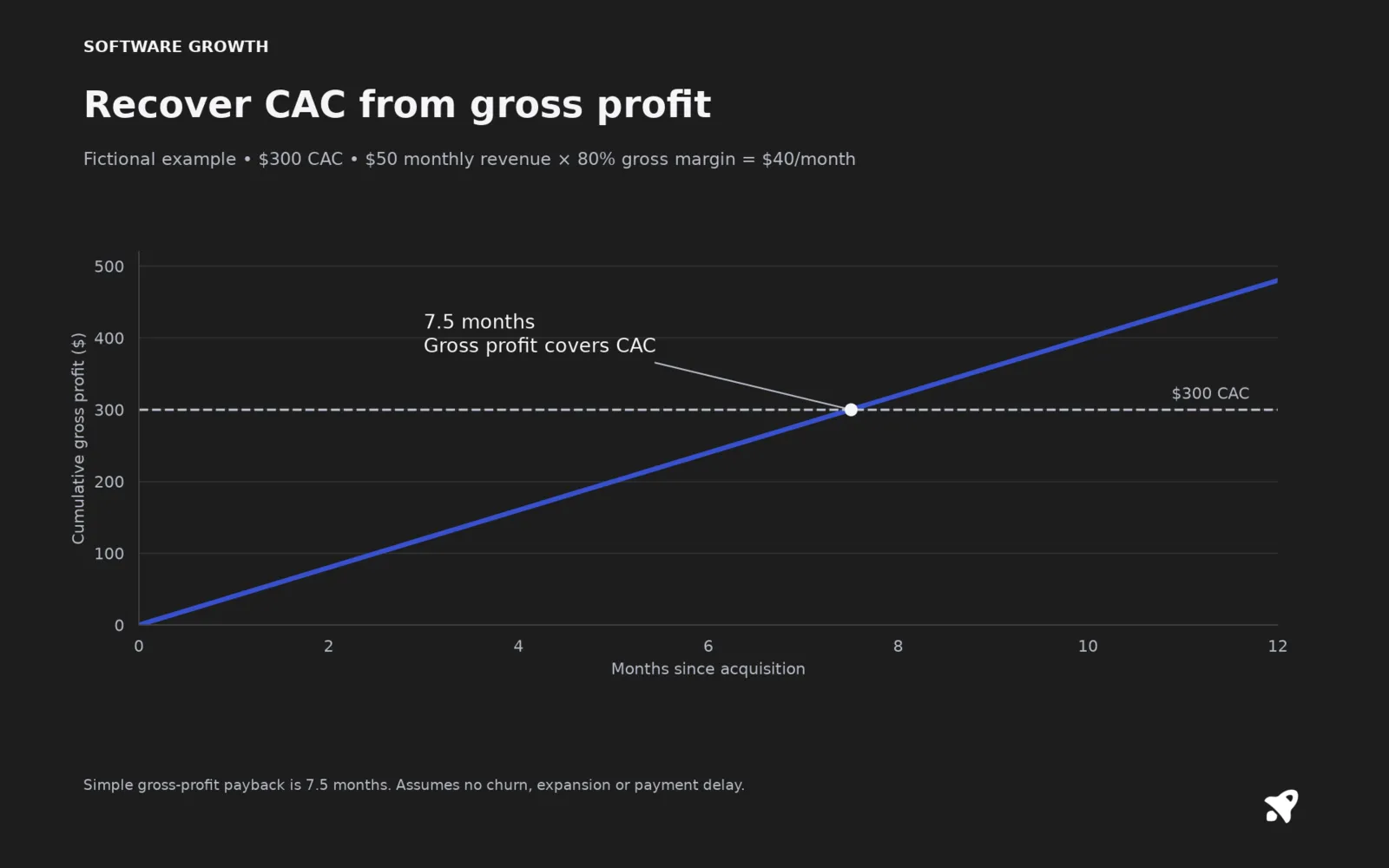
What good looks like
- David Skok says a healthy SaaS business recovers CAC in about 5 to 7 months, and that beyond 12 months profitability is anemic.
- Bessemer's cloud benchmarks, which skew to venture-backed companies, put SMB-focused payback under 12 months, mid-market under 18 and enterprise under 24. Their average at $1 to $10 million ARR is about 15 months.
Those numbers come from companies with funding to carry the gap. Your own limit is your cash.
Why it matters more than LTV for small teams
The LTV:CAC ratio assumes customers stay for years. Payback needs only the first few months of data, so it is easier to measure early and harder to fudge. If payback is 7.5 months and your customers are likely to stay at least that long, every new cohort funds the next one. With annual prepaid plans, payback can be effectively instant, which is why bootstrapped founders often push annual billing.
Common mistakes
- Using revenue instead of gross profit, which makes payback look shorter than it is.
- Ignoring churn. If 10% of customers leave in the first two months, the real payback is longer than the formula says.
- Mixing expansion revenue into new customer payback without saying so.
- Calculating it on a blended basis only. Look at it by channel as well, as described under blended CAC.
How to shorten it
You have four levers: spend less per customer, charge more, improve gross margin, or collect cash earlier through annual plans. Raising ARPA from $50 to $60 in the example gives $48 of gross profit per month and a payback of 6.25 months, a 17% improvement without touching acquisition costs.
A worked comparison
Say two channels each cost $300 per customer on average. Customers from search pay $50 per month on an annual plan, so payback is effectively immediate on cash. Customers from ads pay $50 monthly with higher churn, so payback is 7.5 months on paper and longer in practice. Same CAC, very different cash profile. This is why payback is worth tracking by channel and by billing plan, and why many small teams push annual billing: it turns a months-long wait into a same-day recovery and lets the next round of acquisition start sooner.
Related terms
Sources
- SaaS Metrics 2.0: A Guide to Measuring and Improving What Matters, David Skok, For Entrepreneurs
- Scaling to $100 Million, Bessemer Venture Partners
- The SaaS Metrics That Matter, David Sacks