Growth loop
A growth loop is a closed system where the output of one cycle, such as new content or new users, becomes the input that brings in the next cycle.
A growth loop is a way of describing growth as a cycle instead of a line. In a funnel you push traffic in at the top and count what falls out at the bottom. In a loop, the result of each cycle feeds the next one, so growth compounds without you buying the same input again. The idea was laid out by Brian Balfour and the Reforge team, with Casey Winters, Kevin Kwok and Andrew Chen, in an article arguing that growth loops are the new funnels.
Loops versus funnels
Reforge's argument is that funnels run one way, need more money, more people and more tactics to keep growing, and treat product, channels and monetization as separate silos. Loops are closed systems where output is reinvested as input. They also tie product, acquisition and monetization together, and because each loop is shaped around a specific product and business model, they are harder for competitors to copy than a generic tactic.
A sales funnel is still useful for measuring conversion between stages. A loop adds the question of where the next cycle's input comes from.
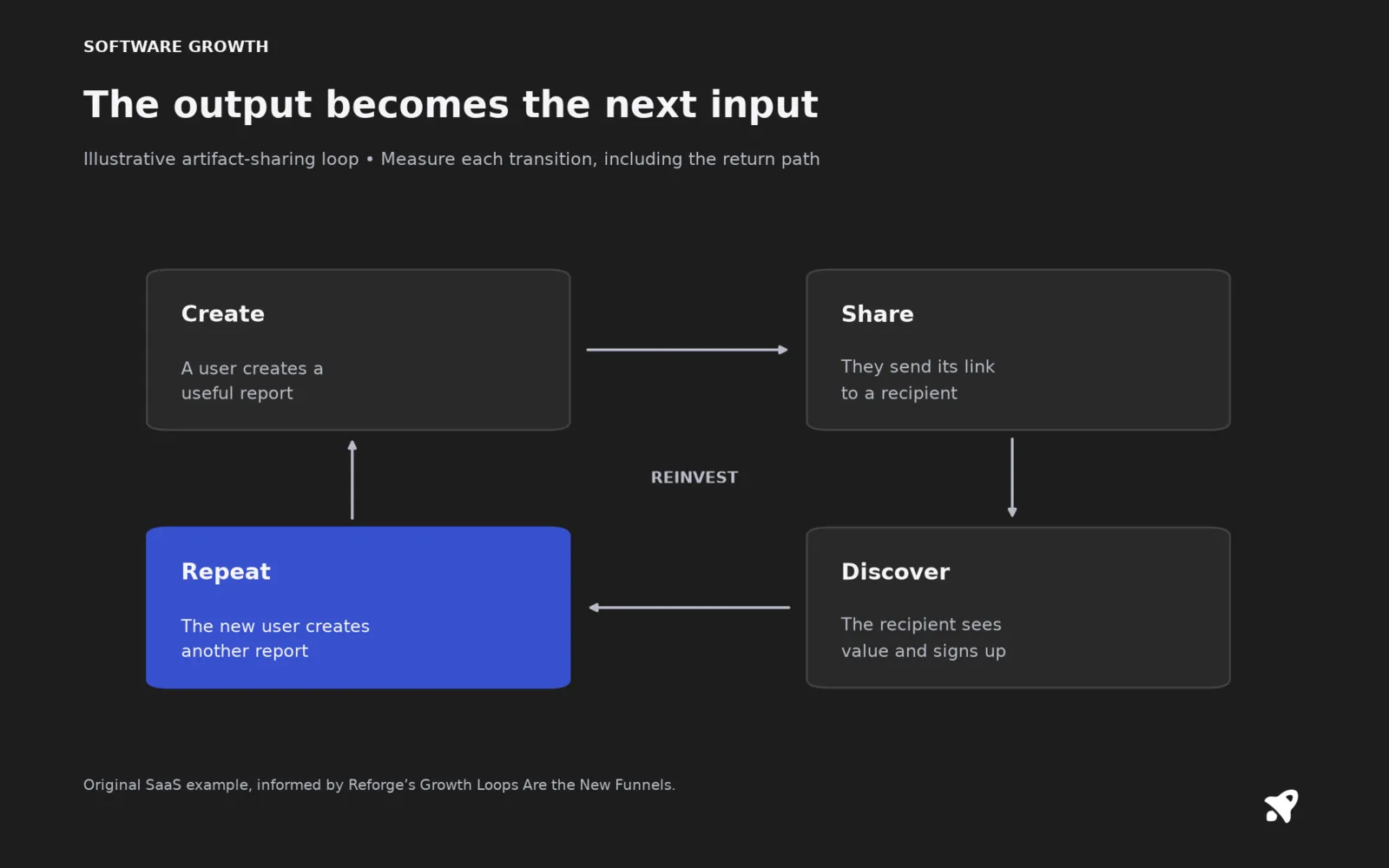
The anatomy of a loop
Every loop has the same four pieces:
- Input: new users or new content entering the loop.
- Action: what those users do inside the product.
- Output: something the action creates, like a page, an invite or a shared link.
- Reinvestment: the output brings in new input.
Reforge's example is Pinterest. Users sign up and save content, saved content signals quality to the algorithm, that content is distributed through search engines, and the people who find it become new users.
Common loop types for software
- Content loops: users create things that search engines index. See user-generated content and programmatic SEO.
- Viral loops: users invite others. Measured by the viral coefficient.
- Usage-visible loops: the product leaves a mark on what users send, as in billboarding.
- Paid loops: revenue from a customer funds ads that bring in more customers, which only works if payback is short.
How to find yours
Pick one loop and write it as a sentence: "A user does X, which creates Y, which brings Z new users." Then measure each step. If a step converts at 10 percent, that step is where to work. A loop's speed matters as much as its size: a loop that completes in a day beats one that takes a month at the same conversion.
A worked loop
Suppose your product lets users publish a public status page. In a month, 200 new users each publish a page, and each page gets 150 visitors, so you get 30,000 visits. If 0.5 percent of visitors sign up, that is 150 new users, who publish their own pages the next month. The loop yields 150 users from 200, a ratio of 0.75. Each change you make, such as more visible branding or a faster setup, moves one of those numbers and you can see the effect on the next cycle. A ratio below 1 still helps: it means the loop returns three-quarters of its input every cycle, and other channels top up the rest.
For small teams
Do not try to build three loops. Early on, a weak loop usually fails because the product does not retain users, not because the loop is badly designed. Fix activation and retention first, then add a loop on top. The related idea of a flywheel describes the same compounding effect at the company level.
Related terms
- Viral coefficient (K-factor)
- Billboarding
- User-generated content (UGC)
- Flywheel
- Programmatic SEO
- Sales funnel
Sources
- Growth Loops are the New Funnels, Reforge
- The New SEO Playbook: UGC-Driven Assets, The Growth Mind