Stair step approach
Rob Walling's path for bootstrappers. Start with a simple one-time product, repeat it until you own your time, then move to recurring-revenue SaaS.
The stair step approach is a framework by Rob Walling, founder of MicroConf and co-founder of TinySeed, for people who want to go from a day job to running their own software business without raising money. The idea is simple: do not start with the hardest thing. Climb one step at a time, and let each step fund and teach the next.
The three steps
Walling lays it out in an essay on the MicroConf site, based on patterns he saw in hundreds of successful bootstrappers.
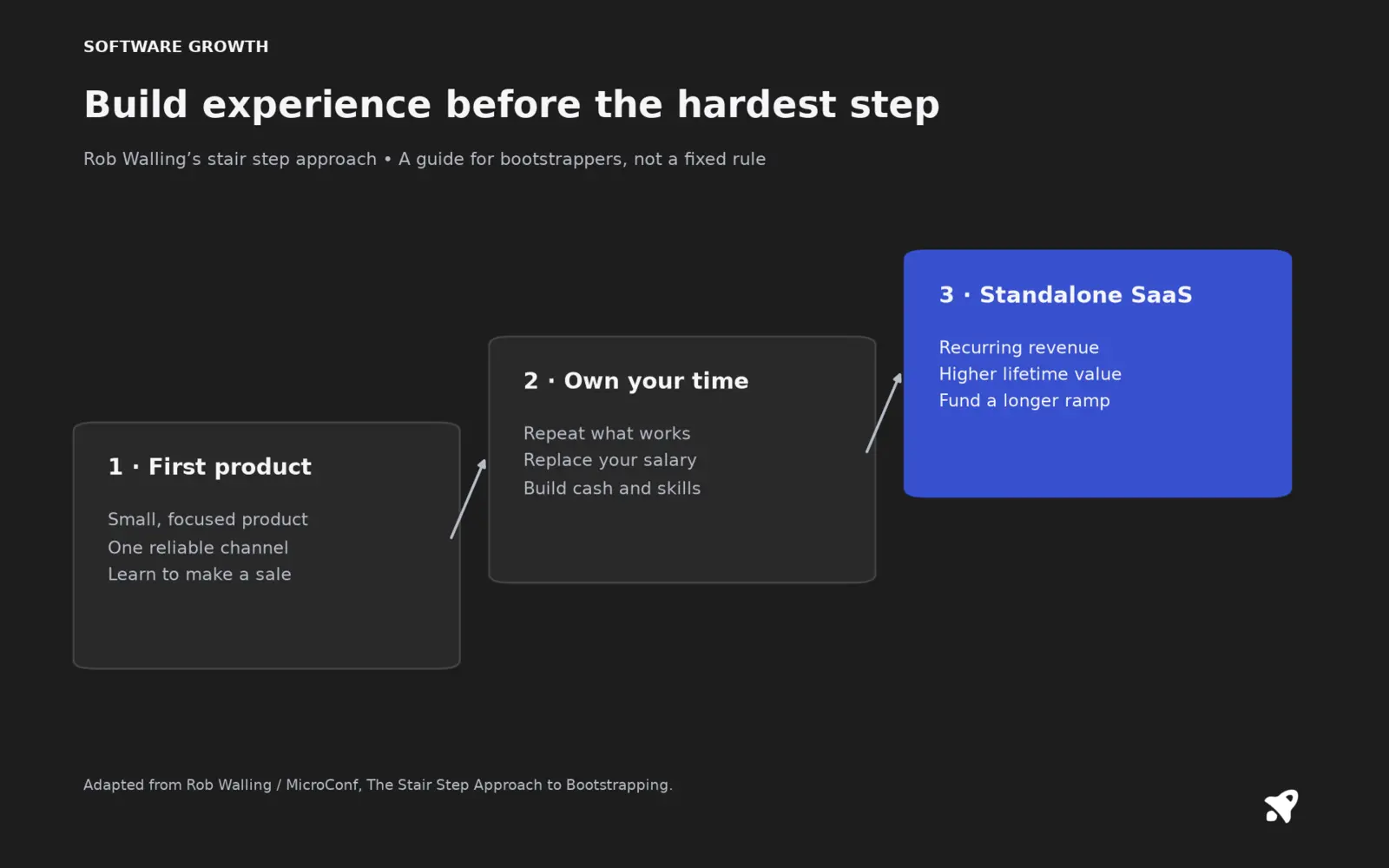
- Step 1: your first product. Build something simple, often a one-time-purchase add-on to an existing ecosystem such as a WordPress plugin, a Shopify app or a Heroku add-on. These are small to build, cheap to buy and come with built-in discovery through the app store or plugin repository. Focus on a single traffic channel, preferably free and organic, instead of splitting your time across several.
- Step 2: own your time. Double down on what worked and repeat it, with a larger product or several small ones, until combined revenue replaces your salary. His examples include a founder with three plugins that together paid the bills, and another with two paid plugins for Pinterest and Stripe Checkout.
- Step 3: recurring revenue. With income, experience and confidence, go after a stand-alone subscription product. Higher customer lifetime value makes channels like paid ads and content marketing workable, and a good product keeps most of its customers month after month.
Walling notes that he began seeing this pattern around 2009, talked about it on his podcast from about 2010 and gave it a name in 2013.
Why the order matters
A subscription product looks attractive, but it is slow. You need a billing system, onboarding, support and enough customers before revenue matters. Walling's point is that there is a long ramp to meaningful revenue, so beginners who start with SaaS often run out of energy before it pays. A one-time product reaches its first dollars faster, which gives you proof, confidence and cash.
Example
You build a $49 Shopify plugin and sell 30 per month, or $1,470. A second plugin adds $900. You pair them with a third and reach $4,500 per month, enough to quit your job in a low-cost region. Then you start a $39 per month tool that solves a related problem for the same customers. At 150 subscribers it earns $5,850 per month, more than all three plugins combined, and it recurs.
How to use it
- Pick one traction channel for your first product and test it before building more.
- Choose a small, narrow audience you can reach cheaply.
- Treat ramen profitability as the finish of step 2, not the end of the road.
- Reuse what you learn: the customers, audience and skills from steps 1 and 2 are your advantage in step 3.
Caveats
The approach was written when plugin and app marketplaces were less crowded and AI tools did not exist. The principle still holds, though the specific products change. A micro-SaaS can serve as step 1 or step 3 depending on its price and how it is sold. It fits bootstrapping and the broader indie hacker path, and it is a guide, not a law.
Related terms
Sources
- The Stair Step Approach to Bootstrapping, Rob Walling, MicroConf
- Rob Walling: Stair-stepping into SaaS success, The Bootstrapped Founder, Arvid Kahl