Beachhead market
A beachhead market is the narrow first segment a startup chooses to win completely, then uses as a base to expand into nearby markets.
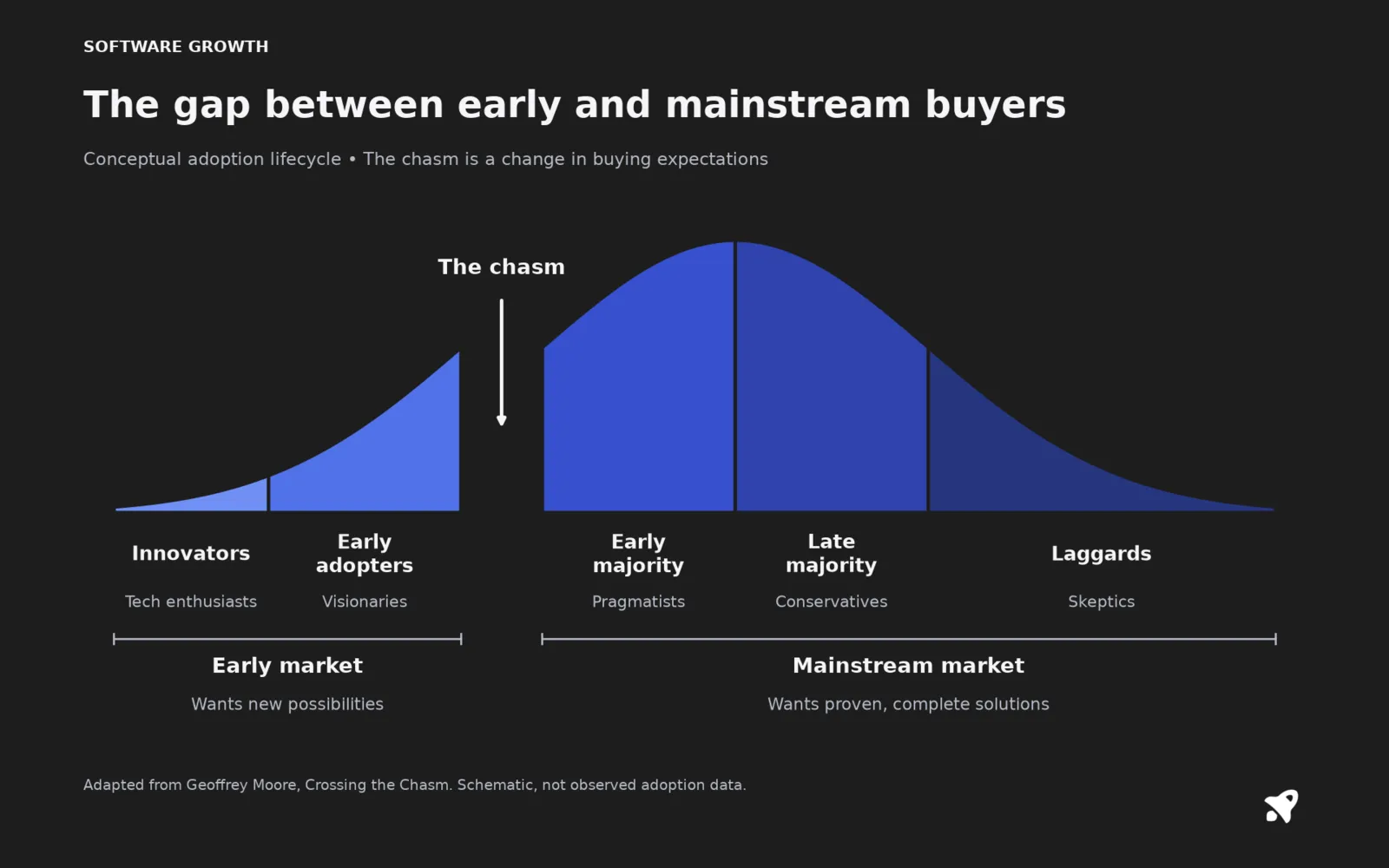
A beachhead market is the first, narrow group of customers you aim to dominate. The name comes from military strategy: you concentrate your force on one small landing point, secure it and then move inland. Geoffrey Moore brought the idea into tech marketing in his book Crossing the Chasm, where he compares it to the D-Day landing.
Why start narrow
New products have few resources. If you spread across ten segments you will be average in all of them. If you pick one, you can learn its language, win its references and show up everywhere it looks. Customers in a tight group talk to each other, so early wins spread. Paul Graham's essay on doing things that don't scale makes a similar case with Facebook, which started at Harvard and spread from there.
How to pick one
In a conversation with Lenny Rachitsky, Moore described a good beachhead as a target segment that is big enough to matter, small enough to lead, and a good fit with your crown jewels (your core strengths). Use those three tests:
- Big enough to matter. There must be enough buyers to sustain you.
- Small enough to lead. You can realistically become the default choice within a year or two.
- Fits what you do best. The segment's problem should match your product, skills or access.
Add a practical fourth: you can reach them cheaply, through a forum, a conference, a directory or a few communities.
Example
Instead of "project management for teams," you choose "project management for wedding planners." Suppose there are 20,000 wedding planners in your market and you charge $39 per month. Winning 5 percent gives 1,000 customers. 20,000 times 0.05 equals 1,000. At $39, that is $39,000 in MRR. You get there by being the product wedding planners recommend to each other. From there you can add event planners, then corporate event teams.
Beachhead vs related terms
A beachhead is a market choice. An ideal customer profile is a description of the best-fit customer inside it. Positioning is how you present yourself to them. The three work together. It also lines up with vertical SaaS, which often grows from one industry niche.
Common mistakes
- Choosing a segment because it is large, not because you can win it.
- Defining it by demographics instead of a shared problem.
- Expanding too early, before customers refer you without being asked.
- Picking a niche so small that it cannot pay your bills.
For bootstrapped founders
A beachhead fits low-budget growth well, because you rely on word of mouth and cheap, targeted channels rather than ad spend. Once you hold most of one niche, adjacent segments become easier, and you can move on with references and revenue behind you. This is the same logic that sits behind crossing the chasm.
Related terms
- ICP (Ideal customer profile)
- Crossing the chasm
- Vertical SaaS
- Early adopters
- Go-to-market strategy (GTM)
- Positioning
Sources
- Geoffrey Moore on finding your beachhead, crossing the chasm, and dominating a market, Lenny's Newsletter
- Do Things that Don't Scale, Paul Graham