Early adopters
Early adopters are the first customers to try a new product, tolerate its rough edges and, if it solves a real problem, tell others about it.
Early adopters are the people who buy a product before it is proven, because they see a benefit the mainstream does not see yet. They accept missing features, rough documentation and a founder answering their support email. For a new SaaS they are the first 10 to 100 paying customers, and they decide whether you learn fast enough to survive.
Where the term comes from
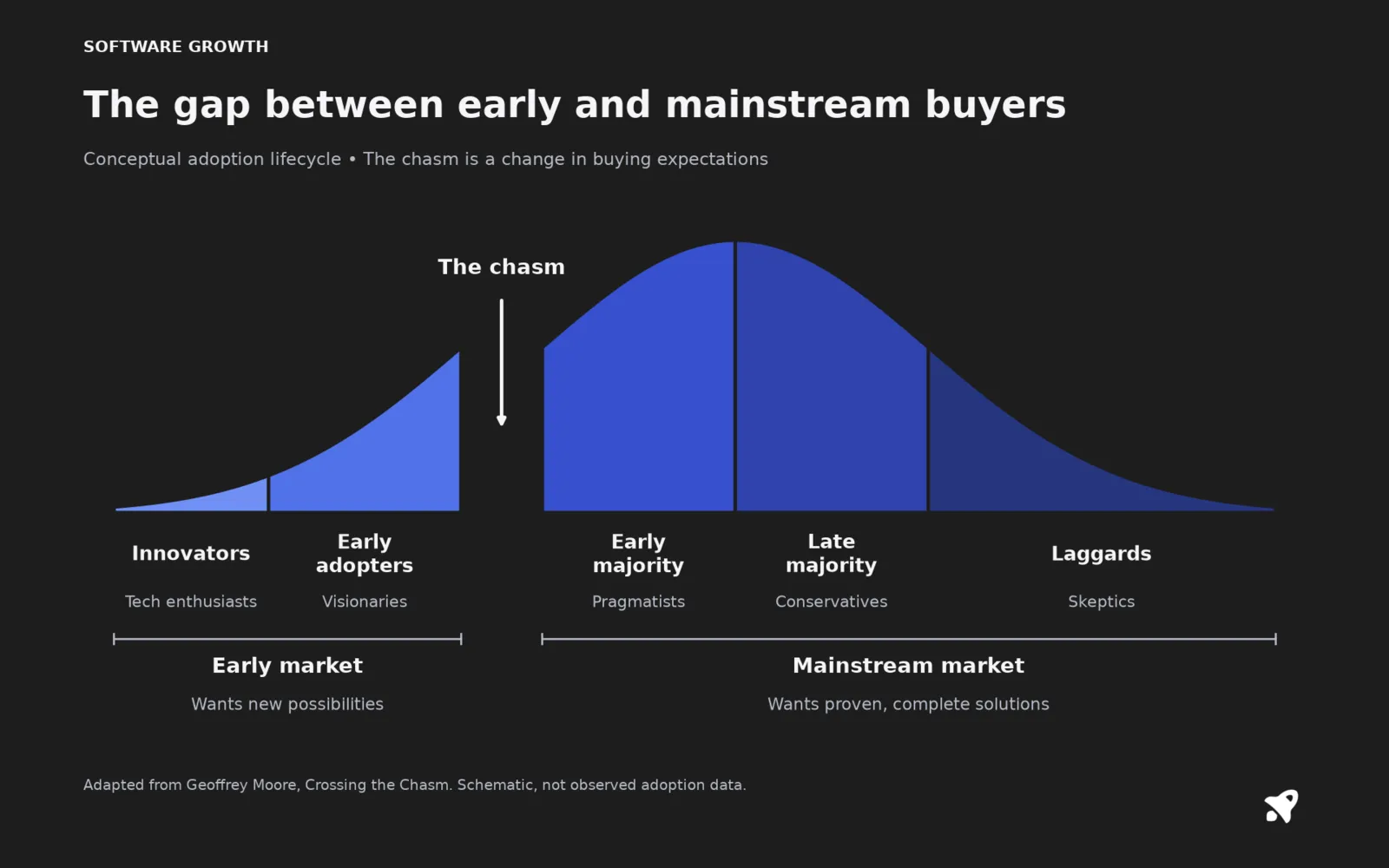
Everett Rogers' diffusion of innovations theory divides any market into five groups by when they adopt. The percentages below are the standard split, which reflect a bell-shaped distribution of adoption times, not fixed laws (ProductMint):
- Innovators: 2.5 percent. Adventurous and risk-tolerant.
- Early adopters: 13.5 percent. Visionaries and opinion leaders in their circles.
- Early majority: 34 percent. Pragmatic, want proof it works.
- Late majority: 34 percent. Skeptical, adopt when most others have.
- Laggards: 16 percent. Adopt only when they must.
Early adopters conduct more research than innovators and hold social influence in their category, which is why their opinion travels.
What early adopters want
Geoffrey Moore, in Crossing the Chasm, describes early adopters as change agents who seek a competitive advantage through a break from the past and accept imperfections to get it (Yevgeniy Brikman's notes on the book). The early majority is different: pragmatists who want evolution, stability and proven reliability. This difference is the root of the chasm between the two groups.
How to find them
- Look for the pain. People already hacking a workaround with spreadsheets, scripts or three tools are the strongest candidates.
- Go where the problem is discussed. Niche forums, communities and newsletters beat broad ads.
- Talk to them one by one. Offer a call. Early on, customer development is the product of the work.
- Ask for commitment. A paid pilot or pre-order separates real early adopters from polite interest.
What to do once you have them
They are a source of learning more than revenue. Use them to reach product-market fit: watch how they use the product, ask why they stay or leave, and look for the common thread. Characterize the group: what industry, role and problem do your most engaged early adopters share? That becomes your first ideal customer profile.
The trap: building for them forever
Early adopters tolerate complexity and want customization. If you keep following their requests, you may build something only they want. The mainstream will want it simpler, more polished and proven. Watch for the signal: early signups come easily but new customers who are not like them struggle to activate or churn quickly. That signals you are at the edge of the chasm.
For a bootstrapped founder
You can't afford a big launch, so a small group of committed early adopters is your whole market for a while. Charge them from the start, even a small amount. Free users tell you much less than paying ones, and paying early adopters prove the problem is worth solving. Choose one niche, then expand into the neighboring segment using the story they tell, which is Moore's beachhead approach.
Related terms
- Crossing the chasm
- Beachhead market
- Product-market fit
- ICP (Ideal customer profile)
- Customer development
- MVP (Minimum viable product)
Sources
- The Five Adopter Categories: Definition and Examples, ProductMint
- Crossing the Chasm by Geoffrey Moore (book notes), Yevgeniy Brikman