PLG (Product-led growth)
Product-led growth is a go-to-market strategy where the product itself drives acquisition, conversion and expansion, usually through self-serve signup.
Product-led growth, or PLG, means people find your software, try it and start paying without talking to a salesperson first. The product does the selling. OpenView, the venture firm that helped popularize the term around 2016, defines it as a go-to-market strategy that relies on the product as the primary driver of customer acquisition, conversion, and expansion, according to its partner Blake Bartlett.
Wes Bush of ProductLed describes it the same way: the product is the main vehicle to acquire, activate and retain customers, with Slack and Dropbox as the examples most people have experienced first-hand.
How PLG works
A typical PLG motion has four parts:
- A way to start without friction: a freemium plan, a free trial, or a cheap entry tier you can buy with a card.
- Fast time to value, so a new user reaches a useful result in the first session.
- Built-in distribution: sharing, invites, templates or embedded branding that bring in more users.
- A path to pay, triggered by usage limits, team features or product-qualified leads.
Bartlett points to Calendly as an example of a product with virality built into how it is used: the person you send a link to experiences the product immediately. He also names Slack and Snowflake as strong examples of expansion through internal usage and usage-based pricing.
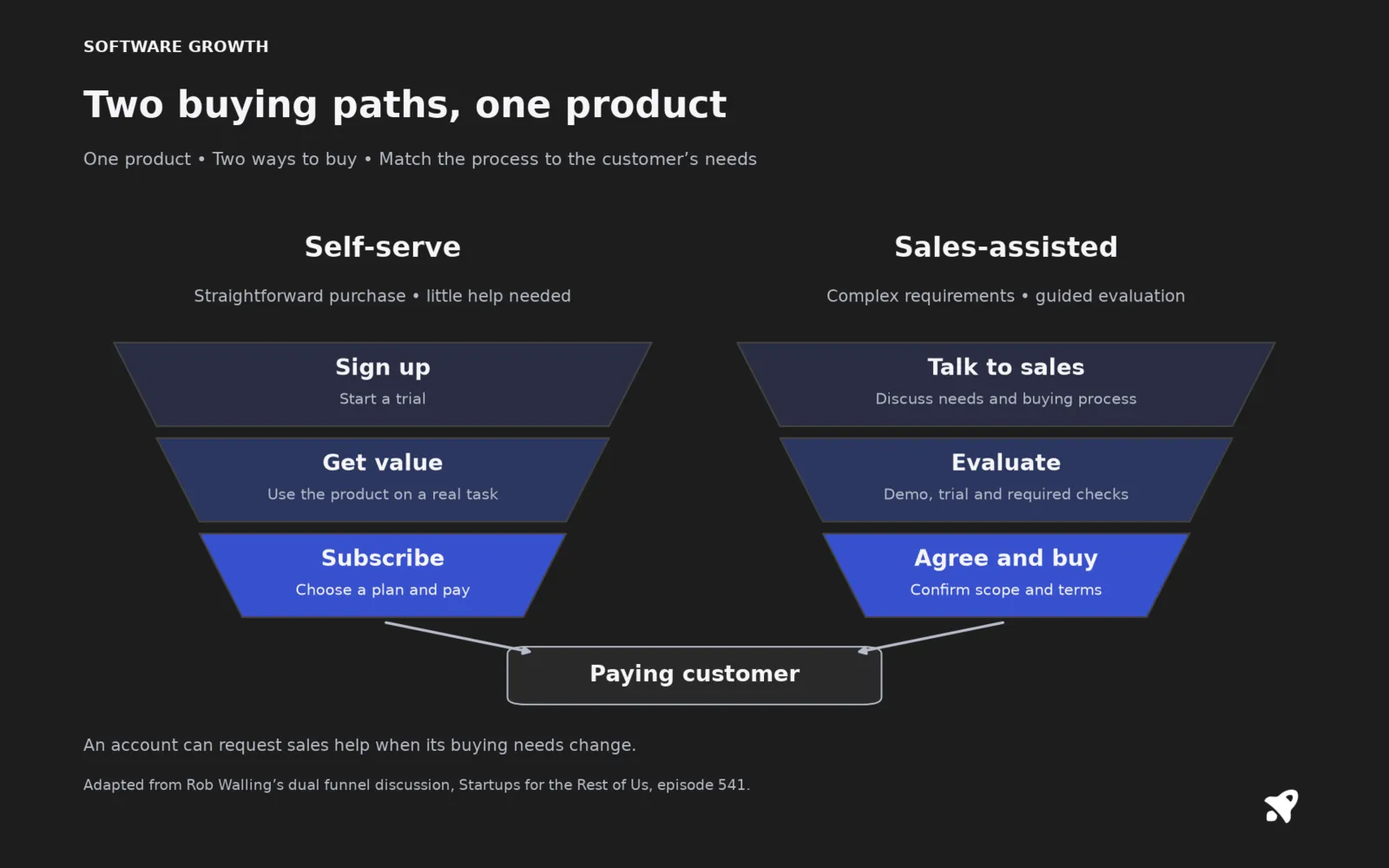
PLG is not the absence of sales
Bartlett says PLG is not anti-sales. Datadog, Atlassian and Snowflake all added enterprise sales teams as they grew while keeping self-service available. The usual pattern is a self-serve base for small accounts and sales help for larger ones. That hybrid is covered in sales-led growth, which is the model PLG is most often compared with.
What it costs you
PLG is cheaper per customer to acquire, but not free. You pay in product work instead of sales salaries: onboarding flows, a pricing page that works without a human, usage analytics, and support that scales. If your product needs a long setup, a security review or a custom integration before it is useful, a self-serve trial will mostly produce confused signups.
Fit for a bootstrapped SaaS
For a solo founder or a team of three, PLG is often the only affordable motion, because you cannot pay a sales team before you have revenue. It works best when:
- One person can decide to try and buy the product on their own.
- The price is low enough to expense without approval.
- Value shows up within minutes or days, not weeks.
Watch the conversion step from free to paid and the share of free users who never activate. A big free user count with a thin paid base is a signal that the free tier is too generous or that activation is broken, not that PLG is working.
Pair PLG with a clear ideal customer profile. Open signup invites everyone, and the wrong users cost you support time without ever paying.
Related terms
- Sales-led growth
- Self-serve (self-service SaaS)
- Freemium
- PQL (Product qualified lead)
- TTV (Time to value)
- Free trial