Sales-led growth
Sales-led growth is a go-to-market model where a sales team finds, nurtures and closes customers, usually through demos, calls and negotiated contracts.
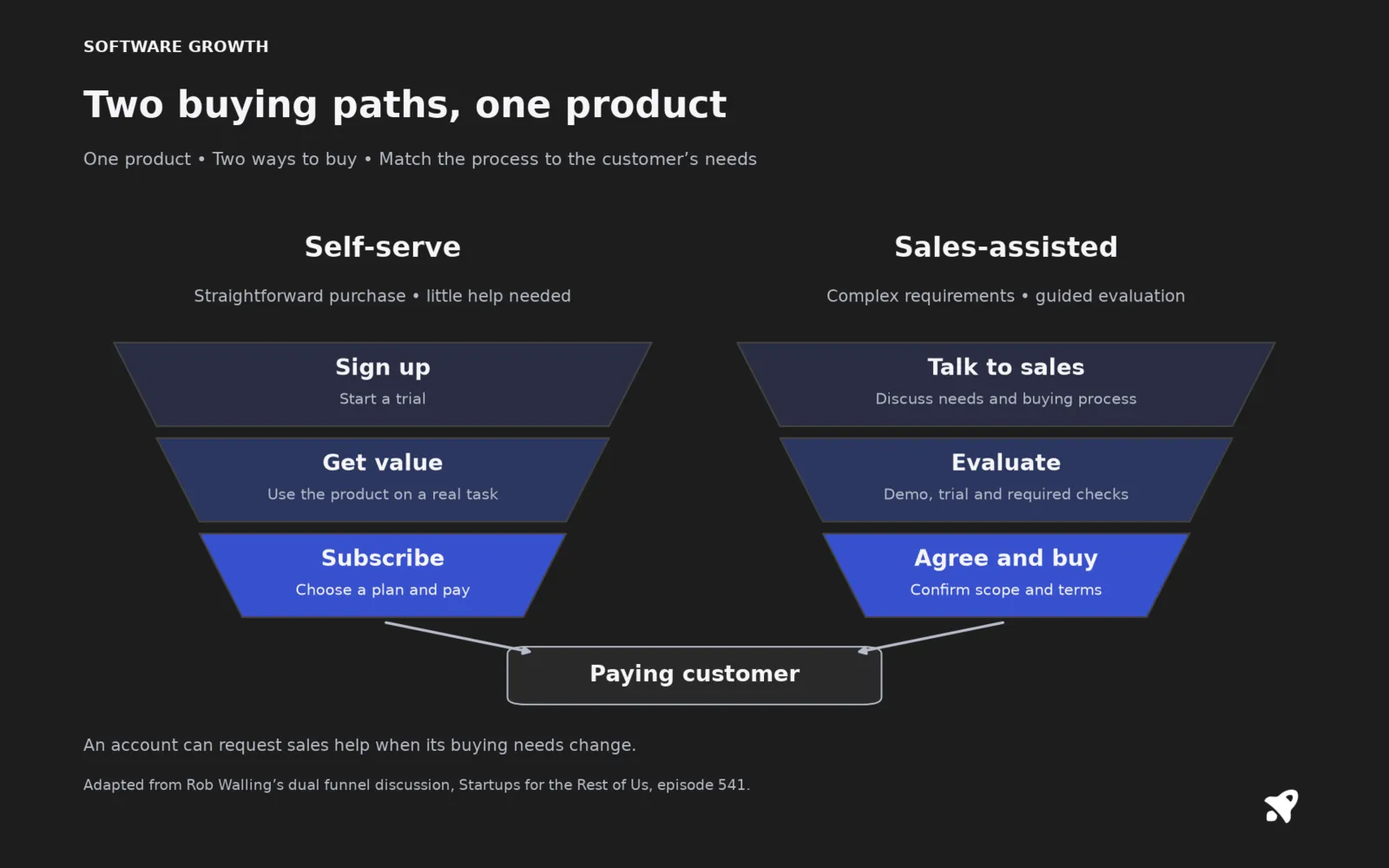
In sales-led growth (SLG), people close the deals. Marketing generates leads, reps qualify them, run demos, handle objections and negotiate a contract. The product matters, but a human walks the buyer through it. It is the traditional enterprise software model and the one product-led growth is usually contrasted with.
When sales-led makes sense
SLG fits when a buyer needs help to say yes. Common signs:
- High annual contract value, enough to pay for a rep and still make money.
- A complex product that needs setup, integrations or data migration.
- Several people in the buying decision, including security or procurement.
- A buyer who does not know they have the problem and needs to be educated.
One comparison of the two models notes that sales-led growth works well for complex, higher-priced products, with long sales cycles, one-on-one support through demos and calls, and onboarding guided by a rep (Froged).
The economics
Sales-led growth costs more per customer, and the cost arrives before the revenue: you hire reps, wait through the sales cycle, and only then see the contract. That is why it needs large deals. If your average contract is $600 a year, a rep cannot pay for themselves. If it is $30,000 a year, they can.
It also scales with headcount. Doubling new customers usually means more reps, more sales support and more management, while a self-serve motion can scale with traffic.
Hybrid models are normal
Many companies mix the two. Slack, Atlassian and Dropbox are cited as examples of companies that combine self-serve adoption with sales help for bigger accounts. In practice a small team often starts self-serve, then adds a sales-assist layer once larger customers appear. This is sometimes called low-touch sales: a rep who helps a user who has already started, rather than prospecting cold with outbound sales.
For small and bootstrapped teams
Founder-led sales is the right starting point for many B2B products. Selling the first 20 customers yourself teaches you who buys and why, and you cannot learn that from a hired rep. Hire sales only after you can describe a repeatable process: who the buyer is, where you find them, what the demo covers and what a typical deal costs and earns. Until then, a sales hire amplifies guesses.
Related terms
- PLG (Product-led growth)
- Outbound sales
- Sales cycle
- Low-touch sales
- Go-to-market strategy (GTM)
- ACV (Annual contract value)