ARR multiple
An ARR multiple values a SaaS company as a multiple of its annual recurring revenue. A $1M ARR business at 3x is valued at $3M.
An ARR multiple is the price a buyer pays divided by the company's annual recurring revenue. It is the shorthand people use for SaaS valuation: "we sold at 3x ARR." It is popular because recurring revenue is more predictable than one-time sales, so buyers will pay for revenue rather than only for profit.
How to calculate it
Example: a product with $50,000 MRR has $600,000 ARR. At a 3x multiple the valuation is $1,800,000. The multiple is also computed after the fact: sold for $1.8M on $600K ARR is 1.8 / 0.6 = 3x.
How SaaS multiples have changed over time
The market can change your valuation even when your revenue keeps growing. The chart below plots 141 monthly observations from the SaaS Capital Index, from January 2015 through September 2026.
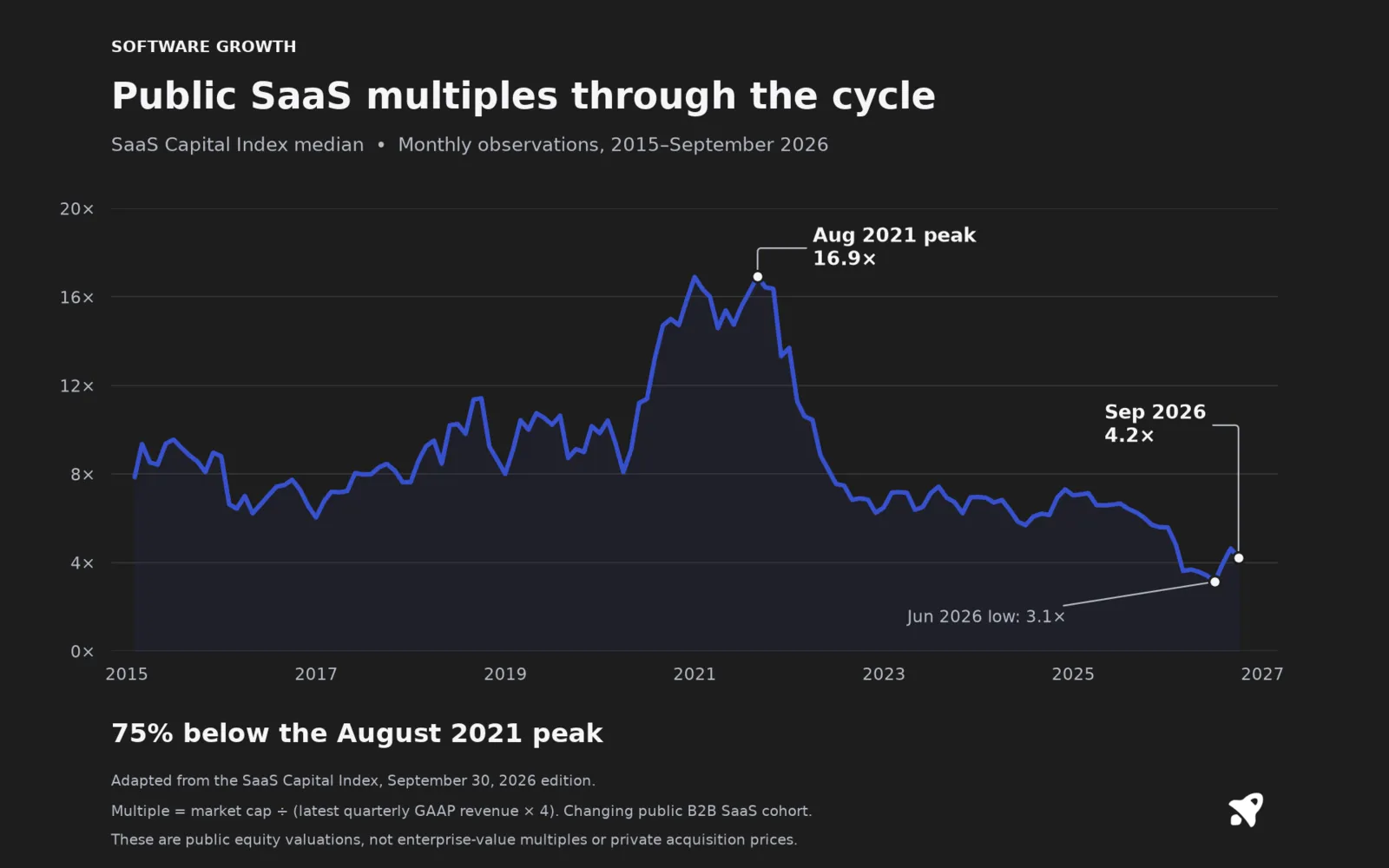
What this measures: the median public B2B SaaS company's market capitalization divided by its latest quarterly GAAP revenue multiplied by four. SaaS Capital calls this an ARR multiple, but the denominator is annualized reported revenue. Market cap does not adjust for cash or debt, so this is not an enterprise-value multiple or a record of private acquisition prices.
The 2020–2021 peak
The median reached 16.9x in August 2021. SaaS Capital's historical analysis connects the pandemic-era rise to demand for remote work software and abundant cheap capital. That period helps explain the unusually high valuations founders still hear about.
The reset after 2021
By December 2022, the median was 6.5x. It ended both 2023 and 2024 near 7.0x, then 2025 at 5.6x. The compression therefore began well before the 2026 AI sell-off. SaaS Capital points to interest-rate increases as part of the earlier reset.
AI enthusiasm has not lifted all SaaS valuations
In its April 2026 commentary, SaaS Capital attributes the renewed fall partly to investor concern that AI could threaten existing SaaS business models. The median subsequently reached 3.1x in June and recovered to 4.2x in September. September's reading was still about 75% below the August 2021 peak.
This series measures existing public SaaS companies. It does not measure private AI startup funding rounds. Headlines about an AI company's premium valuation and a falling SaaS median can coexist. The chart shows the price change; it cannot isolate how much of that change was caused by AI.
What this means for a small SaaS
Use the history to question the multiple in your plan. A fictional business with $1M ARR valued at 8x would have an $8M valuation. If ARR grew 25% to $1.25M but the applicable multiple fell to 4x, the valuation would be $5M. Revenue increased while the implied valuation fell. These are illustrative assumptions, not a forecast or an offer.
For your own business, start with comparable transactions of a similar size, growth rate, and profitability. A public-market median supplies context; it does not tell you what a buyer will pay for an owner-operated SaaS.
Download the monthly chart data (CSV). Values are copied from the published median series and plotted without smoothing. Labels round to one decimal. Index membership changes over time; pre-Q3 2019 history reflects the companies active when the index was first compiled, so this is not a fixed basket of companies.
What moves the multiple
There is no fixed rate. Published ranges vary by source, period and company size, so be wary of any single number. The factors buyers weigh are consistent:
- Growth rate. Faster growth earns a higher multiple.
- Retention, especially net revenue retention and churn.
- Margins and profitability.
- Customer concentration.
- How dependent the business is on the founder.
ARR multiple vs SDE multiple
FE International notes that which metric leads depends on size, growth profile and the buyer's own model, not a universal rule. In general, smaller owner-operated SaaS businesses are priced on seller's discretionary earnings, because the buyer is buying the owner's income. Larger, faster-growing companies are priced on revenue. The two can give very different answers for the same company. A profitable $400K ARR business that earns $165K SDE might sell at 3.5x SDE ($577K), which is about 1.4x ARR, while a venture-backed company with the same ARR but heavy losses might be valued on revenue and growth.
Common mistakes
- Counting one-time fees, services, or usage spikes as ARR.
- Applying a headline multiple from a much larger company to a small one.
- Ignoring that ARR can drop right after a sale if customers leave. Buyers test this in due diligence.
Treat the multiple as a way to compare offers and sanity-check a price, not as a promise of what you can get.
Related terms
- ARR (Annual recurring revenue)
- SDE (Seller's discretionary earnings)
- NRR (Net revenue retention)
- Customer concentration
- Exit strategy
- EBITDA
Sources
- SaaS Capital Index and downloadable monthly data, SaaS Capital, September 30, 2026 edition
- SaaS Valuation Multiples: Understanding the New Normal, SaaS Capital, August 6, 2025
- Four early 2026 SaaS trends, SaaS Capital, April 9, 2026
- ARR vs revenue vs SDE vs EBITDA: which number values a SaaS business, FE International
- SDE Calculation for SaaS: The Complete Valuation Guide for Sub-$5M Companies, Development Corporate