ARR (Annual recurring revenue)
ARR is your current recurring revenue expressed as a yearly figure, usually MRR multiplied by 12. It is a run rate, not revenue earned over a year.
ARR (annual recurring revenue) is the yearly value of the recurring revenue your customers are paying for right now. Most SaaS companies calculate it as MRR × 12, leaving out one-time fees such as setup and consulting.
ARR answers a simple question: if nothing changed, how much recurring revenue would the business bring in over the next 12 months? It is a run rate, so it is different from revenue already earned, from cash in the bank and from the value of contracts signed. It is the headline number for investors, acquirers and anyone comparing SaaS companies, because it puts monthly plans, annual plans and multi-year contracts on one yearly scale.
How to calculate ARR
Take your normalized MRR and multiply by twelve. ChartMogul defines it the same way in its metric glossary, as an estimate of what a subscription will earn over the next 12 months at its current MRR.
A product at $20,000 MRR has $240,000 ARR. You can also add up annual values directly: a customer on a $1,200 annual plan contributes $1,200 of ARR, and a customer paying $100 a month contributes the same.
The acronym has two meanings, and it helps to know which one you are using. ChartMogul's ARR guide (updated September 8, 2026) separates them:
- Annualized run rate: MRR × 12. It includes monthly plans, and it is what most modern SaaS companies mean by ARR.
- Annual recurring revenue in the strict sense: only contracts of 12 months or longer, calculated as total contract value divided by the number of years. A $6,000 contract over four years is $1,500 of ARR.
If most of your customers pay monthly, use the run-rate version and say so. The strict version suits businesses that sell annual or multi-year contracts almost exclusively.
What counts and what doesn't
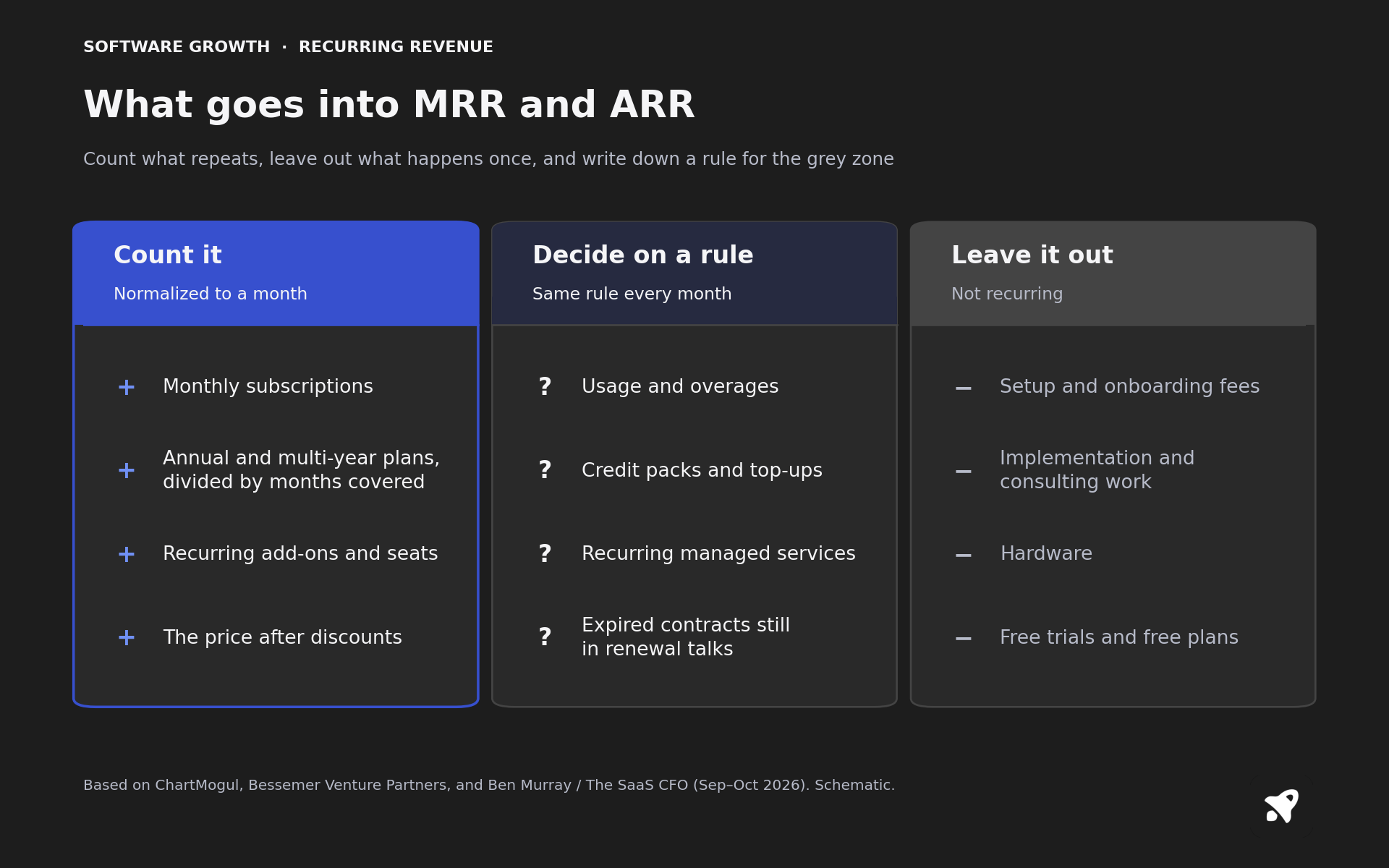
ARR follows the same rules as MRR. Count subscriptions at the price customers actually pay, after discounts. Strip out setup fees, implementation, consulting and other one-time charges, and exclude free trials. ChartMogul names folding one-time fees or services revenue into ARR as a common mistake, because it overstates the revenue you can count on.
Bessemer's Atlas draws a useful line: ARR is recognized recurring revenue times twelve, while annual run rate revenue (ARRR) also includes non-recurring items such as services. If you report a number that includes services, call it run rate revenue, not ARR.
Some revenue sits in a grey zone, and companies treat it differently. Ben Murray, who writes and teaches as The SaaS CFO, studied how public technology companies define ARR and found several combinations: subscription revenue alone, subscription plus variable revenue such as usage or overages, and in some cases recurring managed services too. Some companies leave overages out entirely; others annualize the overages that keep recurring. None of these is wrong, as long as you pick one, write it down and apply it every month.
Worked example
Ledgerly is a fictional bootstrapped invoicing tool. At the end of October its customers look like this:
- 310 customers on the $49 monthly plan: 310 × $49 = $15,190 MRR
- 40 customers on a $468 annual plan: $468 ÷ 12 = $39 a month each, so 40 × $39 = $1,560 MRR
- 3 accounting firms on two-year contracts worth $9,600 a year each: $9,600 ÷ 12 = $800 a month each, so $2,400 MRR
- Usage overages that averaged $600 a month over the last three months
- $3,000 of one-time onboarding fees billed this month
Subscription MRR is $15,190 + $1,560 + $2,400 = $19,150, so subscription ARR is $19,150 × 12 = $229,800. The onboarding fees never enter the calculation.
The overages need a rule. If Ledgerly decides that recurring usage counts, measured as the trailing three-month average, MRR becomes $19,150 + $600 = $19,750 and ARR becomes $237,000. Both numbers are defensible. What matters is that Ledgerly states which one it reports and uses the same rule next month.
ARR vs revenue, bookings and cash
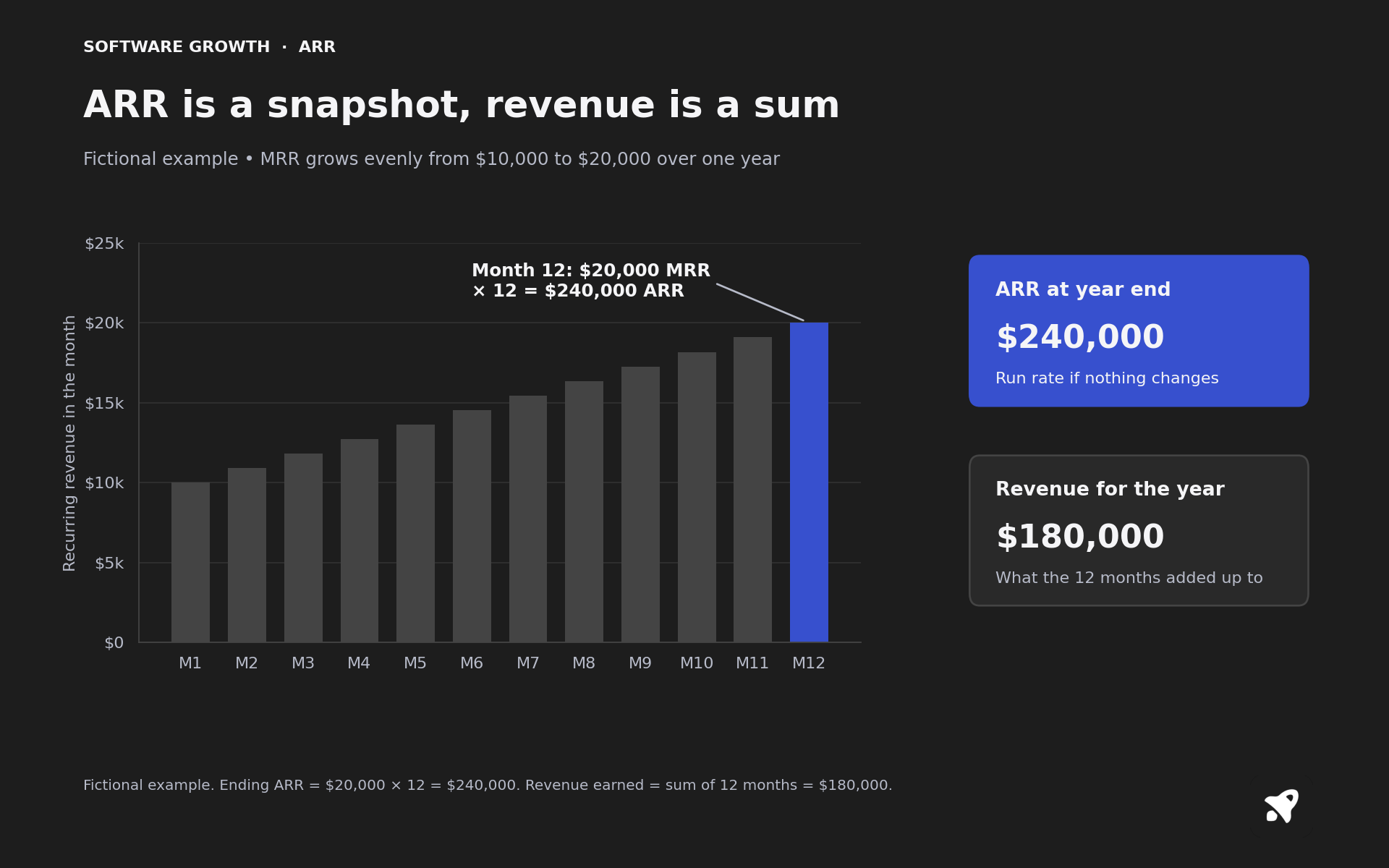
ARR is a snapshot of your run rate today. Revenue is what you actually earned over a period. Suppose MRR grew steadily from $10,000 to $20,000 across a year. Ending ARR is $240,000, but revenue for that year is $180,000, because the early months were smaller. Neither is wrong; they answer different questions. Revenue, as recognized under accounting rules, also lags or leads cash depending on how customers pay.
Three more numbers get confused with ARR:
- Bookings are the value of contracts signed. If Ledgerly signs another accounting firm to a two-year, $19,200 contract, bookings rise by $19,200 that day, but ARR rises by only $9,600, the yearly value.
- Billings are what you invoice. Bill that contract annually and you invoice $9,600 now and $9,600 in a year.
- Cash is what has actually arrived. An annual prepayment fills the bank account up front, while the money not yet earned sits as deferred revenue.
Annual contract value is the yearly value of one contract, and ARR is the total across all customers. Total contract value covers the whole term. Stripe lays out the difference between the three clearly.
ARR vs MRR
They are the same data on different scales. MRR is the working number: it shows what changed this month and reacts quickly to a pricing test or a bad week of cancellations. ARR is the scale number: it is easier to compare against other companies and fits annual planning.
Dodo Payments suggests MRR for companies under roughly $1M ARR and for short contracts, ARR for fundraising and larger accounts with annual deals. That matches how most small teams behave. If most customers pay monthly, talk in MRR. If you sell annual contracts to a few dozen businesses, ARR is the natural unit.
Deal size also shapes how ARR moves. With big annual contracts, ARR grows in jumps. Rob Walling, answering a listener planning to sell to hospitals, where deals can take 12 to 18 months to close, described what that feels like:
I just imagine MRR or ARR being basically zero for 12 to 18 months.
Rob Walling / Startups for the Rest of Us, episode 847 (August 25, 2026)

Then one quarter-million-dollar contract arrives and ARR jumps by $250,000. Walling says he has seen companies make that model work, but that he would want deals closing every one to three months to stay motivated.
Benchmarks for bootstrapped SaaS
Most ARR benchmarks come from venture-backed companies, so treat them with care. These come from ChartMogul's data on thousands of smaller software companies, analyzed by Kyle Poyar:
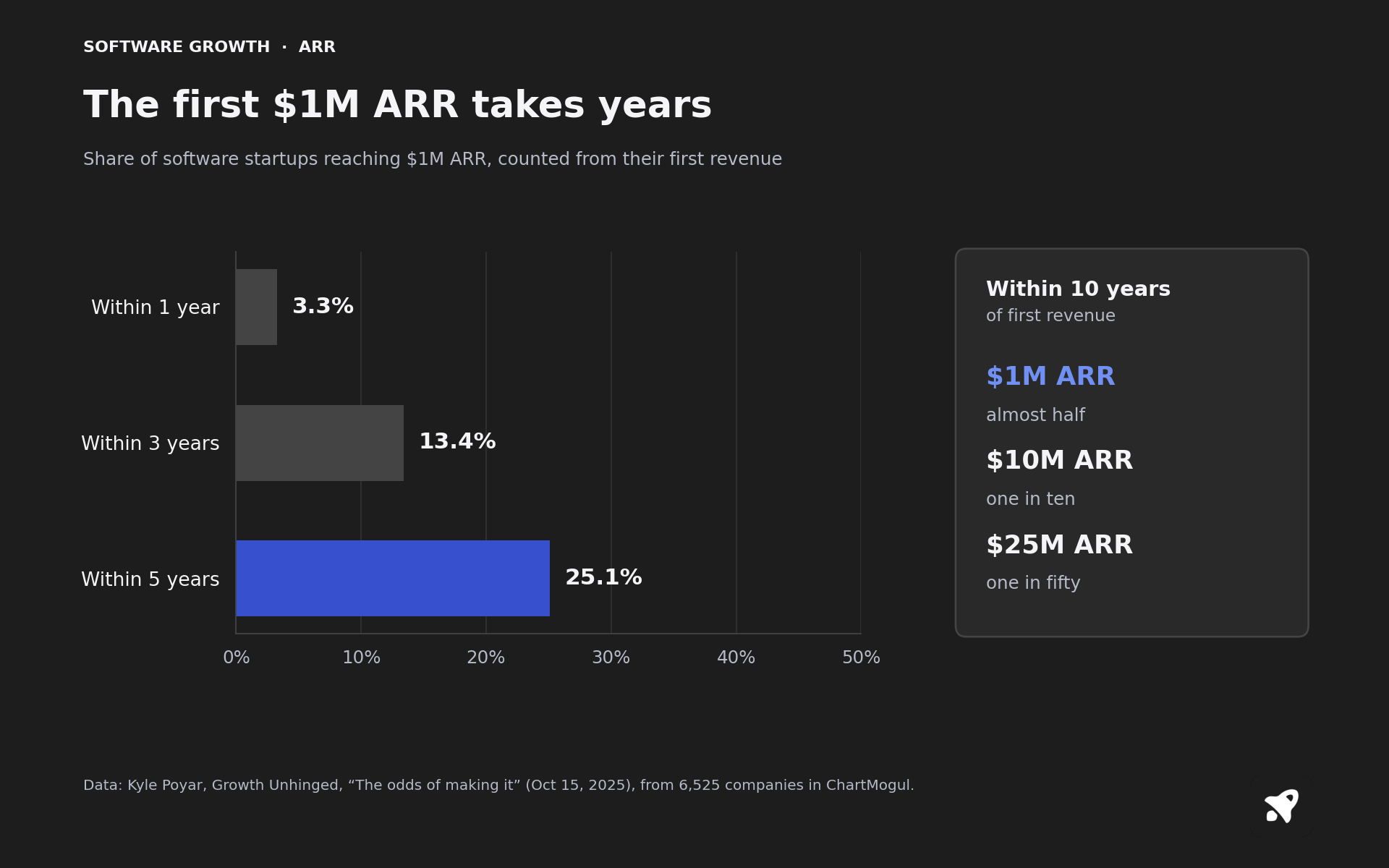
- The first $1M ARR usually takes two to five years from the first revenue. In Poyar's analysis of 6,525 companies, 3.3% got there in under a year, 13.4% in under three years and 25.1% within five. Almost half reach $1M within ten years if they keep going, but only one in ten reach $10M and one in fifty reach $25M.
- The most common path to $10,000 MRR ($120,000 ARR) is about 100 customers paying about $100 a month. 53% of the 1,043 companies in Poyar's deal-size study got there that way. Companies charging $300 to $2,999 a month per account kept far more of their revenue: median annualized gross revenue retention at $10,000 MRR was 70.5%, against 31.6% for the $30 to $299 group.
- Growth rates decay. In a ChartMogul sample of more than 700 companies, the median company kept only 43% of its growth rate from one year to the next, according to Poyar's growth endurance study (April 15, 2026). A company growing 65% one year typically grew 28% the next. Plan ARR targets with that in mind, and see ARR growth rate.
The data shows that startups become what they hunt, and most never change.
Kyle Poyar / Startups become what they hunt (June 3, 2026)
Poyar's point is that the price you start at, and the customer it attracts, tends to stay with you. 70% of the companies in his sample still served the same size of customer three years after reaching $10,000 MRR.
What changed recently: ARR definitions under scrutiny
Usage-based and AI pricing has made ARR harder to pin down, and through September and October 2026 Ben Murray ran a series of short videos on how companies define it. Drawing on the filings of public technology companies, his main points were:
- Look behind the headline number (September 24, 2026). Companies combine subscription, variable and managed-services revenue in different ways, so two "ARR" figures may not be comparable.
- Your definition should answer five questions (September 30, 2026): what revenue is included, what is excluded, whether ARR is built from recognized revenue, contracts or both, what the annualization formula is, and how usage revenue is handled. One common method for usage is the trailing 90 days of usage revenue × 4.
- Disclose changes (October 7, 2026). If you change your ARR definition, state the old and new definitions and how prior periods were affected. Some public companies have restated ARR downward after a change.
- Know the hidden assumptions (October 14, 2026). Many ARR definitions assume existing contracts will renew, and some keep expired contracts in ARR during a renewal grace period. ARR is not a forecast and not GAAP revenue.
The same tension shows up in AI pricing. Elena Verna, who works at Lovable, wrote on October 16, 2026 about how AI products sell credits: Lovable's $25 a month plan includes 100 credits. She describes credits as a common currency that lets a product with very different underlying costs be packaged into something resembling a subscription. For ARR, the subscription part is clearly recurring. Extra credit top-ups behave like usage, so they need the same written rule as overages.
Common mistakes
- Annualizing a spike. Multiplying one great month by twelve, or counting a single large usage invoice, inflates ARR. ChartMogul warns that some transactional businesses take their best month × 12 to sound more like SaaS. Use committed, repeating revenue only.
- Counting contract value as ARR. A $19,200 two-year deal adds $9,600 of ARR, not $19,200. The full value is a booking.
- Including customers who have already given notice. If a contract ends next month and will not renew, it is not recurring. A forward-looking view like committed MRR handles this better.
- Mixing currencies at inconsistent rates. Pick a rate policy and stick with it.
- Calling a revenue run rate ARR when it includes services or pass-through fees.
- Quietly changing the definition. If you start counting usage or managed services, say so and restate earlier months.
Which to use as a small SaaS
Track MRR weekly or monthly and report ARR when someone outside the company asks, such as a buyer, a lender or a marketplace like Acquire. If you are selling the business, the multiple applied to ARR is the headline (see ARR multiple), so make sure your ARR number holds up under a line-by-line check against Stripe or your billing tool during due diligence. Write your definition in one paragraph using Murray's five questions, and keep it with your metrics.
Listen, watch and read next
- Watch: Why ARR Is So Often Misstated: 5 Questions to Get It Right, Ben Murray, The SaaS CFO (September 30, 2026). A seven-minute checklist for writing an ARR definition that survives scrutiny.
- Watch: The Hidden Complexity Behind ARR Disclosures, Ben Murray (October 14, 2026). Renewal assumptions, grace periods and why ARR is not GAAP revenue.
- Read: The odds of making it, Kyle Poyar (October 15, 2025). Real data on how long it takes software companies to reach $1M ARR and beyond.
- Read: Startups become what they hunt, Kyle Poyar (June 3, 2026). How your starting price point shapes retention and ARR growth for years.
- Listen: Startups for the Rest of Us, episode 847, Rob Walling (August 25, 2026). Includes his take on long enterprise sales cycles and lumpy ARR.
- Read: ARR: Annual Recurring Revenue vs Annualized Run Rate, ChartMogul. The two meanings of ARR, with formulas and examples.
Related terms
- MRR (Monthly recurring revenue)
- ARR growth rate
- ACV (Annual contract value)
- Bookings
- Recurring revenue
- ARR multiple
- Net new MRR
Sources
- Subscription Analytics glossary, ChartMogul
- ARR: Annual Recurring Revenue vs Annualized Run Rate, ChartMogul, updated September 8, 2026
- The five accounting metrics for cloud companies, Bessemer Venture Partners
- MRR vs ARR: Which Revenue Metric Matters More for Your SaaS, Dodo Payments
- Annual contract value (ACV) in SaaS, Stripe
- How Public Tech Companies Are Categorizing ARR, Ben Murray, The SaaS CFO, September 24, 2026
- Why ARR Is So Often Misstated: 5 Questions to Get It Right, Ben Murray, The SaaS CFO, September 30, 2026
- Common ARR Disclosure Mistakes And How to Avoid Them, Ben Murray, The SaaS CFO, October 7, 2026
- The Hidden Complexity Behind ARR Disclosures, Ben Murray, The SaaS CFO, October 14, 2026
- The odds of making it, Kyle Poyar, Growth Unhinged, October 15, 2025
- Startups become what they hunt, Kyle Poyar, Growth Unhinged, June 3, 2026
- The slow decay of growth (and how to avoid it), Kyle Poyar, Growth Unhinged, April 15, 2026
- Episode 847: What Second Time Founders Do Differently, Pricing AI Agents, and More Listener Questions, Rob Walling, Startups for the Rest of Us, August 25, 2026
- What on earth is going on with AI pricing and packaging?, Elena Verna, October 16, 2026