Learning loop (data moat)
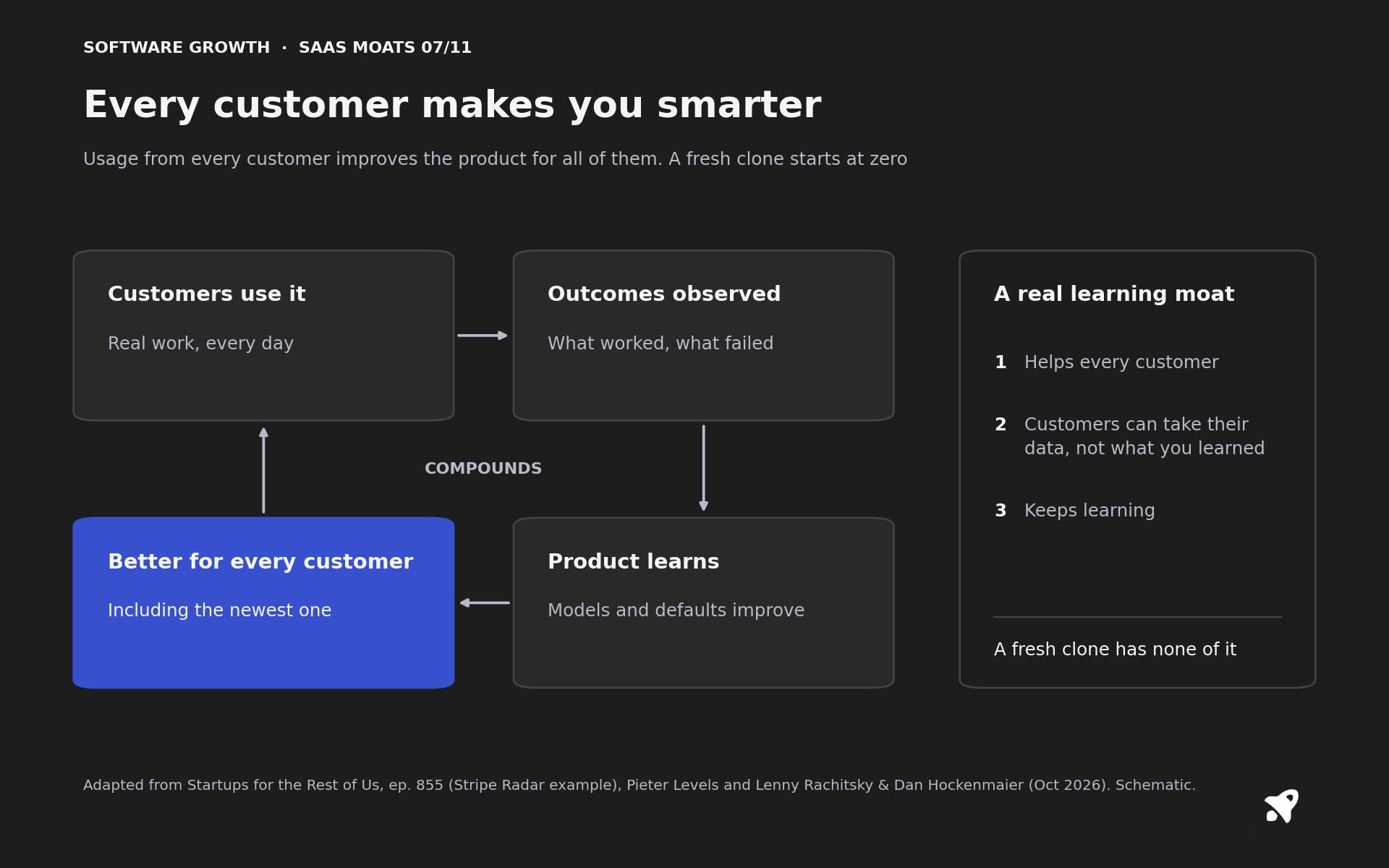
A learning loop is when real usage by every customer makes the product better for all of them, so a new competitor can't match it just by copying the code.
A learning loop is a product mechanism where customers use the software, the product observes real outcomes, and those observations improve it for everyone. Over time the product knows things that no competitor, and no single customer, could learn alone. It is sometimes called a data moat or a data network effect.
The classic example
No single merchant could ever build Stripe Radar.
Rob Walling / Startups for the Rest of Us, episode 855 (October 20, 2026), from 38:03

Stripe Radar detects fraud using transaction data across all merchants. Lenny Rachitsky and Dan Hockenmaier use the same example and count data as one of only four compounding advantages, alongside switching costs, network effects and scale. They note that AI products make this advantage more common: Cursor, for example, learns from each suggestion users accept or reject.
Three tests
In episode 855, Walling says a learning loop only counts as a moat if it passes three tests:
- Every customer makes it better for every other customer.
- Customers can take their data, but not what you learned from it.
- It keeps learning, because last month's data isn't enough.
Einar Vollset adds two nuances. The learning can start within one customer or one organization before it spreads across your base. And it has to come from real-world outcomes on a real-world clock, not from something a competitor could simulate with synthetic data. In the same episode, he calls a learning loop built on an AI product that does the work the strongest moat of all (from 54:46).
For small SaaS
You don't need Stripe's volume to start. Look for outcomes your product already sees that customers can't see on their own: which email subject lines got replies across all accounts, which onboarding steps predicted retention, which invoices got paid late. If you can turn those into better defaults or recommendations, and keep doing it, you have the start of a loop.
Related terms
Sources
- Episode 855: The Eight SaaS Moats that Still Work in the Age of AI, Rob Walling and Einar Vollset, Startups for the Rest of Us, October 20, 2026
- How to tell if a startup has a moat, Lenny Rachitsky and Dan Hockenmaier, October 13, 2026