Negative churn
Net negative churn (also called negative churn) happens when expansion from existing customers exceeds revenue lost to cancellations and downgrades, so your base grows without new sales.
Negative churn, or net negative churn, means existing customers pay you more this month than the same group did last month, even after counting those who left. Your revenue grows with zero new sales. It is the strongest sign of a healthy subscription business, and it is the same fact as net revenue retention above 100%.
How to calculate negative churn
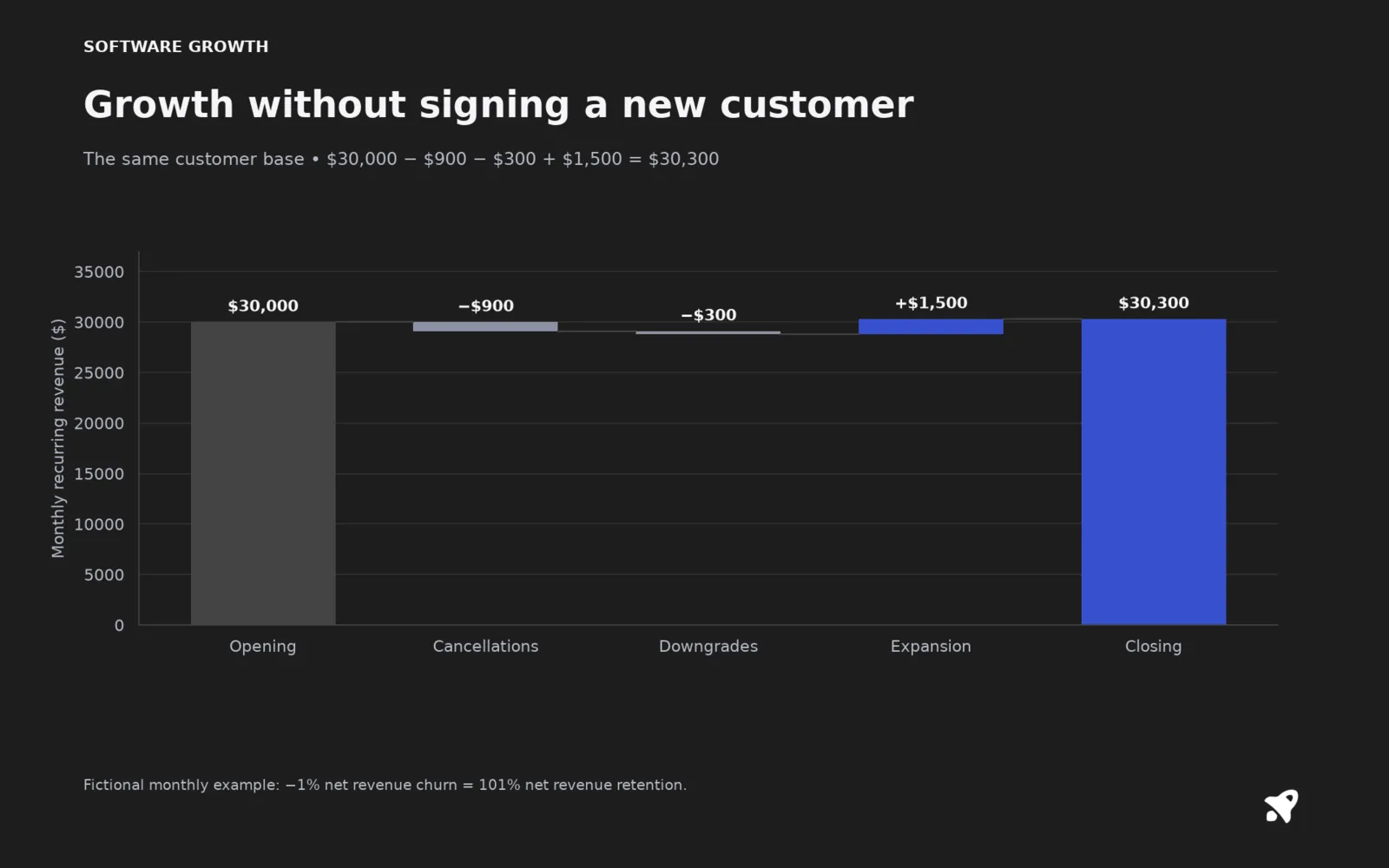
You start the month at $30,000 MRR. Cancellations remove $900 and downgrades remove $300. Existing customers add $1,500 through upgrades and extra seats. Net MRR churn is (900 + 300 - 1,500) / 30,000 = -1%. The base grew by 1% before you signed a single new customer. ChartMogul uses the same definition in its guide to negative churn, and notes that about 40% of companies in the $15 to $30 million ARR range reach it, from its analysis of more than 2,100 SaaS companies.
Why it matters
David Skok's SaaS Metrics 2.0 shows the effect over time: with 3% negative churn, revenue reaches about $450k after 40 months versus about $140k with 3% positive churn, more than three times as much. Tomasz Tunguz points to New Relic and Zendesk, which his upsell ratios post reports at 114% and 120% net retention, meaning existing customers spent 14% and 20% more each year.
How to get there
Skok names two routes: pricing that grows with usage, such as per seat or per unit, and upsell or cross-sell to a higher tier. In practice:
- Choose a value metric that rises when the customer gets more value, so more usage means more revenue without a sales call.
- Build plan tiers with a real reason to move up, and show the limit before the customer hits a wall.
- Lower gross churn first. Expansion cannot cover a leaking base for long.
Common mistakes
- Celebrating net negative churn while gross churn is high. Five large accounts expanding can hide fifty small ones leaving. Check gross revenue churn too.
- Counting reactivated customers as expansion without noting it.
- Assuming you need it. Many profitable bootstrapped products run on flat pricing with low, steady churn and never reach it.
If your pricing is flat and your customers are small businesses, negative churn is unlikely. Aim for low gross churn instead, and treat any expansion as a bonus.
Related terms
- Revenue churn
- NRR (Net revenue retention)
- Expansion revenue
- Expansion MRR
- Land and expand
- Churn rate
Sources
- Net negative churn in SaaS, ChartMogul
- SaaS Metrics 2.0: A Guide to Measuring and Improving what Matters, David Skok, For Entrepreneurs
- How Much Should Your Startup Spend on Customer Account Expansion?, Tomasz Tunguz