Expansion MRR
Expansion MRR is the extra monthly recurring revenue you earn from existing customers through upgrades, added seats, add-ons or usage growth.
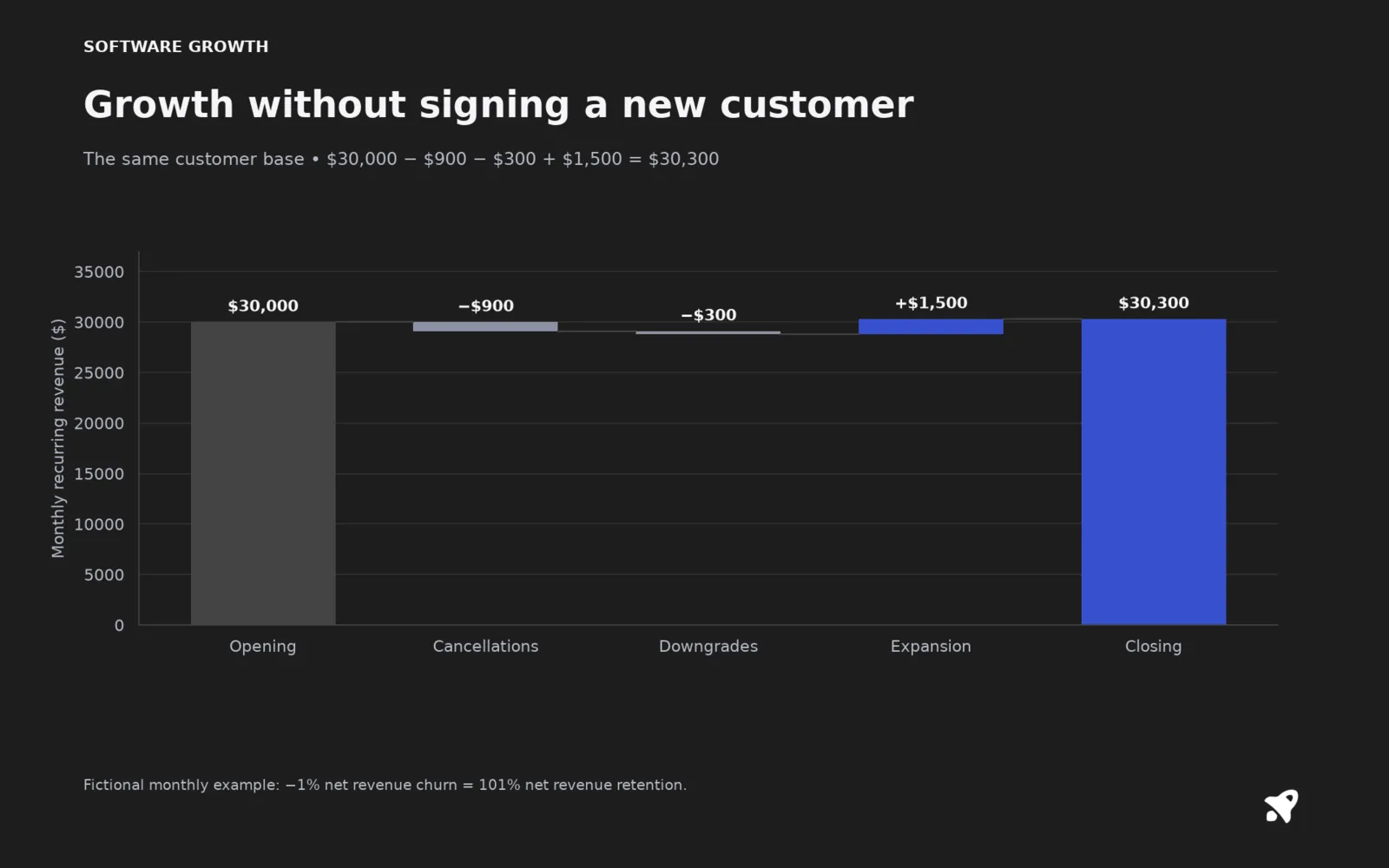
Expansion MRR is growth you did not have to acquire. A customer who already trusts you pays more, so your recurring revenue rises without any new acquisition cost. It is the engine behind negative churn.
How to calculate expansion MRR
For each existing customer whose monthly payment went up, take the increase. Sum them.
Suppose 18 customers move from a $50 plan to a $100 plan in a month. Expansion MRR is 18 x $50 = $900. If a customer goes from $100 to $130 through two extra seats, that adds $30.
ChartMogul's documentation lists subscription upgrades, additional subscriptions and expiring discounts as sources of expansion.
Where expansion comes from
- Plan upgrades (upselling to a higher tier).
- Seat growth in per-seat pricing, as a team adds people.
- Usage growth under usage-based pricing.
- Add-ons and extra products.
- Price increases on existing customers. Count these as expansion, but separate them in your notes, because they say nothing about product pull.
Why it matters
Rob Walling lists expansion revenue among the metrics to keep high, and calls net negative churn a major advantage for a SaaS business (episode 620). When expansion MRR exceeds churned and contraction MRR combined, your existing base grows on its own. That is what net revenue retention above 100% means.
Mistakes to avoid
- Counting new customers. A first purchase is new MRR, even if the plan is large.
- Counting a customer who returns. That is reactivation.
- Ignoring the downside. A product with $900 of expansion and $300 of contraction has only $600 of net expansion.
- Treating one-time purchases as expansion. A paid migration is not recurring.
Small SaaS angle
A solo founder with a flat $29 plan has no expansion by design. If you want it, you need a second axis customers can grow along, such as seats, projects, contacts or volume. Pick the one that tracks the value your customers get, then check that a bigger customer paying more feels fair to them. Expansion that customers resent shows up later as churn.
Related terms
- MRR (Monthly recurring revenue)
- Contraction MRR
- NRR (Net revenue retention)
- Upsell
- Land and expand
- Negative churn
Sources
- Understanding MRR movements, ChartMogul
- Episode 620: Finding SaaS ideas, customer pain, SaaS metrics and more, Startups for the Rest of Us
- SaaS Metrics 2.0, David Skok, For Entrepreneurs