Net new MRR
Net new MRR is the total change in monthly recurring revenue over a period: new, expansion and reactivation MRR, minus contraction and churned MRR.
Net new MRR is the one-line scorecard for the month. It nets everything that added recurring revenue against everything that removed it, so you see whether the business actually grew and by how much in dollars.
How to calculate net new MRR
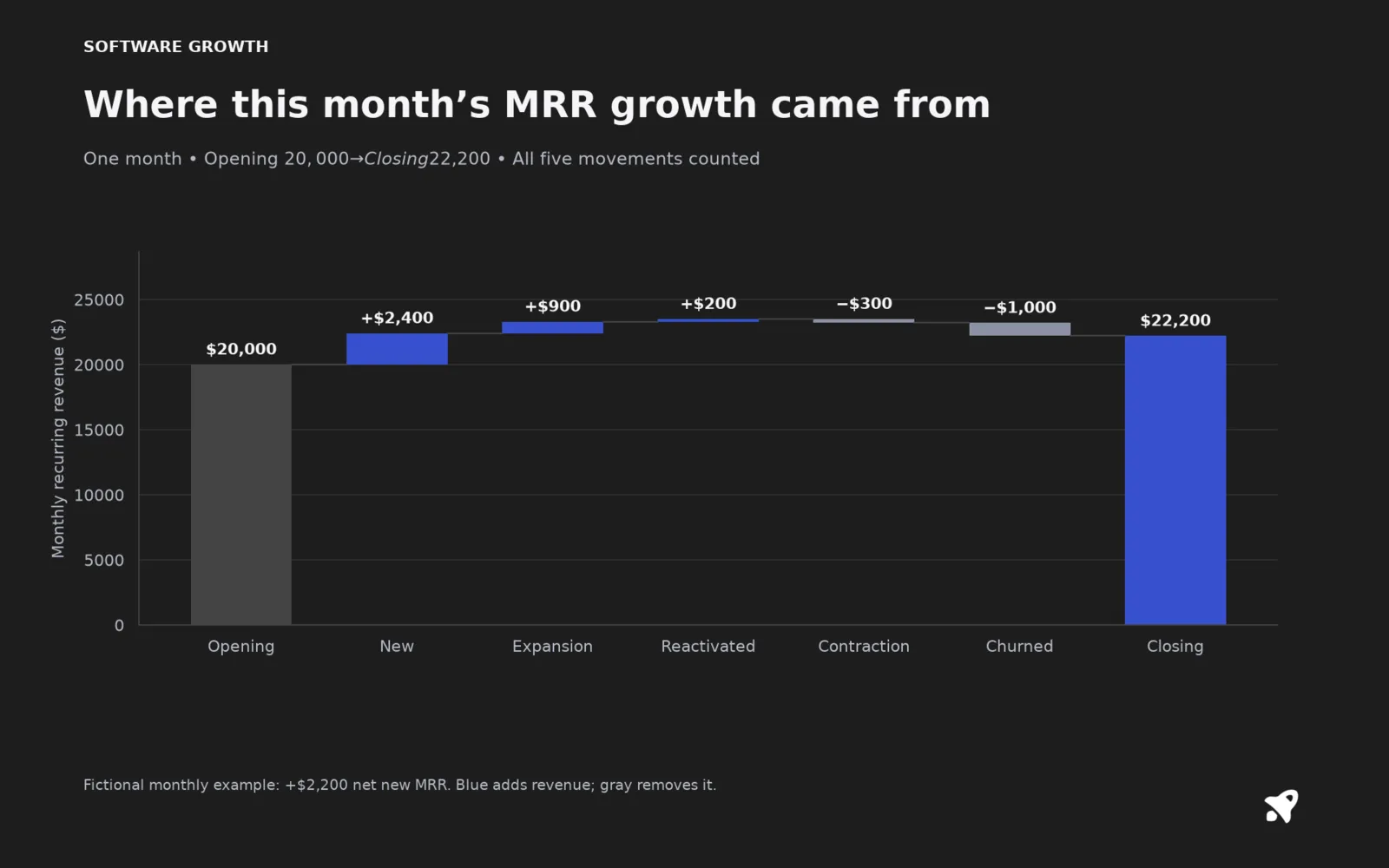
Take a month with $2,400 of new MRR, $900 of expansion, $200 of reactivation, $300 of contraction and $1,000 of churn.
Net new MRR is $2,200. Starting MRR of $20,000 becomes $22,200. It must equal the change in your MRR between the two dates. If it does not, a movement is being misclassified or missed, which makes it a good reconciliation check.
David Skok recommends charting new, expansion and churned MRR together with net new MRR so you can see what drove each month, in SaaS Metrics 2.0. ChartMogul's MRR Movements chart shows the same breakdown.
Why dollars, not percent
The percent version is MRR growth rate: 2,200 / 20,000 = 11%. Rob Walling advises bootstrapped founders to follow both the percentage and the absolute dollars added, and says absolute growth matters most for them (episode 620). A move from $1,000 to $1,500 is 50% growth but only $500. Dollars show how much room you have to hire, spend on marketing or take a salary.
Reading the mix
- Mostly new MRR: growth depends on acquisition, and slowing sign-ups will stall you.
- Healthy expansion: the base is carrying part of the load.
- Large churn and contraction: you are filling a leaking bucket. The SaaS quick ratio summarizes this by dividing gains by losses. Here it is (2,400 + 900 + 200) / (300 + 1,000) = 2.7.
Small SaaS angle
Net new MRR is volatile at small scale. Look at a rolling three-month total before you decide a pricing change or a channel worked. Also record it per channel and per plan when you can. A flat month with big gross movement on both sides is a different problem from a flat month where nothing happened.
Related terms
Sources
- SaaS Metrics 2.0, David Skok, For Entrepreneurs
- Chart: MRR Movements, ChartMogul
- Episode 620: Finding SaaS ideas, customer pain, SaaS metrics and more, Startups for the Rest of Us