Low-touch sales
Low-touch sales is a short, mostly automated buying path with limited human help, between fully self-serve and high-touch enterprise selling.
Low-touch sales is the middle ground between self-serve and enterprise selling. Most of the journey is automated (website, trial, onboarding emails), and a person steps in briefly: a 20-minute demo, a chat reply or a quick call before the card goes in. The goal is to give buyers the help they need without paying for a full sales process.
No-touch, low-touch and high-touch
- No-touch (self-serve). No human contact before purchase. Fits low prices and simple products.
- Low-touch. Light human involvement, such as a short demo or chat, often by a founder or one inside sales person. Prices tend to be in the low thousands per year.
- High-touch. A named salesperson, several calls, custom proposals, security reviews and negotiation. Fits large contracts.
The boundaries are loose, and no standard defines them. What stays consistent is that price drives the touch level.
Joel York's three models
Joel York of Chaotic Flow lays this out as a spectrum defined by price and complexity: customer self-service, transactional sales and enterprise sales. Low-touch sits close to his transactional model, which uses inside sales reps supported by online content and automation, aiming for efficient, high-volume sales and support, short sales cycles and rapid onboarding. He gives Marketo and Zendesk as examples. As price rises, buyers want to know there are real people behind the site, and expect signed contracts and a person to talk to. He also warns that a startup can usually master only one model at a time.
Christoph Janz's version
Christoph Janz frames it as customer count versus revenue per account. For a $100M business, he lists 100,000 customers at about $1,000 a year (rabbits), 10,000 at about $10,000 (deer) and 1,000 at about $100,000 (elephants). Deer can use inside sales to close inbound leads, which is low-touch in practice, while elephants need field sales and a larger budget. He says rabbits are the hardest tier: you rely on inbound marketing, product quality and funnel optimization, and there is no silver bullet.
What Rob Walling says
On Startups for the Rest of Us, Rob Walling argues you should pick the touch strategy that supports how your customers buy, and that low prices require low touch. A founder with a $30 per month plan cannot afford extensive hand-holding. He also says low-touch can win against high-touch competitors by being simpler, cheaper and more accessible, which is how he positioned Drip against Infusionsoft.
Does the math work?
Example: an annual contract of $3,000 at 80% gross margin gives $2,400 of margin in year one. If you accept spending 50% of it on acquisition, you have about $1,200 per customer. A 30-minute demo costs you roughly an hour of founder time with prep and follow-up. At 25% close rate, that is 4 hours per customer, so your time must be worth under $300 an hour for the numbers to hold. At $300 a year, the same demo does not pay.
Jason Lemkin's benchmarks say deals under $5,000 should close in around 30 days, which is the range low-touch aims for.
Making it work
- Let the product do the selling: a trial, good onboarding and clear pricing.
- Offer a human for the few buyers who need one, not for everyone.
- Track average contract value by touch level and move customers to the cheapest touch that still closes.
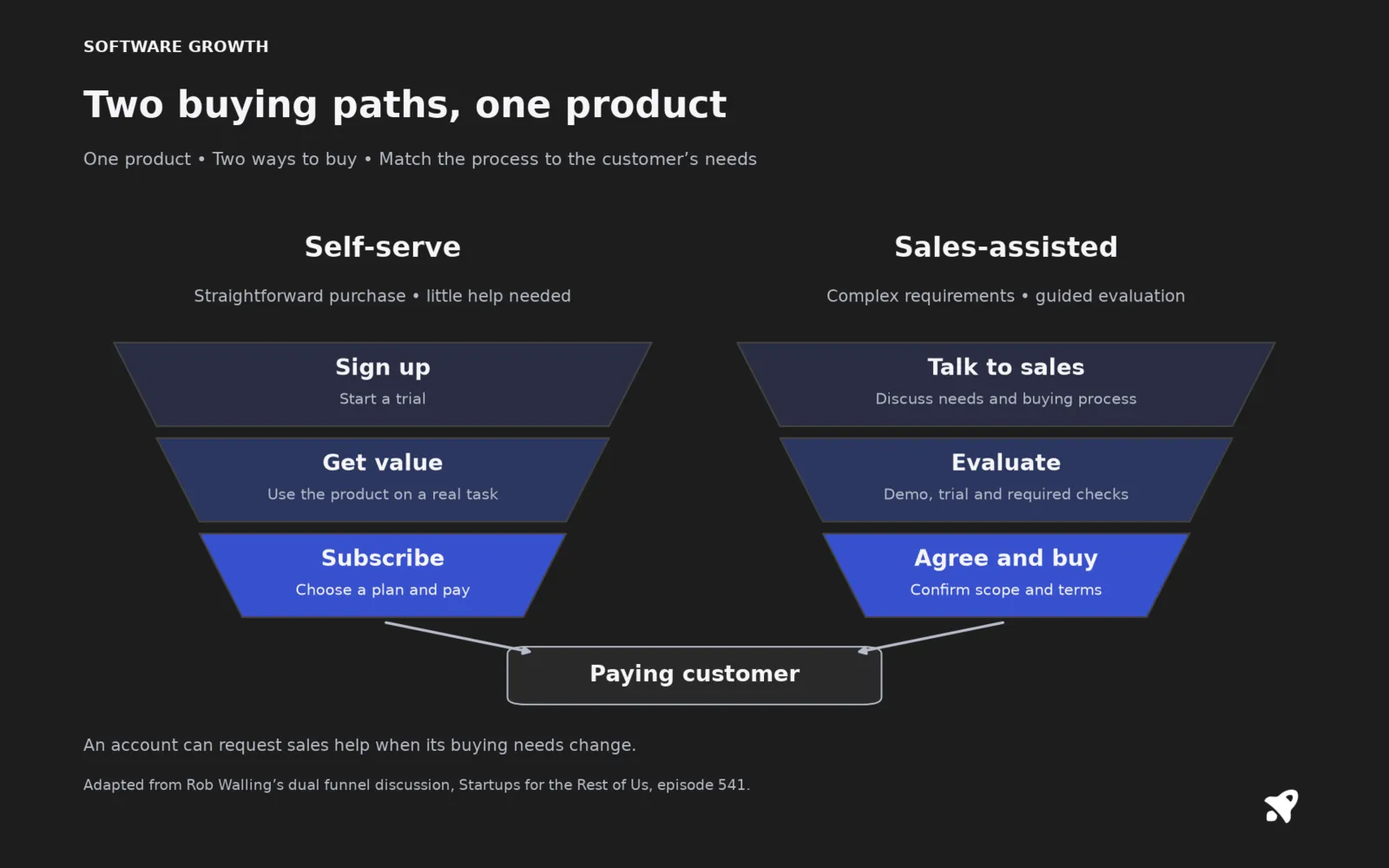
- Run a dual funnel if you serve both small and large customers, with separate flows for each.
Related terms
- Self-serve (self-service SaaS)
- Sales-led growth
- PLG (Product-led growth)
- Sales cycle
- ACV (Average contract value)
- Outbound sales
Sources
- SaaS Sales Models: Strategic and Organizational Choices, Chaotic Flow / Joel York
- Five ways to build a $100 million business, The Angel VC / Christoph Janz
- Episode 691: Freemium, High Touch vs Low Touch Selling as an Introvert, and More Listener Questions, Startups For the Rest of Us
- Dear SaaStr: What's a Good Benchmark for B2B Sales Cycles?, SaaStr / Jason Lemkin