SAM (Serviceable addressable market)
Serviceable addressable market (SAM) is the part of your total market you can reach with your current product, pricing, geography and channels.
Serviceable addressable market (SAM) is the segment of your total addressable market that you can really serve today. Your product might apply to 18,000 businesses, but if it only supports English, one payment processor or US tax rules, only some of those can buy it. SAM removes the rest. The next step down is SOM, the serviceable obtainable market: the share of SAM you can realistically win in the next one to three years.
How to calculate SAM and SOM
Churnkey's guide gives these formulas: SAM is the target segment of TAM times annual contract value, and SOM is your market share percentage times your SAM (Churnkey). Written out:
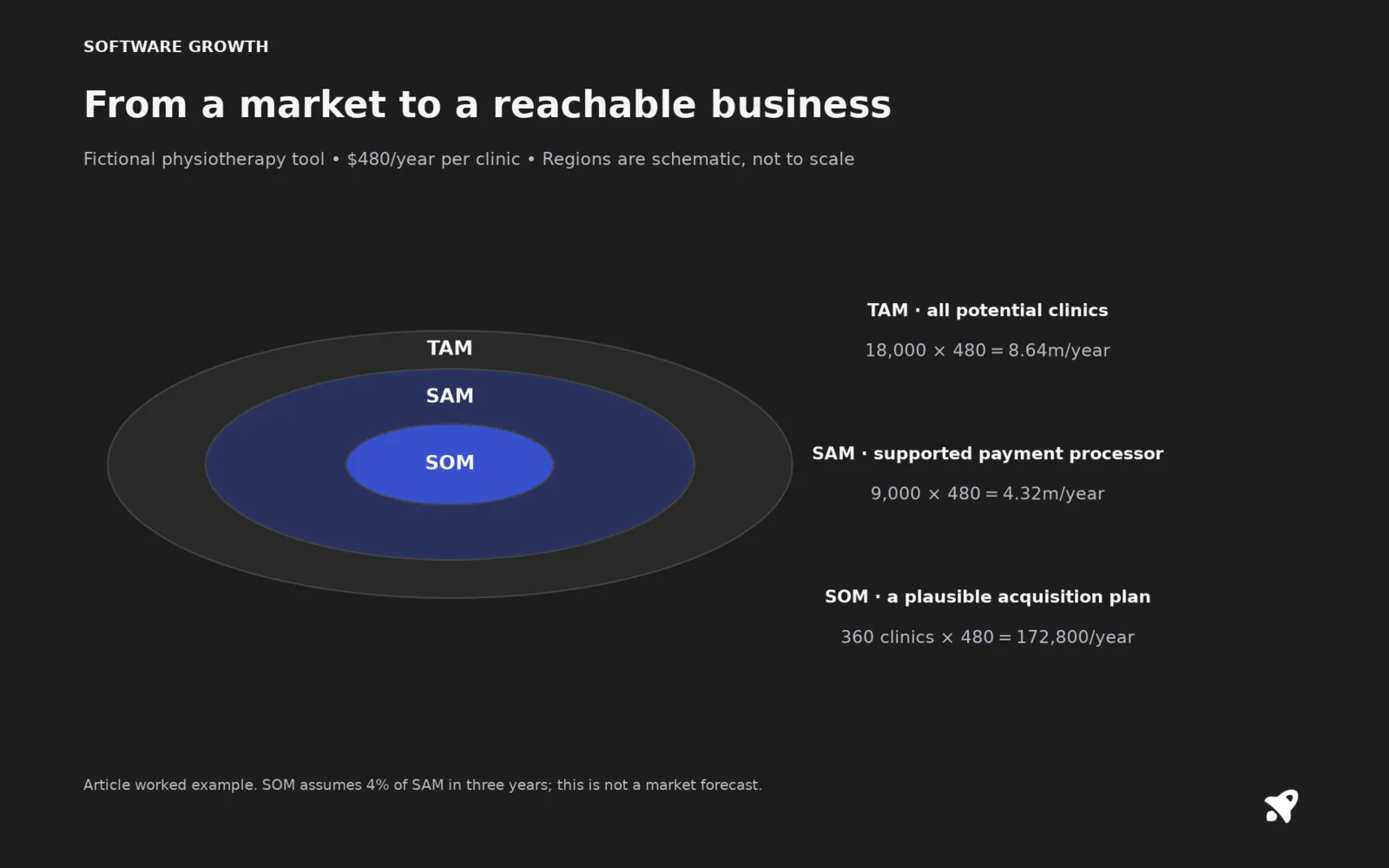
Worked example
Take a scheduling tool for physiotherapy clinics priced at $480 a year. The TAM is 18,000 clinics, or $8.64 million. Your product integrates with one payment processor used by 9,000 of those clinics, and you only sell in English, which excludes none. SAM is therefore:
You have a small marketing budget and expect to win 4 percent of that segment in three years:
That is 360 clinics. Whether that is enough depends on your costs. Churnkey's own example uses a 6,000-account market at $1,500, giving a TAM of $9 million and a SAM of $5 million with 3,333 reachable accounts.
What narrows a market down
- Geography, language and regulation.
- Product fit: the features you actually have, not the roadmap.
- Integrations your buyers require.
- Price: customers who cannot afford you are not serviceable.
- Channels: if you rely on search and have no sales team, enterprises requiring a procurement process are out of reach.
Why SOM matters most
Investors tend to focus on SAM and SOM because those are the numbers tied to a plan, and sales and finance teams use SOM to forecast. For a bootstrapped company, SOM is also a reality check on your go-to-market plan: if SOM at a realistic share is $170,000 and you need $400,000 to pay yourself and a hire, you must widen the product, raise the price or add segments.
Mistakes
- Setting SOM by hoping for a percent of the market. Build it from channels: how many leads you can reach, and at what conversion rate.
- Letting SAM equal TAM because it looks better in a pitch.
- Never updating it. SAM grows as you add integrations or languages, and each is a reason to build.
Start inside one beachhead market defined by your ideal customer profile, then widen SAM deliberately.
Related terms
- TAM (Total addressable market)
- Beachhead market
- ICP (Ideal customer profile)
- Go-to-market strategy (GTM)
- ARPA (Average revenue per account)
Sources
- How to Calculate TAM, SAM, and SOM, Churnkey
- Market size: TAM, SAM, & SOM, Carta