TAM (Total addressable market)
Total addressable market is the total yearly revenue available if every potential customer for your product bought it at your price.
Total addressable market (TAM) is the most revenue your product could earn if every customer who could use it bought it. It is a ceiling, not a forecast. Investors use it to judge whether a company can get large. Founders should use it for something simpler: to check that a market is big enough to build a business in, and small enough that you can win a piece of it.
Two ways to calculate TAM
Top-down starts with an industry figure from an analyst report and takes a slice. It is fast, but it tends to produce huge numbers that say little. "The software market is $500 billion and we need 1 percent" is not a plan.
Bottom-up starts from real customers: count the accounts that could use you and multiply by what each would pay. Churnkey's guide gives the formula as the number of accounts in the market times the annual contract value (Churnkey). Investors generally prefer it because it shows you understand your pricing and your buyer.
Worked example
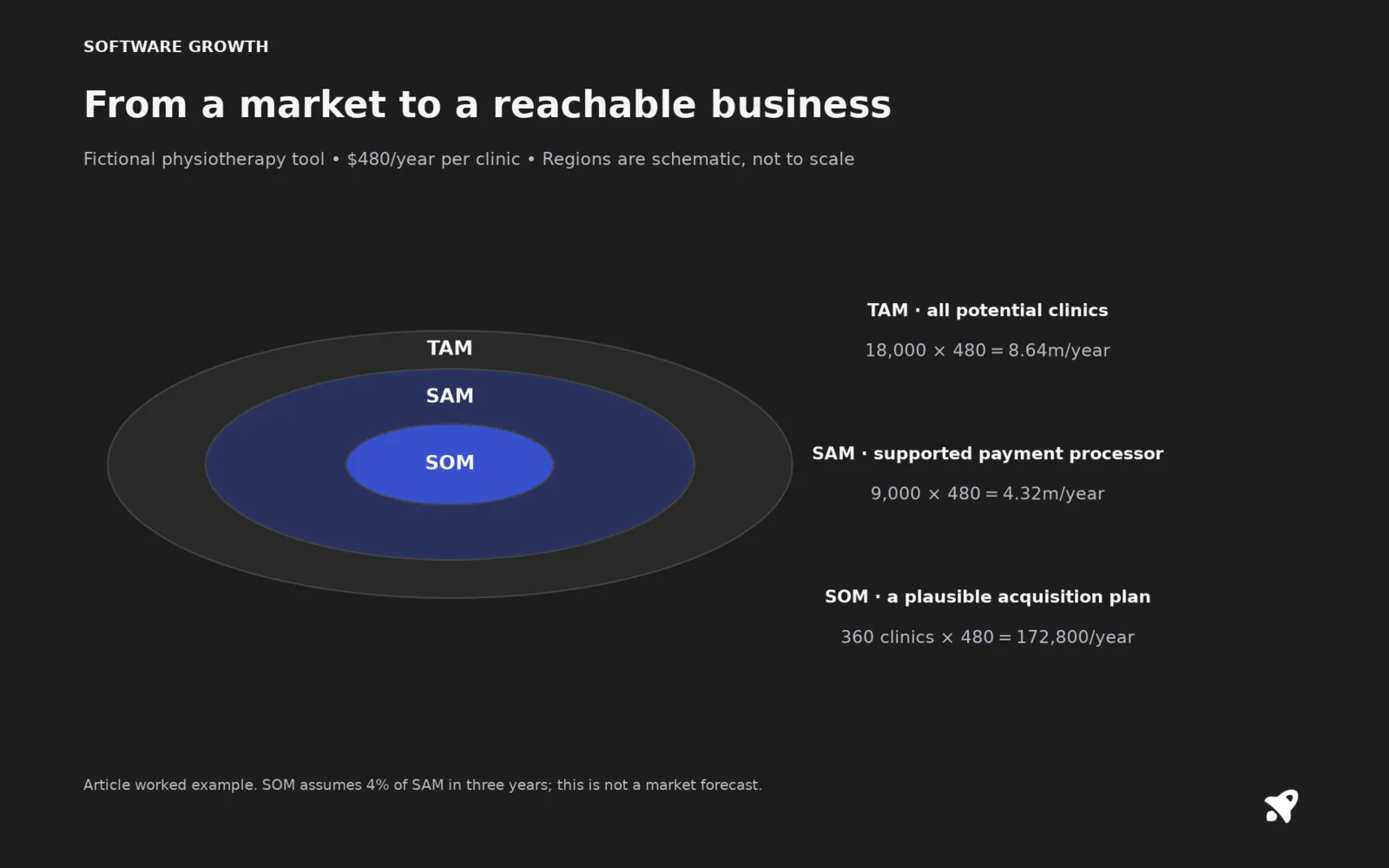
You sell scheduling software to independent physiotherapy clinics. You find about 18,000 clinics in the US through a public licensing directory, and your plan costs $40 a month.
That is a TAM of about $8.6 million. For a bootstrapped company this is a good size. It is too small for a venture-backed company, but 1,000 clinics, a 5.6 percent share, would be $480,000 a year.
Pitfalls
- Counting everyone. Use only accounts that fit your ideal customer profile. Counting all small businesses because they have invoices inflates the number.
- Using a price you do not charge. Use your real price, or your average annual contract value, not an aspirational enterprise tier.
- Double counting. A clinic using a spreadsheet and a clinic using a competitor are both customers, but the second costs more to win.
- Treating TAM as the target. The slice you can reach is the serviceable addressable market, and the slice you can win in a few years is smaller still.
What is a good TAM?
It depends on who you are. A venture investor wants a market large enough that a winner reaches hundreds of millions in revenue. A bootstrapper needs far less: $1 million of annual revenue is a good living and fits in a market of $20 million. Jason Cohen argues that startups can win by targeting niches too small for incumbents. He notes that large companies need products generating $50 to $100 million or more a year to justify the investment, so a market worth $1 to $5 million can be yours alone (A Smart Bear).
Using TAM well
Work it out on a spreadsheet with the assumptions visible, so you can change the price or the segment and see the effect. Then ask what you must believe: how many accounts you need, and whether you can reach that many. If you need 40 percent of the market to hit your revenue goal, the market is too small or the price too low. For a new product, begin in one beachhead market and expand once you hold it.
Related terms
- SAM (Serviceable addressable market)
- ICP (Ideal customer profile)
- Beachhead market
- ACV (Annual contract value)
- ARPA (Average revenue per account)
- Horizontal SaaS
Sources
- How to Calculate TAM, SAM, and SOM, Churnkey
- How startups beat incumbents, A Smart Bear (Jason Cohen)
- Market size: TAM, SAM, & SOM, Carta