AEO (Answer engine optimization)
Getting your product named, recommended and cited in answers from AI assistants like ChatGPT, Gemini, Perplexity and Google AI Overviews. Also called GEO.
Answer engine optimization (AEO) is the work of getting your product named, recommended and cited when people ask AI assistants such as ChatGPT, Claude, Gemini, Perplexity or Google's AI Overviews a question. Generative engine optimization (GEO) is another name for the same practice. The one-line rule: SEO competes for a click on a ranked link, while AEO competes for a mention inside the answer itself.
It matters because buyers now shortlist software by asking an assistant, and many never click through to compare. In Kyle Poyar's 2026 State of B2B GTM report (October 14, 2026), 39% of 300 surveyed go-to-market leaders called AI search a core channel, up 11 points from the year before. This guide covers how assistants choose what to recommend, what a small SaaS team can do about it, and how to tell whether it's working.
AEO, GEO and SEO
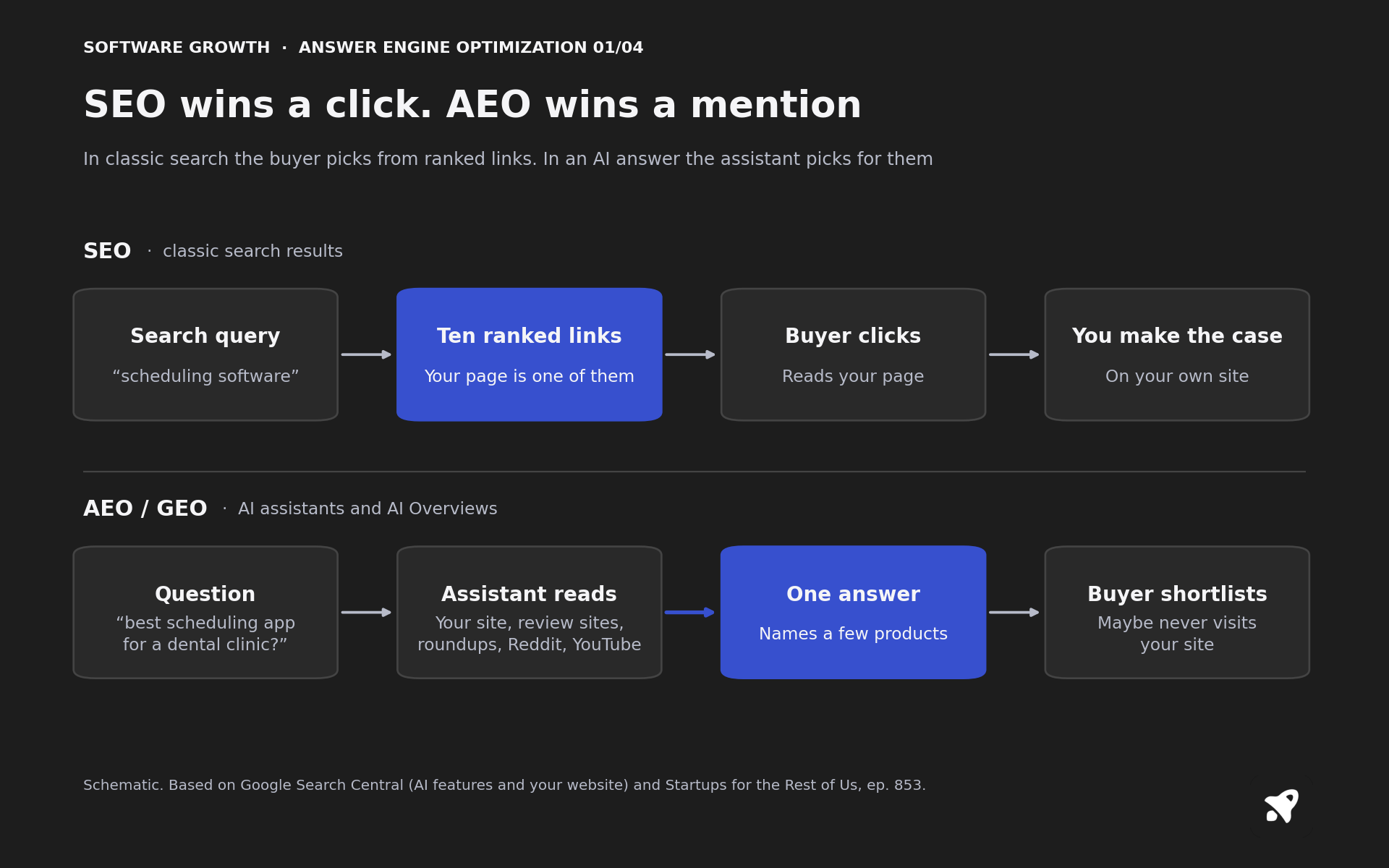
The two acronyms describe the same goal. "Generative engine optimization" comes from a 2023 research paper by Pranjal Aggarwal and colleagues (published at KDD 2024). "Answer engine optimization" is the name more marketers use; Poyar's report treats AI search and AEO as one channel. Ethan Smith of Graphite compares the two terms on Lenny's Podcast (from 06:19). Pick whichever your team says; the work is the same.
AEO builds on SEO rather than replacing it. Google's own guidance on AI features and your website says there are no additional requirements to appear in AI Overviews or AI Mode: the page has to be indexed and eligible for a snippet, and the usual SEO best practices apply.
SEO is still definitely a massive component of GEO
Ross Hudgens / Startups for the Rest of Us, episode 853 (October 6, 2026), from 1:28
Hudgens, who runs the agency Siege Media and wrote the book Generative Engine Optimization, names what is new: off-site work such as affiliate mentions and reviews on third-party websites. In SEO, your own pages carry most of the weight. AEO puts much more weight on what other sites say about you.
How AI assistants pick and cite sources
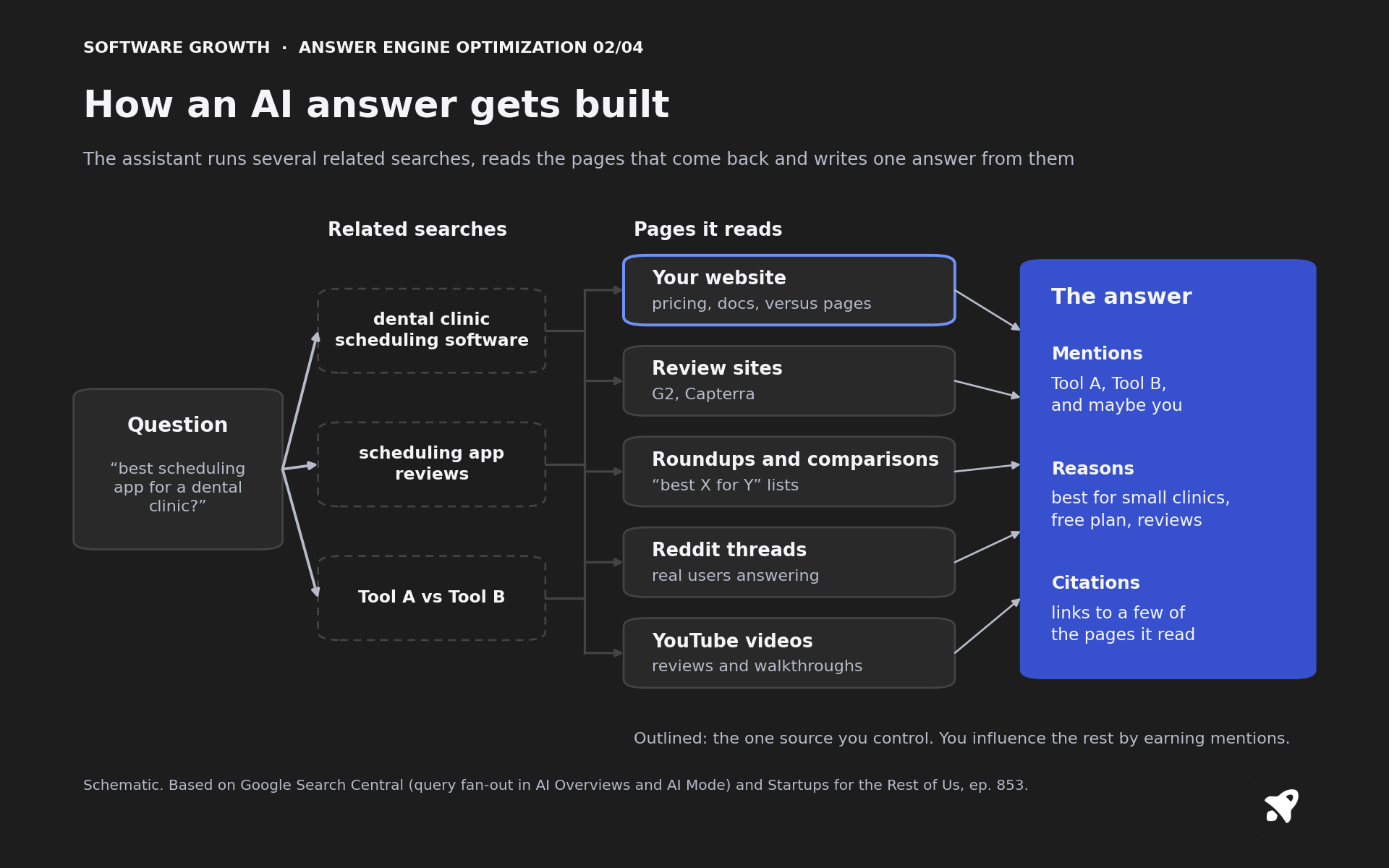
When an assistant searches the web before answering, it behaves like a fast, impatient researcher. Google describes a "query fan-out" technique for AI Overviews and AI Mode: the system issues several related searches across subtopics, reads the supporting pages and writes one response with links. The products that show up are the ones those pages mention, describe clearly and agree on.
For B2B software, Hudgens says the pages that matter most are:
- Review sites. G2 and Capterra are a large share of what models draw on, and he sees G2's influence growing. He goes as far as betting that a company with strong reviews could ignore its own website and still get recommended.
- "Best X" roundups. In niche B2B markets there are few independent affiliate sites, so the roundups that exist, including ones on vendors' own sites, carry a lot of weight.
- Comparison pages. "X vs Y" articles answer the exact question a buyer asks when they're choosing.
- Reddit and YouTube. Both are heavily cited. Hudgens says Reddit's share of citations has come down, and that in his agency's testing Gemini makes good use of YouTube while other assistants do less.
The original GEO paper tested which page edits made content show up more in generated answers. Adding citations to credible sources, relevant quotations and statistics improved visibility by roughly 30–40% on the researchers' benchmark, while keyword stuffing offered "little to no improvement". Treat that as a direction, not a guarantee: it was a 2023 lab benchmark, and the engines have changed a lot since.
One more practical point: the engines often cite different pages for the same question. Kevin Indig reports that 91% of citations appear in only one of ChatGPT, Perplexity or AI Overviews, so check each assistant your buyers use separately.
What SaaS founders can do
None of this needs a big team. Hudgens' advice to a bootstrapped founder doing $5k–50k a month starts with reviews, roundups and versus pages, in that order.
1. Get reviews where buyers and models look
Make asking for reviews a routine, not a campaign. Hudgens suggests giving happy customers an easy choice, such as a review on G2 or a reply in a relevant Reddit thread. If your niche has its own directory or category listings, get on them too. Some listing sites take payment for better placement, and Walling notes founders disagree about whether that's acceptable, so decide where your line is.
2. Publish an honest "best X" roundup
Write the roundup for your category on your own site, listing yourself alongside competitors. Hudgens' guidelines from episode 853 (from 6:33):
- Don't call yourself "best overall". Claim a segment you really win, like "best for small clinics". That is a positioning decision, and it also makes it easier for other writers to include you with the same label.
- Do real research. Give each product a screenshot and a pros and cons section. Around ten entries is typical.
- Update it about quarterly, checking pricing and positioning for every entry. He says freshness helps.
3. Write versus pages
Hudgens calls comparison pages an underrated tactic (from 11:06). When Siege Media looked across its B2B SaaS clients, the sites with the most versus articles had the most LLM traffic overall, a stronger correlation than for "alternatives" or "best X" pages. That is a correlation, not proof, but versus pages are bottom-of-funnel content worth having anyway. Use a neutral voice, don't insult the competitor, and keep every claim checkable. If you need dozens of them, programmatic SEO can supply the template, but each page still needs real facts.
The fear of a legal letter stops many founders. Walling's experience across TinySeed's 217 investments: maybe a quarter have versus pages, and only three or four ever got complaints. Most were settled by fixing the sentence the competitor objected to.
4. Be talked about on Reddit and YouTube
How can I just be in all these places?
Rob Walling / Startups for the Rest of Us, episode 853 (October 6, 2026)

Walling was describing how he marketed Drip years ago, by showing up on every searchable surface he could find. That instinct fits AEO well. For Reddit, Hudgens' rule is simple (from 21:47): go where your audience already is. If your buyers hang out there, answer questions honestly under your own name and the mentions follow; if they don't, posting there is spam. He only suggests starting your own subreddit once you have serious branded search volume, roughly 20,000 searches a month as a starting point, lower for high-value customers.
For YouTube, look for creators who already review software in your broader category and offer to pay for an honest review, directly or through an influencer marketplace. Put plain descriptors such as "best for small clinics" in the video description, which Hudgens says gets crawled. This is ordinary content marketing and affiliate marketing, pointed at the places assistants read.
5. Make your own pages easy to quote
- Answer the question in the first sentence or two, then give the detail. Match the page to the search intent.
- Be specific: who the product is for, what it costs, what it integrates with and where it's weak. Vague pages give a model nothing to say about you.
- Add sources, numbers and quotes where they're real. That is what the GEO paper rewarded.
- Keep pricing and feature pages current, in plain text rather than images.
- Don't block crawlers. Google's checklist includes allowing crawling in robots.txt and at your CDN, and making sure any structured data matches the visible text.
6. llms.txt: cheap, but don't expect much
llms.txt is a proposal by Jeremy Howard (first published September 3, 2024; version 2 updated August 10, 2026): a markdown file at /llms.txt that gives AI agents a short summary of your site and links to clean markdown versions of key pages. The proposal says it is used most heavily for software documentation, where coding agents follow it to find API references.
Two honest caveats. Google says you don't need AI text files, machine-readable files or special markup to appear in AI Overviews or AI Mode. And none of the sources here claim llms.txt changes which products an assistant recommends. If developers use your API or docs, adding one is a small job worth doing. As a way to get into "best X" answers, don't count on it.
How to measure it
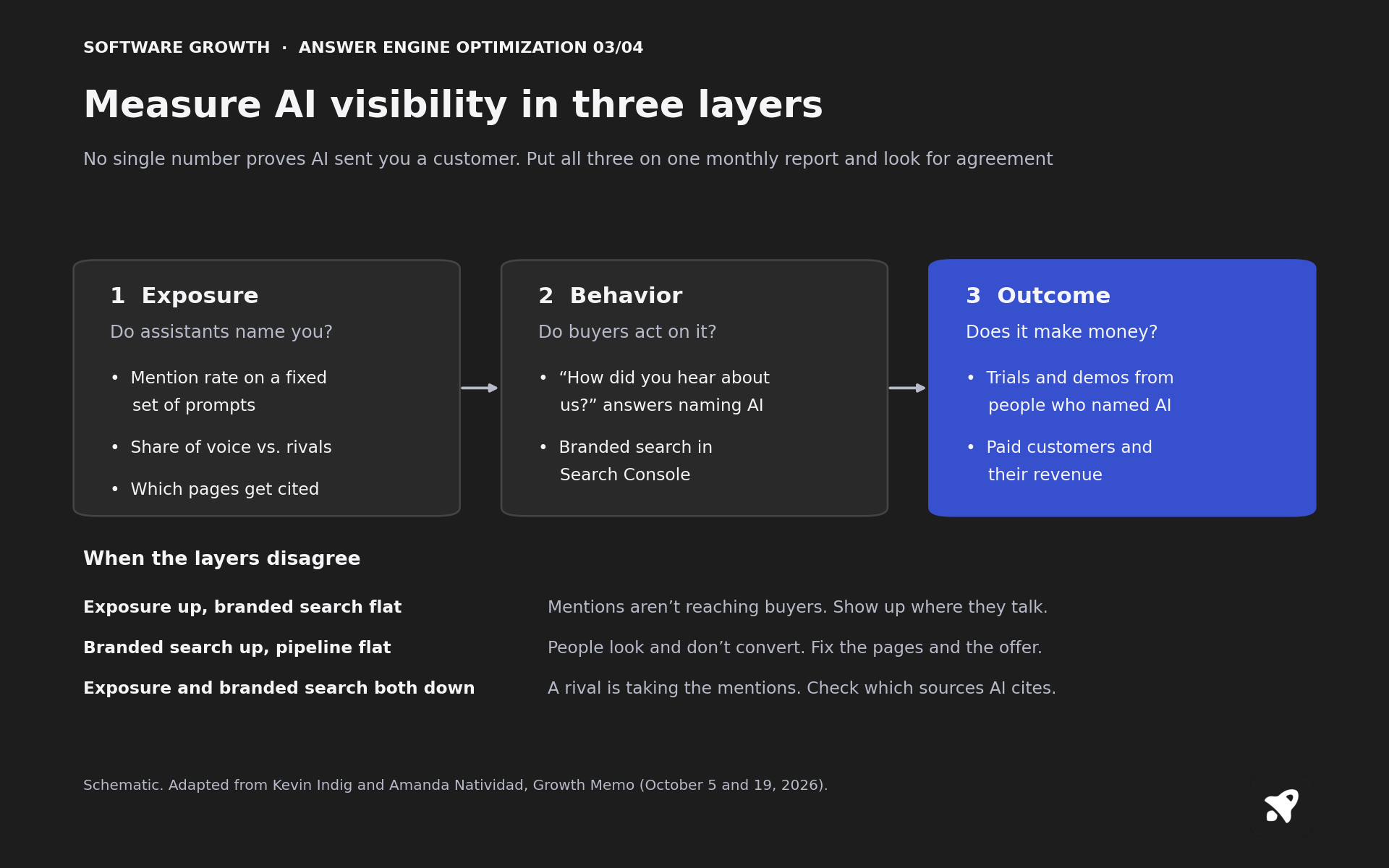
AI search is hard to attribute, so measure it in layers.
- Build a fixed prompt set. There's no reliable data on how often people ask assistants a given question. Hudgens says one vendor's "prompt volume" figures are explicitly synthetic, so he uses ordinary keyword research as a proxy: turn your highest-volume category keywords into questions like "what is the best project management software for agencies?"
- Track your mention rate. Run the same prompts in the assistants your buyers use, monthly, and count how many answers name you and your competitors. Prompt-tracking tools such as Peec AI (which Siege Media uses) automate this; a spreadsheet works for 20–30 prompts. Answers vary from run to run, so watch the trend, not single results.
- Study the cited sources. Look at the URLs the answers cite. Hudgens' approach (from 25:38): get positively mentioned on as many of those pages as you can, or publish a better page that replaces them.
- Ask new customers. Add "AI assistant (ChatGPT, Gemini, etc.)" as an option in your "How did you hear about us?" question, with a free-text box.
- Connect it to revenue. Follow the people who say AI sent them through trial, purchase and retention.
Don't expect analytics to do it for you. Google counts AI Overviews and AI Mode traffic inside the normal Web totals in Search Console. Indig went looking for AI visits hiding in "direct" traffic across twelve sites and found that much of the growth was bots. In a separate analysis of four brands, he couldn't find a reliable link between AI visibility and later branded search or direct traffic.
An effect could still exist. I just couldn’t isolate it.
Kevin Indig / Does AI drive more direct traffic? (October 19, 2026)
The exception he describes is Ramp, which, according to growth expert Eric Wu, traced 30–40% of its direct traffic to answer engines, confirmed by asking users. Self-reported attribution is what made that possible. His recommendation, with Amanda Natividad of SparkToro: put exposure, behavior and outcome on the same monthly report and look for them to move together. See marketing attribution for the wider problem.
Worked example
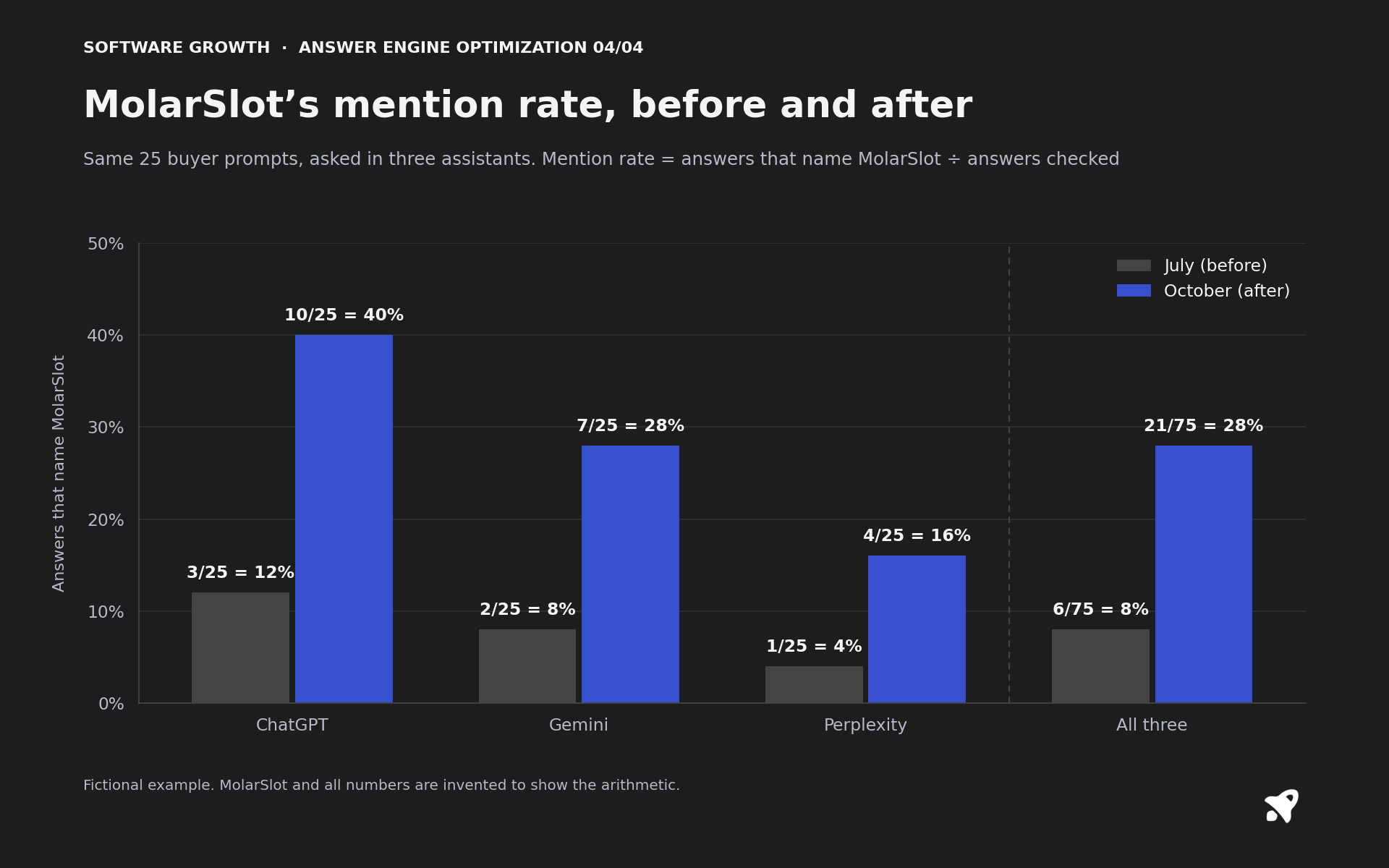
Fictional example. MolarSlot is a two-person SaaS that sells appointment scheduling to dental clinics for $79 a month.
Baseline (July). The founders turn their top 25 keywords into prompts ("best scheduling software for a small dental clinic", "MolarSlot vs Tool A" and so on) and run each in ChatGPT, Gemini and Perplexity: 25 × 3 = 75 answers. MolarSlot appears in 6 of them: 6 ÷ 75 = 8%. Their biggest competitor appears in 39: 39 ÷ 75 = 52%.
Diagnosis. Across the 75 answers, 14 pages are cited at least twice: six G2 and Capterra category pages, four roundups on other sites, two Reddit threads and two pages on the competitor's site. MolarSlot is mentioned on 3 of the 14.
Three months of work.
- They ask 120 active customers for a G2 review; 31 leave one.
- They publish "Best dental scheduling software for small clinics" with eight products, claiming "best for clinics with one to three chairs" for themselves, plus four versus pages.
- They email the authors of the four cited roundups with screenshots and current pricing; two add MolarSlot.
- They answer two cited Reddit threads, disclosing that they're the founders.
MolarSlot now appears on 3 + 2 roundups + 1 Reddit thread = 6 of the 14 cited pages, plus its own new roundup.
Result (October). Same 75 prompts: MolarSlot appears in 21 answers. 21 ÷ 75 = 28%, up from 8%. A jump that size is unlikely to be run-to-run noise; a move from 6 to 8 would be.
Behavior and outcome. In October, 160 clinics start a trial and 22 pick "AI assistant" as how they heard about MolarSlot: 22 ÷ 160 = 13.75%, about 14%. Six of those 22 become paying customers: 6 × $79 = $474 in new MRR. The founders keep tracking it as one channel among several, because self-reported answers undercount people who don't remember where they first heard of you.
What changed in 2026
- AI search went mainstream in B2B. In Poyar's survey, run in September 2026, AI search saw the biggest increase in adoption of any channel, and it topped the list of channels where leaders plan to increase investment. Companies with deals under $5k and those above $50M ARR reported the best results.
- The goal is shifting from visibility to influence. Poyar argues the next question is whether assistants say the right things about your product and pricing, to the right people.
- Founders got a playbook. In episode 853 (October 6, 2026), Rob Walling and Ross Hudgens walk through roundups, versus pages, YouTube, Reddit and measurement for bootstrapped SaaS.
- Attribution got more honest. Indig's October memos argue that click-based attribution undercounts AI influence and that teams should plan around exposure, behavior and outcome together.
- llms.txt reached version 2 (August 2026), with the spec now framed around agents reading documentation.
The first wave of AI search (AEO) was about visibility.
Kyle Poyar / What's working in B2B GTM in 2026 (October 14, 2026)
Common mistakes
- Treating AEO as separate from SEO. If Google can't index a page, AI Overviews won't cite it either.
- Calling yourself "best overall" in your own roundup. Claim the segment you really win.
- Posting on Reddit where your buyers aren't, or posting without saying who you are.
- Flooding your site with AI-written filler. Ethan Smith discusses what works and what doesn't with AI-generated content on Lenny's Podcast (from 51:35).
- Trusting "prompt volume" numbers that are modeled, not measured.
- Expecting llms.txt or schema markup to get you recommended on their own.
- Judging the channel by last-click attribution alone, then cutting it because it "doesn't convert".
- Letting your roundup and versus pages go stale. Out-of-date pricing is easy for buyers, and models, to spot.
Listen, watch and read next
- Watch: How to Become the SaaS That AI Recommends, Startups for the Rest of Us, episode 853 (October 6, 2026). The most practical half hour on this topic for bootstrappers: roundups at 6:33, versus pages at 11:06, Reddit at 21:47, first steps and measurement at 25:38.
- Listen: The ultimate guide to AEO, Ethan Smith on Lenny's Podcast (September 14, 2025). A longer playbook; AEO vs GEO at 06:19 and tracking share of voice at 33:35.
- Read: What's working in B2B GTM in 2026, Kyle Poyar (October 14, 2026). Survey data on how many teams now treat AI search as a core channel.
- Read: Does AI drive more direct traffic?, Kevin Indig (October 19, 2026). A careful look at what analytics can and can't tell you about AI traffic.
- Read: How to plan 2027 when traffic is down and AI won't attribute, Kevin Indig with Amanda Natividad (October 5, 2026). How to budget and report on a channel you can't fully track.
- Read: AI features and your website, Google Search Central. Short, official and useful for cutting through myths about special markup.
Related terms
- Search engine optimization (SEO)
- Search intent
- Keyword research
- Content marketing
- Programmatic SEO
- Marketing attribution
Sources
- Episode 853: How to Become the SaaS That AI Recommends, Rob Walling with Ross Hudgens, Startups for the Rest of Us, October 6, 2026 (video)
- What's working in B2B GTM in 2026, Kyle Poyar, Growth Unhinged, October 14, 2026
- Does AI drive more direct traffic?, Kevin Indig, Growth Memo, October 19, 2026
- How to plan 2027 when traffic is down and AI won't attribute, Kevin Indig, Growth Memo, October 5, 2026
- The ultimate guide to AEO, Ethan Smith on Lenny's Podcast, September 14, 2025
- AI features and your website, Google Search Central (last updated December 10, 2025)
- GEO: Generative Engine Optimization, Pranjal Aggarwal et al., KDD 2024
- The /llms.txt file, v2, Jeremy Howard, updated August 10, 2026
- Generative Engine Optimization: The Definitive Guide to AI SEO, Ross Hudgens