Growth channels (Traction channels)
Growth channels help you acquire customers. Explore 19 traction channels, sponsorships, and SaaS experiments to find what works for your business.
Growth channels, also called traction channels, are the routes a business uses to reach potential customers and acquire users or buyers. Search, sales, partnerships, and sponsorships are examples. A channel becomes useful when it repeatedly brings customers who get value and keep paying. Traffic alone does not tell you that.
For a small SaaS business, the practical question is which channel fits your buyers, your price, and the time you can invest. Below is a guide to the 19 channels in Gabriel Weinberg and Justin Mares’ Traction, with SaaS-specific experiments and sponsorships covered under social and display ads. The suggested tests are starting points, not benchmarks or promises of results.
Read the traction definition for the difference between early demand and lasting growth. If you want to put a channel to work, start here.
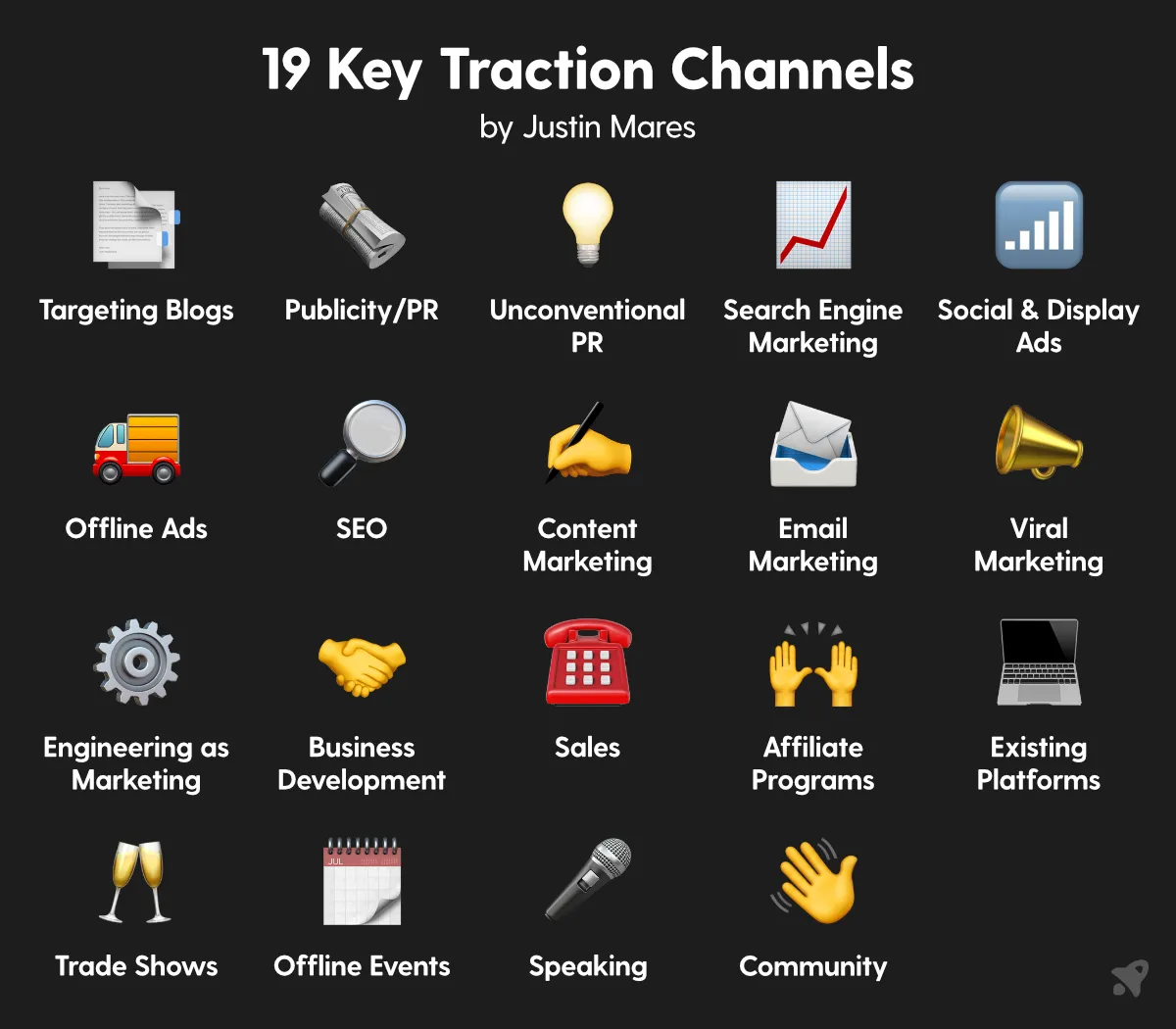
Choose a growth channel around your customer 🎯
A channel is a route to a customer. A tactic is a specific action within it: SEO is a channel, while publishing a comparison page is a tactic. A business can combine channels: a useful guide gets discovered through search, earns an email subscriber, and later brings a qualified demo request.
The original Traction framework is a useful menu. It does not mean you need 19 marketing programs. Brian Balfour’s product-channel fit argument adds a constraint: the product and the rules of its distribution channel need to work together. An app built around useful invitations has different options from expensive software sold through a buying committee.
“Products are built to fit with channels. Channels do not mold to products.”
Brian Balfour, Product Channel Fit

Your situation |
Channels worth investigating first |
What you need to learn |
|---|---|---|
Buyers already search for a clear problem |
SEO and a narrow paid-search test |
Which queries lead to customers who activate |
A small set of businesses can buy valuable contracts |
Sales and business development |
Who owns the problem and can authorize a purchase |
The product is easy to demonstrate |
Creator sponsorships, content, or social ads |
Whether the audience recognizes the problem and tries the product |
Customers naturally share work or invite teammates |
Viral marketing and relevant platforms |
Whether recipients become active customers themselves |
Buyers gather around a specialist profession |
Trade shows, speaking, or a useful community |
Whether relationships turn into qualified follow-up conversations |
This table is an editorial shortlist, not a ranking. If you need first customers, favor a test that puts you close to buyers and teaches you why they buy. If you already know the buyer and have healthy retention, you can invest in a channel that takes longer to develop.
1. Targeting blogs 📑
Targeting blogs means reaching readers through specialist publications that already serve your audience. For a SaaS, these might be an industry blog, a respected comparison site, or a practitioner who writes detailed software reviews. The audience’s relevance matters more than its size.
For example, an agency reporting tool could offer a marketing-operations publication an original walkthrough of how to build a client report. Make it useful enough to stand without a product pitch. An independent review is another option; give the reviewer access and let them describe the product honestly.
Start with a short list of publications your customers actually read. Pitch one specific contribution and track referral visits through activation and payment. A publication that produces a few suitable customers can be more useful than a large site that sends curiosity clicks. Agree whether a placement is editorial, sponsored, or affiliate-supported so readers understand the relationship.
2. Publicity 🗞️
Publicity is earned coverage in news outlets and other media. A journalist needs a story with value for their readers. A routine feature launch rarely provides that on its own; an original finding, a change affecting an industry, or a compelling founder story can be a better starting point.
With permission to analyze aggregated customer data, a scheduling SaaS might investigate a genuine change in appointment behavior. Publish the method and limits, then pitch reporters who cover that industry. If you do not have meaningful data, use a concrete customer story with their permission.
Test a focused pitch to a few suitable journalists. Measure relevant inbound conversations and subsequent product use. Coverage can create credibility, but the people reading it still need a reason to buy. A pile of press logos is a weak result when your customers never encounter those publications.
3. Unconventional PR 💡
Unconventional PR creates attention through an unexpected action: a memorable demonstration, a public challenge, or a creative campaign. It can suit a founder with a sharp understanding of an audience and something worth showing.
For a website monitoring product, an interactive exhibit that makes downtime visible could demonstrate the problem. The campaign should connect naturally to what the software does. A giveaway with a generic prize may attract people who will never need it.
Before committing, try a small version in a relevant community. Watch whether people discuss the actual problem, visit the product, and become qualified users. Budget the production effort as well as the cash spend. Attention is useful when it introduces the right people to a product they understand; it can become expensive entertainment when the connection is missing.
4. Search engine marketing 📈
In the book’s taxonomy, search engine marketing means paid search ads. It is worth testing when buyers express a clear need in their searches and your business can afford the resulting customer acquisition cost.
For an appointment reminder SaaS, start with a narrow set of queries about reminder software for a particular profession. Use a landing page that addresses that profession’s workflow. Broad terms such as “productivity” could send visitors with entirely different needs.
Run a capped test and review the actual search queries, not only the keywords you selected. Measure activated trials or qualified demos before judging cost per paying customer.
If acquisition economics look poor, investigate intent, the offer, and the path to first value before increasing spend.
5. Social and display ads 📊
Social and display ads reach people while they browse feeds or websites. Your message needs to make the problem recognizable without relying on a search query. Products with a clear visual demonstration have something concrete to show.
A screenshot annotation app could show a support agent turning a confusing explanation into a marked-up image. Test a few genuinely different messages to one relevant audience: saving explanation time, reducing misunderstandings, or making client feedback easier.
Use a small spend cap and follow visitors through the product. Judge the campaign on qualified acquisition, not likes or video views. Test the message separately from a major change to the landing page when you want to understand what caused the result. Retargeting is a supporting tactic here; keep its performance separate from campaigns that introduce you to new buyers.
Sponsorships: creators, newsletters, podcasts, and events 🤝
Sponsorships let you pay to reach an audience someone else has built. A placement might be a newsletter mention, a podcast read, a YouTube integration, or support for an industry event. Creator sponsorships are grouped here as a way to buy attention in social feeds and videos. Newsletter, podcast, and event placements follow the same audience-fit logic, while also overlapping targeting blogs and offline events. This is an editorial grouping within the original 19 channels.
The appeal is audience fit and a chance to explain the product in context. A tutorial creator can show the workflow your SaaS improves. A specialist newsletter can put the offer in front of people already discussing the problem. The publisher’s reputation does not guarantee that their audience will buy.
Research the audience before buying a placement
Start with the topics your customers care about, then inspect a publisher’s recent content and past sponsor integrations. Ask who the audience is, how distribution is measured, and what the proposed placement includes. Match the geography, language, profession, and problem to your product. A large subscriber number can hide a poor fit. For YouTube placements, review recent videos in the same format and ask for available audience geography and viewing data. Compare Shorts separately from long-form videos when estimating reach. The influencer vetting guide provides a fuller checklist for audience fit, recent performance, and sponsor history.
Run a small sponsorship test
Choose one relevant placement you can afford to learn from. Agree the deliverables: format, message, publication timing, link or code, reporting, and any reuse rights you need. Give the publisher a short brief explaining the buyer’s problem and the first useful product action. Leave room for an honest presentation in their own voice. For a complete pilot plan, see influencer marketing for startups.
Use a landing page that continues the same promise and a unique campaign link or code. Measure qualified visits, activation, demos, and paying customers over a stated window. Add the placement fee, production cost, and other campaign costs before calculating acquisition cost. Don’t commit to a large package solely because one placement produced a promising click count.
Understand the limits of sponsorship attribution
Some viewers return later through search or another device, so tracked conversions will miss part of the effect. Codes and customer surveys can add context, but neither creates perfect attribution. For newsletters, privacy features can inflate opens. For podcasts, IAB Tech Lab’s measurement guidelines distinguish downloads, audience, and ad delivery; those are different from customers acquired.
6. Offline ads 🚚
Offline ads include print, outdoor placements, direct mail, and other advertising outside the usual digital ad platforms. They can be worth considering when buyers are concentrated in a place or in a specialist publication.
A local service-business SaaS could test a small placement in a trade magazine or send a useful printed checklist to a carefully selected group of businesses. The offer should connect to a problem those owners recognize.
Give each test a memorable URL, QR code, or campaign code, then ask incoming customers how they heard about you. Include design, printing, and delivery in the cost. Attribution will be incomplete, so record what the tracking can and cannot tell you. Start with a placement you can afford to learn from before committing to a long contract.
7. Search engine optimization 🔎
SEO helps customers discover your product through unpaid search results. It fits problems people already research: how to perform a task, how products compare, or where to find a particular tool.
A time-tracking SaaS could create a useful guide to tracking billable hours for agencies, a template, and a product page that explains the agency workflow. Start with one topic where you can provide a better answer from real expertise. Google’s SEO Starter Guide emphasizes useful content and helping search engines discover and understand pages.
Watch discovery and relevant queries first, then activation and customers from those pages. Search visibility can take time, so a short test can validate the topic’s usefulness without proving its eventual ranking. Avoid creating hundreds of near-identical pages. Programmatic SEO needs useful underlying data and distinct value on each page.
8. Content marketing ✍️
Content marketing attracts buyers through useful material: guides, videos, templates, research, or practical examples. SEO is one possible distribution route. A guide can also reach readers through email, a partner, or a community.
For a customer-support SaaS, create a thorough workflow for investigating a recurring support problem. Show a real process or a clearly labeled example. Give readers a useful next step that connects to the paid product.
Your first test should include distribution. Share one strong piece with people who have the problem and invite feedback. Measure qualified subscribers, demos, or trials, and ask which parts helped them decide. Publishing on a schedule without learning who reads the work can produce a large archive with little commercial value. Update a useful piece before making another version of the same advice.
9. Email marketing 📩
Email marketing uses a permission-based audience to maintain a relationship and help people take the next useful step. It can educate prospective buyers, help trial users activate, or bring customers back to a valuable feature.
“Permission is like dating. You don’t start by asking for the sale at first impression.”
Seth Godin, Permission Marketing

For a reporting SaaS, a short onboarding sequence could explain how to connect a data source, create a first report, and share it with a client. Each message should address the reader’s current stage rather than push every feature at once.
Test one sequence against its intended outcome: a reply, a completed setup, or a purchase. Treat opens cautiously. Mailchimp explains that Apple Mail Privacy Protection can inflate open counts. An email list also needs an acquisition source; email alone does not explain how new people discover your business. Keep cold sales outreach distinct from opted-in marketing.
10. Viral marketing 📣
Viral marketing happens when existing use brings new users into the product. A teammate invitation, shared document, booking link, or client portal can create that opportunity.
A project planning app might let a customer invite a contractor to comment on a task. The contractor receives something useful immediately, and may later create a workspace of their own. Design around that actual collaboration rather than asking for invitations before users understand the product.
Test one sharing moment and track invited people through their first useful action. Count new customer accounts separately from additional seats in an existing account. A referral incentive can also bring new customers. Track whether referred people activate, pay, and refer others; offering a reward alone does not establish a repeatable loop. Remove friction from a useful invitation without making the invitation mandatory or exposing private work.
11. Engineering as marketing ⚙️
Engineering as marketing means building a useful tool that introduces people to the paid problem you solve. Calculators, checkers, generators, and small utilities are possible formats.
A subscription analytics SaaS could offer a retention calculator that explains its inputs and gives a useful result without requiring a sales call. The result can show where the full product helps: following cohorts continuously rather than calculating one snapshot.
Before building the asset, decide how the first relevant users will discover it. Build the narrowest useful version and measure how many relevant users move into the paid product. Include maintenance and support in the cost.
Start with the connection between the free task and your paid value, then decide what to build.
12. Business development 🤝
Business development creates growth through partnerships. These might include a joint offer, a distribution agreement, a reseller relationship, or an integration promoted to a partner’s customers.
An invoicing SaaS could partner with bookkeeping firms whose clients need a better way to send invoices. The arrangement should explain what the client receives, what the partner gains, and who owns onboarding and support.
Start with one partner and one specific customer workflow. Agree a concrete introduction or campaign, then follow partner-sourced accounts through activation and payment.
Before expanding, check whether the partnership creates suitable customers at a margin you can support, including commissions and the extra work it creates.
13. Sales ☎️
Sales involves direct conversations that help a buyer understand the product, evaluate fit, and make a purchase. It is particularly worth investigating when contracts can support personal attention or a buying decision needs explanation.
For an agency operations SaaS, research a small group of agencies and ask about a specific problem in their workflow. A discovery call can reveal who owns it, what they use today, and what would make a change worthwhile.
Test a focused prospect list and a clear offer. Track qualified conversations, opportunity progress, and closed customers. Include your selling time when estimating cost. A long list of outbound emails is an activity count. The stronger signal is whether the right buyers recognize a pressing problem and move toward a decision. Use what you learn to improve both the product and its positioning.
14. Affiliate programs 🙌
Affiliate programs reward partners for referring customers. They can suit products that specialists already recommend to their audience, such as consultants, educators, or publishers.
A course platform could recruit a few educators who help creators choose software. Give them product access, useful material, and clear terms covering attribution, payouts, cancellations, and prohibited promotion methods.
Begin with a handful of relevant partners rather than opening a program and hoping people arrive. Measure incremental paying customers and their retention after commissions. Watch for referrals that would have happened anyway, misleading promotions, or low-quality traffic. A commission is a distribution cost; it needs to fit your margin. Partners should disclose the relationship to their audience.
15. Existing platforms 💻
Existing platforms bring you to customers inside an ecosystem they already use. App marketplaces, integration directories, and specialist product communities can all offer discovery.
A Shopify reporting app has an obvious place to reach Shopify merchants. Its listing should make the particular reporting job clear, and the installation should lead quickly to a useful result. A generic directory submission may have much weaker buyer intent.
Test one platform where your customers already work. Track installs through successful setup and payment, not installs alone. Platform distribution comes with dependence on someone else’s rules, permissions, ranking, and fees. Check those constraints before building the business around it, and retain a direct relationship with customers where the platform allows it.
16. Trade shows 🥂
Trade shows bring buyers and vendors together around an industry. They can be useful when a concentrated group of relevant buyers attends and a customer relationship is valuable enough to justify the expense.
A SaaS for dental practices could attend an industry event and arrange conversations with practice owners beforehand. You can learn a lot as an attendee before paying for a booth.
Make the first test about qualified meetings and follow-up. Record ticket costs, travel, preparation, and time away from the business. Agree a next step with each suitable prospect while the conversation is fresh. A bag full of badge scans tells you little about purchase intent; a small set of buyers who continue an evaluation is much more useful.
17. Offline events 🗓️
Offline events create relationships through gatherings you host, support, or attend. Workshops, meetups, customer dinners, and local sessions are possible formats.
A SaaS for independent studios could host a small workshop on handling client handoffs. Participants should leave with a useful process even if they never buy. The event also gives you a chance to understand the work behind their questions.
Start with a modest format and a relevant audience. Track suitable conversations, agreed follow-ups, and later product use. Count organizing time and venue costs. Event sponsorship overlaps this channel, but buying a logo placement is a different experiment from running a workshop. Choose the format based on the interaction you need, rather than the prestige of the event.
18. Speaking engagements 🎤
Speaking engagements reach buyers by teaching something useful in a setting they trust. Conferences, industry meetups, and online talks can give a specialist founder a relevant audience.
A security monitoring founder might explain how small engineering teams can investigate an alert without building a large operations department. Show a practical method and offer a useful resource afterward.
Test one talk with a clear connection to your buyer’s problem. Measure qualified follow-up questions, resource requests, and product evaluations. Audience size alone is not the result. Avoid turning an educational slot into a disguised demo; the teaching should work on its own, with a straightforward invitation for anyone who wants to learn about the product.
19. Community building 👋
Community building brings people together around a recurring interest or problem. It needs a reason to return: useful discussion, shared work, feedback, or access to peers.
A SaaS for freelancers could facilitate a small group where members discuss quoting and project scope. Help people solve real problems and let the product earn its place in those conversations.
Test a recurring discussion with a small, relevant group before launching an empty forum. Watch whether members return, help each other, and refer suitable people. Track commercial outcomes separately from participation. Community work can support acquisition and retention, but it requires attention and moderation. If every conversation depends on the founder prompting it, account for that ongoing cost before expanding.
Use Bullseye to run a useful channel experiment 🧪
Weinberg’s Bullseye framework moves from brainstorming channels, to small tests, to concentrating on the strongest demonstrated option. The test needs to teach you about customer cost, available volume, and customer fit. It should be sized to your resources and the channel’s time to show useful evidence.
Start by listing a plausible tactic for each channel. Then choose a few options you can actually execute. A solo founder might begin with direct sales conversations and one content experiment. A team with a known buyer and an understandable demo could test a creator placement alongside paid search.
Use a timeframe that matches the mechanism. A sales conversation can teach you something tomorrow; search visibility and retained customer cohorts take longer. Compare early learning separately from eventual economics, and avoid declaring a winner from a tiny sample.
A worked channel experiment 📝
Here is an illustrative test for a reporting SaaS that already has a working product. Hypothesis: small agencies with several client accounts need a quicker way to produce their weekly reports, and a personal workflow review will reveal whether the product fits.
Contact 20 researched agencies over three weeks, with a $200 cash cap and ten hours of founder time. Define a qualified conversation as one with someone who owns reporting, has the problem now, and can consider a purchase. The team’s chosen initial signal is three qualified conversations and two accounts that produce and share a report. These are experiment choices, not industry benchmarks.
Repeat if suitable buyers reach that useful action and show purchase intent; observe the sales cycle before calling the economics proven. Change the offer if the problem is real but the workflow review is unappealing. Stop that particular prospecting approach if you reach the intended audience and repeatedly find no need. A test with no replies may require a different contact route before you can conclude anything about demand.
Measure customers, acquisition cost, and retention 📏
Follow each channel through the same customer journey: a relevant visit or contact, a useful product action, payment, and continued use. Define activation around the value the customer came for. A signup can be a useful early signal, but it is only one step.
For campaign links, Google’s campaign URL documentation explains how UTM parameters identify the source, medium, and campaign. Keep names consistent. Add sales notes and a “How did you hear about us?” question when they help explain gaps in the tracking.
Separate customers by acquisition source and watch their cohort retention. A cheap channel that brings customers who leave quickly can be worse than a more expensive one that brings customers who stay. Also ask whether you can repeat the result at meaningful volume; a single opportunity may work without becoming a durable channel.
Common questions about traction channels ❓
Are growth channels and traction channels the same? 🔄
The terms are often used interchangeably for acquisition routes. Growth is broader: onboarding, retention, expansion, and pricing can increase a SaaS business after the customer arrives. This guide focuses on reaching and acquiring customers.
Which traction channel is best for SaaS? 🎯
Choose from your buyer’s behavior and your economics. Search can fit an existing need, sales can fit a complex purchase, and invitations can fit collaboration. Test the connection between the channel and your particular product before making it the main strategy.
How many channels should a small team use? 🔢
Test a small number you can execute and measure properly, then concentrate resources where the evidence is strongest. Supporting work may span channels: email can help convert customers acquired through search. Add another major acquisition effort when you have the capacity to learn from it.
Related terms 🔗
- Traction
- Go-to-market strategy
- Marketing attribution
- Product-led growth
- Customer acquisition cost
- Retention rate
Sources 📚
- Permission Marketing, Seth Godin
- Traction: publisher’s book excerpt, Gabriel Weinberg and Justin Mares
- The 19 Channels You Can Use to Get Traction, Gabriel Weinberg
- The Bullseye Framework for Getting Traction, Gabriel Weinberg
- Product Channel Fit Will Make or Break Your Growth Strategy, Brian Balfour
- SEO Starter Guide, Google Search Central
- Collect campaign data with custom URLs, Google Analytics
- Apple Mail Privacy Protection FAQ, Mailchimp
- Podcast Measurement Guidelines, IAB Tech Lab
- YouTube sponsorships for startups, Sponsorship.so
- How to Vet Influencers Before Sponsoring Them, Sponsorship.so
- Influencer Marketing for Startups — Full Playbook, Sponsorship.so