Dual funnel
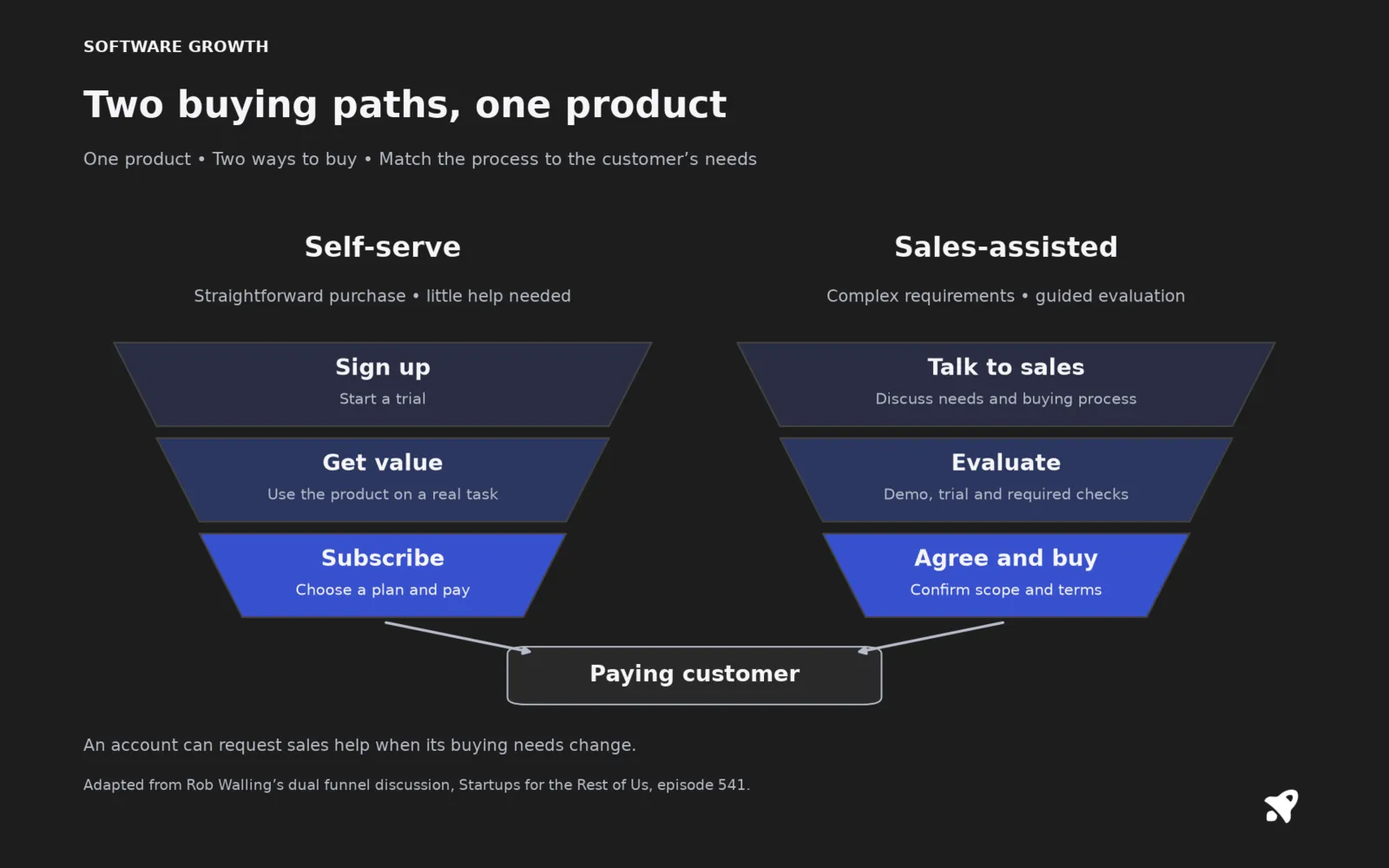
A dual funnel combines a self-serve buying path for smaller SaaS accounts with a sales-assisted path for larger or more complex customers.
A dual funnel is a SaaS sales strategy with two buying paths: a self-serve or low-touch path for smaller accounts, and a higher-touch sales path for customers with larger contracts or more complex needs. Both serve the same business, with different levels of help, pricing, and onboarding.
For a bootstrapped founder, it offers a way to keep straightforward purchases easy while earning enough from larger accounts to support demos, procurement, and implementation. A pricing page with both “Start a trial” and “Talk to sales” can be the entrance to a dual funnel, but those buttons need distinct processes behind them.
Rob Walling's dual funnel idea
The companies that I’m seeing that are really crushing it have both.
Rob Walling / Startups for the Rest of Us, episode 541 (March 23, 2021), dual funnels segment from 22:30

Walling has helped popularize dual funnels among bootstrapped SaaS founders. In episode 541, he describes a broad, lower-price funnel building usage and word of mouth alongside a higher-price funnel for larger customers. He discusses having both at Drip and seeing the approach in companies he advises. This is a documented use of the term in 2021, rather than proof that he was its first author.
How the two paths work
The self-serve path: visitor → signup → first useful outcome → paid subscription. Clear pricing, a trial, and good onboarding do most of the work. Some accounts may need a brief conversation, making this a low-touch path.
The sales path: inquiry → qualification → demo or evaluation → agreement → onboarding. A person helps establish requirements, resolve buying concerns, and coordinate the purchase. The contract needs to support that effort.
Accounts can move between the paths. A small team may start with a card and later need a company-wide agreement. A large company may approach sales directly. Every enterprise buyer does not have to start as a free user.
A fictional SaaS example
Imagine a reporting tool for agencies. A small agency pays $49 a month, connects a data source, and creates its first client report without a call. A larger agency needs shared permissions, an implementation session, and procurement support, so it takes a demo and signs a $12,000 annual agreement.
If the business adds 20 small accounts, that is $980 of new MRR. One $12,000 annual agreement contributes another $1,000 of MRR when expressed monthly. These are illustrative prices and arithmetic, not benchmarks. The larger deal also consumes sales and delivery time, which must be included when comparing the paths.
When a dual funnel makes sense
In episode 828, Walling examines whether the product fits both customer groups, whether larger-account leads exist, and whether the sales process is worth the effort. He warns that enterprise-specific features can absorb months of development and that procurement and contract work require sufficient pricing.
Use those questions before adding a second funnel. Can the same core product solve both groups' problems? Are larger customers already asking to buy? Can you deliver their requirements without abandoning the customers who sustain the business? A bigger logo alone does not answer these questions.
How to start without overwhelming the team
- Keep the existing buying path working. Small accounts should still be able to see prices, try the product, and pay.
- Define what belongs in the sales path. Use requirements such as deployment scope, security review, or guided implementation. Let buyers explain their needs instead of routing by company size alone.
- Qualify before doing a full demo. Confirm the problem, product fit, decision process, budget, and expected timing.
- Price the work you are promising. Document which plan includes procurement support, negotiated terms, or implementation. Test the sales path yourself before hiring for it.
- Review the cost of the second path. Count calls, follow-up, technical work, onboarding, and ongoing support, including founder time.
What to measure
Track each path separately. For self-serve, watch activation, trial conversion, and retention. For sales, track qualified opportunities, win rate, sales cycle, and average contract value. Compare acquisition costs, support costs, and retained revenue for both.
When an account moves into the sales path, keep its acquisition history and record the handoff. Count its revenue once. Blending all signups and demo requests into one conversion rate makes it harder to see which process needs attention.
Common mistakes
- Requiring a demo for inexpensive plans that previously sold themselves.
- Providing enterprise sales and implementation work at self-serve prices.
- Building every feature requested by one large prospect before confirming a purchase.
- Assuming that larger contracts automatically produce better margins or retention.
Related terms
Sources
- Episode 541: Faster Horses & Product Myths, Life-changing Money, Dual Funnels, and More, Rob Walling, Startups for the Rest of Us, March 23, 2021, from 22:30
- Episode 828: Am I Building a SaaS?, Serving Both B2C and B2B, Pricing, and More Listener Questions, Rob Walling, Startups for the Rest of Us, April 14, 2026, from 14:10