Billings
Billings are the total amount you invoice customers in a period, whether or not you have earned it yet. Billings equal revenue plus the change in deferred revenue.
Billings measure what you asked customers to pay during a period. For a business that sells annual plans, billings tell you far more about near-term cash than revenue does, because a customer paying $1,200 up front is billed $1,200 immediately but you earn only $100 of it that month.
How to calculate billings
At the simplest level, billings are the sum of the invoices you issued in the period. Corporate Finance Institute describes them as the amount of signed contracts invoiced during a specific period, following each contract's payment schedule. From the financial statements you can derive it:
Say a month's recognized revenue is $21,000 and deferred revenue grows from $50,000 to $56,000 because customers prepaid annual plans. Billings are 21,000 + (56,000 - 50,000) = $27,000. If deferred revenue had shrunk by $4,000, billings would be $17,000, below revenue.
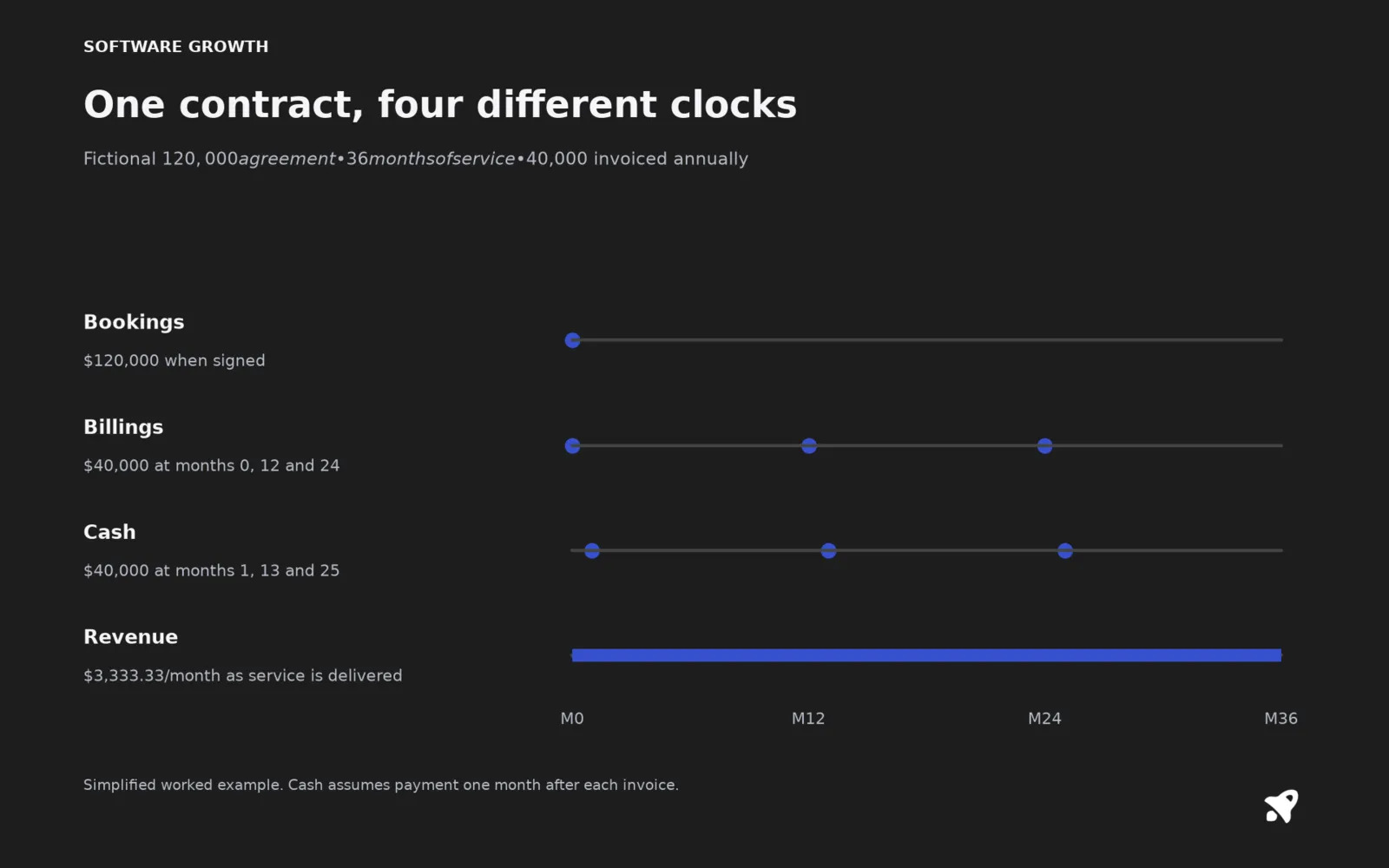
Billings vs bookings vs revenue
- Bookings: contracts signed.
- Billings: invoices issued.
- Revenue: value earned as service is delivered.
On a $36,000 three-year contract invoiced annually, bookings are $36,000 at signing, year one billings are $12,000, and monthly revenue is $1,000. Billed but not yet earned amounts go to deferred revenue.
Why founders track it
Billings are a cash-flow lead indicator. A quarter of strong annual prepayments shows up in billings immediately and in revenue gradually. David Skok highlights prepaying annually as a smart move for cash flow, and says discounting for it is worthwhile. Billings reveal how much cash that choice is creating.
Billings can also mislead. A big multi-year prepayment inflates one quarter's billings without raising MRR, so a jump is not the same as growth. Compare billings against MRR and cash collected, not in isolation.
Calculated vs invoiced
Public companies often report "calculated billings" using the formula above, because they do not publish invoice totals. Your own invoice data is better: pull it from Stripe or your billing tool. Remember that billings are not collected cash. An invoice that is unpaid, or later voided or credited, changes the real figure.
Small SaaS angle
With monthly card billing, billings and revenue are almost identical. They split once you add annual plans. If 20% of customers pay annually, your billings will spike in the months those renewals fall due. That is helpful cash, but plan around the fact that it covers the following eleven months of service, and set aside refunds you may owe.
Related terms
- Bookings
- Deferred revenue
- Revenue recognition
- TCV (Total contract value)
- MRR (Monthly recurring revenue)
Sources
- SaaS Financial Metrics: Bookings vs Billings, Corporate Finance Institute
- SaaS Metrics 2.0, David Skok, For Entrepreneurs
- Subscriptions and invoicing, revenue recognition methodology, Stripe