Revenue recognition
Revenue recognition is the accounting rule for when a payment becomes revenue. For subscriptions under ASC 606, it is spread over the period you deliver the service.
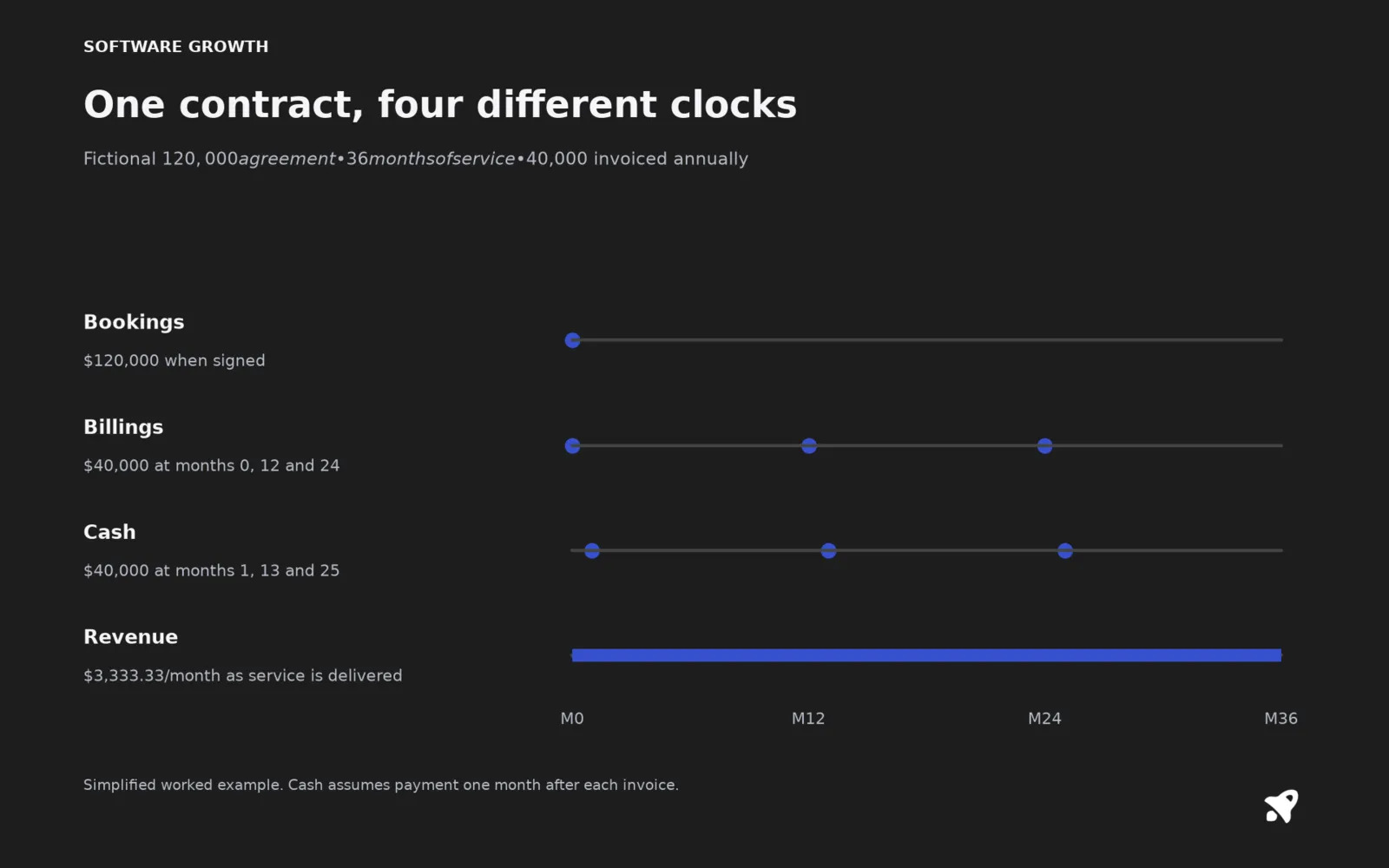
Cash in is not revenue. Under accrual accounting you recognize revenue when you deliver what the customer paid for. For a subscription business, that means recognizing a bit each day or month of the subscription, not all at once when the card is charged.
The standard
In the US the standard is ASC 606. Internationally the equivalent is IFRS 15. Stripe's overview notes that ASC 606 applies to all entities that enter into contracts with customers, which includes a small SaaS company, though its practical impact depends on whether you keep accrual books or cash-basis books, and on your jurisdiction. Ask an accountant which applies to you.
The five steps
ASC 606 uses a five-step model, listed in Stripe's guide:
- Identify the contract with the customer.
- Identify the performance obligations in the contract.
- Determine the transaction price.
- Allocate the price to the obligations.
- Recognize revenue when (or as) each obligation is satisfied.
For a simple plan, steps one to four are short: one customer, one obligation (access to the product), one price. Step five does the work, since access is delivered continuously, so revenue is recognized over time.
A subscription example
A customer pays $1,200 for an annual plan on January 1. Recognition is straightforward:
You record $100 of revenue each month, and the unrecognized balance sits as deferred revenue that falls from $1,200 to zero over the year. Stripe's own tooling works from finalized invoices and spreads each line across its service period, so an invoice for a service period from January 15 to February 14 is split by days across the two months, as their methodology page shows.
When it gets harder
- Bundled deals. A subscription plus implementation work may be separate obligations with separate timing. Setup done in week one can be recognized in week one if it is a distinct service.
- Usage and overages. Variable amounts are recognized as usage occurs.
- Discounts, credits and refunds. They reduce the transaction price, and recognized and deferred amounts adjust proportionally.
- Sales tax and VAT. These are liabilities, not revenue.
Revenue recognition vs MRR
MRR is an operating metric you define for yourself. Recognized revenue is an accounting result with rules. They often differ in a month because of timing, refunds, proration and one-time fees. Baremetrics stresses that MRR is not an accounting figure. Use MRR to run the business and recognized revenue for statements, taxes and due diligence.
Small SaaS angle
You do not need software to understand this, but you do need consistent books once you have annual plans, outside investors or a sale on the horizon. A buyer's financial review checks that revenue recognition matches your contracts, and that billings and deferred revenue reconcile. Set it up correctly while it is cheap to do, and keep a monthly schedule that ties recognized revenue back to invoices.