Bookings
In SaaS finance, bookings are the total value of customer contracts signed in a period, counted when the deal closes regardless of when you invoice or earn it.
Bookings is a sales scorecard. It records the value of contracts that customers committed to in a period, at the moment they sign. It is the earliest of three numbers that follow a deal: bookings, then billings, then revenue.
Bookings vs billings vs revenue
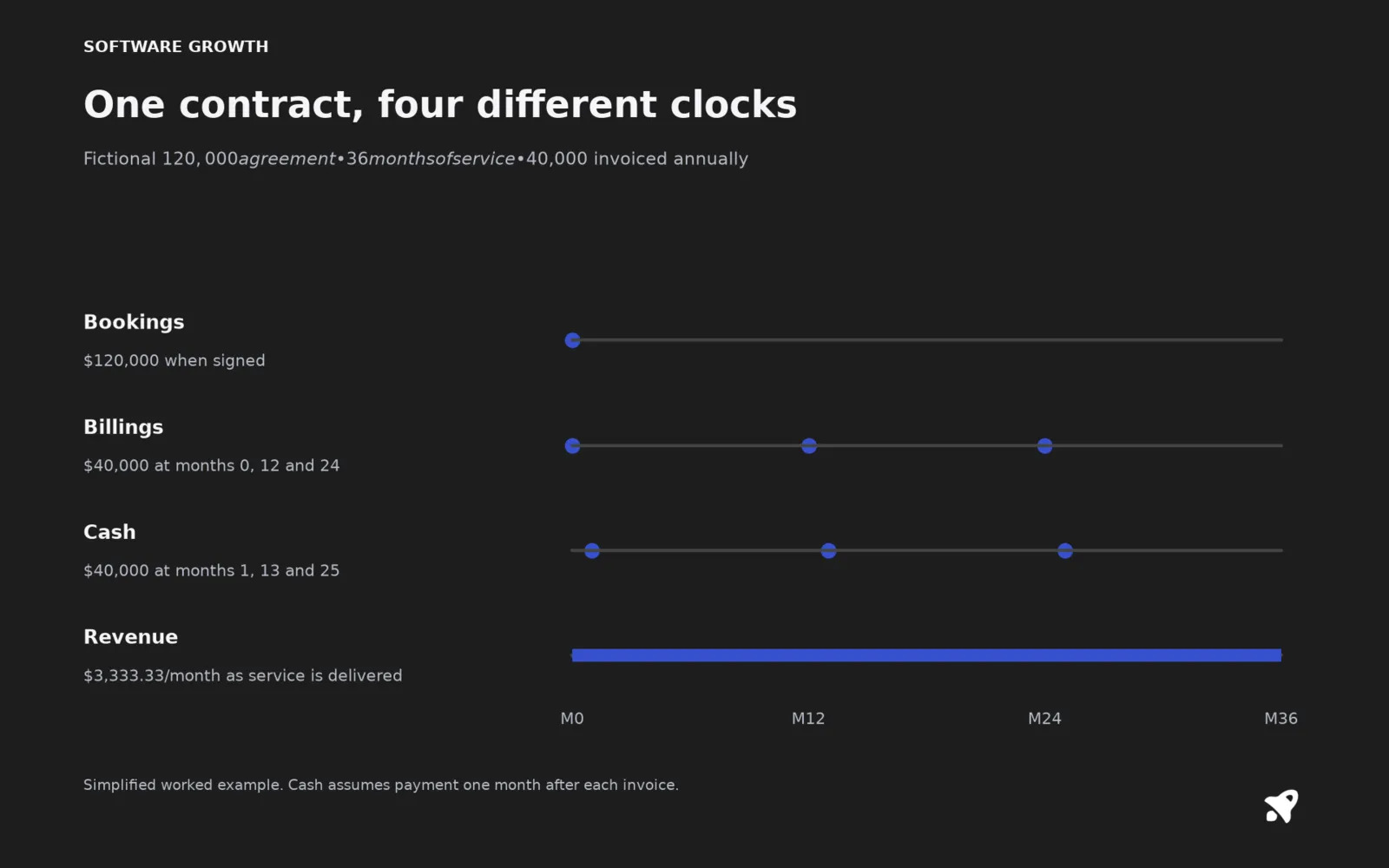
Corporate Finance Institute defines bookings as the total value of contracts secured, recorded when signed, billings as the amount invoiced in a period, and revenue as what is earned as service is delivered under GAAP. Their example is a $120,000 three-year contract billed annually:
- Bookings: $120,000, in the month of signing.
- Billings: $40,000 in year one, and again in years two and three.
- Revenue: about $3,333 a month, recognized evenly over 36 months.
Each answers a different question. Bookings: how much did we sell? Billings: how much did we ask customers to pay? Revenue: how much have we earned? The gap between billings and revenue sits on the balance sheet as deferred revenue.
How to calculate bookings
The definition varies by company. Some count the full TCV, some only the first year, and some count annualized recurring value (new ACV). Pick one and say which. For a small SaaS, a common choice is new annual contract value: 12 new customers at $6,000 ACV is $72,000 of bookings.
Why bookings are a poor health metric alone
Bessemer's Atlas argues that bookings and contract-value metrics can be manipulated and mislead. A longer term or a bundled services line makes bookings larger without making the recurring base any healthier. A signed deal can also slip, shrink or churn before go-live. Pair bookings with MRR and ARR so you see the recurring part.
Mistakes to avoid
- Treating bookings as revenue. They are not income, and they are not on the income statement.
- Counting unsigned deals. A verbal yes is pipeline, not bookings.
- Counting one-time fees as recurring bookings without labeling them.
- Mixing definitions between periods or between you and a benchmark you compare against.
Small SaaS angle
If your customers pay by card each month, bookings add little beyond MRR, because signing and first payment happen together. The term matters once you sign annual or multi-year contracts, invoice after signature or work with sales teams. Then bookings give you early warning, since they lead billings by weeks or months and revenue by longer.
Related terms
- Billings
- TCV (Total contract value)
- ACV (Annual contract value)
- Deferred revenue
- Revenue recognition
- ARR (Annual recurring revenue)
Sources
- SaaS Financial Metrics: Bookings vs Billings, Corporate Finance Institute
- The five accounting metrics for cloud companies, Bessemer Venture Partners
- Annual contract value (ACV) in SaaS, Stripe