Deferred revenue
Deferred revenue is money a customer has paid for service you have not delivered yet. It is a liability that becomes revenue as you deliver.
If a customer pays you $1,200 for a year of your product on January 1, you have $1,200 of cash but have earned none of it. You owe them twelve months of service. Accountants call that obligation deferred revenue, also known as unearned revenue. It is one of the most common line items in a subscription business, and one that founders often misread.
How it works
When the payment arrives, cash goes up and a liability called deferred revenue goes up by the same amount. Each month you deliver service, a slice moves from the liability to revenue. It is a liability because, if you shut down or the customer is owed a refund, you would have to give something back.
Stripe's documentation walks through a simple case. A customer starts a $31 monthly subscription on January 15, so the service period runs through February 14. At the end of January, 17 days (about $17) are recognized as revenue and 14 days ($14) remain deferred, to be recognized in February.
How to calculate it
For a single prepaid plan, the remaining balance is what is left of the service period.
For a $1,200 annual plan paid January 1, you recognize $100 a month. After three months, revenue recognized is $300 and deferred revenue is 1,200 x 9/12 = $900. Across the business, deferred revenue is the sum of these balances for every customer who has paid ahead.
Deferred revenue and billings
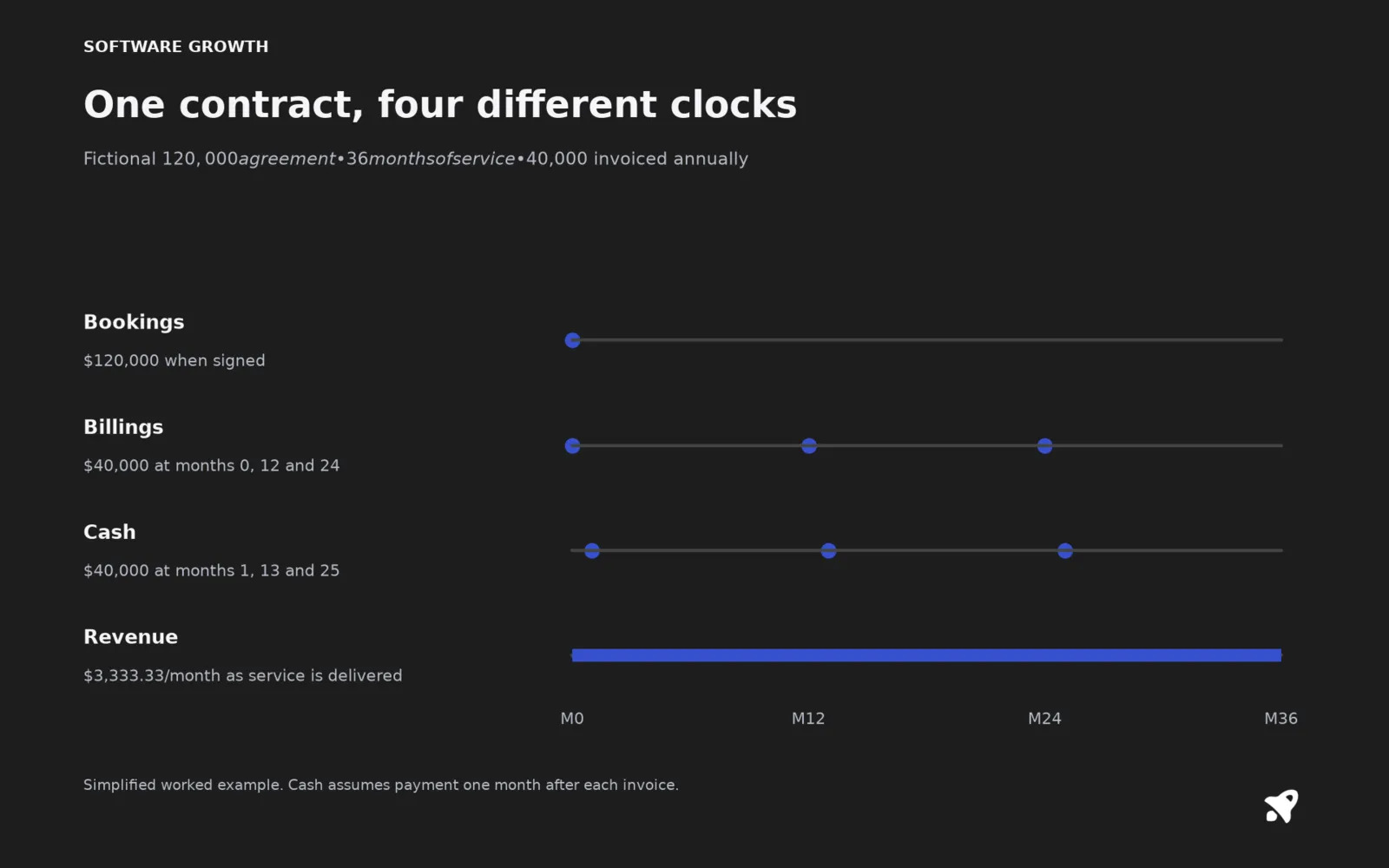
Deferred revenue connects billings to revenue. Billings equal revenue plus the change in deferred revenue, so a growing balance means you are billing more than you earn, usually because more customers are prepaying. Bookings sit before both. That is why a company can have $60,000 of deferred revenue and still need cash: you collected it already, and you must now cover the cost of serving those customers.
Is it good or bad
Good for cash, neutral for profit. David Skok calls annual prepayment really smart for cash flow, and notes it tends to lower churn because customers commit more. But the cash is not free to spend. Treat deferred revenue as money you hold in trust for future service, and keep enough in the bank to refund unused months if you offer refunds.
Cancellations and refunds
If a customer cancels mid-term with no refund, Stripe continues to recognize the invoice over its original service period, because recognition follows the finalized invoice, not the subscription status. Their example is a $90 three-month plan canceled after one month: revenue of $31, $28 and $31 in the three months. If you refund or issue a credit, the deferred balance and the revenue shrink proportionally. See also proration when customers change plans mid-cycle.
Small SaaS angle
- Deferred revenue is not the same as MRR. A customer paying $1,200 annually adds $100 of MRR and $1,200 of cash.
- If you sell annual plans, ask your accountant to book deferred revenue properly, especially if you plan to raise money or sell the company. A buyer will check it.
- Offering an annual discount of two months free converts monthly customers into prepaid ones. You gain cash and, often, retention, and you create a deferred balance you owe in service.
Related terms
- Revenue recognition
- Billings
- Bookings
- MRR (Monthly recurring revenue)
- Proration
- ACV (Annual contract value)
Sources
- Subscriptions and invoicing, revenue recognition methodology, Stripe
- SaaS Metrics 2.0, David Skok, For Entrepreneurs
- SaaS Financial Metrics: Bookings vs Billings, Corporate Finance Institute