Bottom of Funnel (BOFU)
The decision stage of the marketing funnel, where buyers choose between products and need pricing, comparisons and migration answers.
Bottom of funnel (BOFU) is the decision stage of the marketing funnel: the buyer is choosing between specific products and is close to starting a trial, booking a demo or paying. The one-line rule: BOFU work answers the last questions about price, fit, migration and risk so the buyer can decide with confidence.
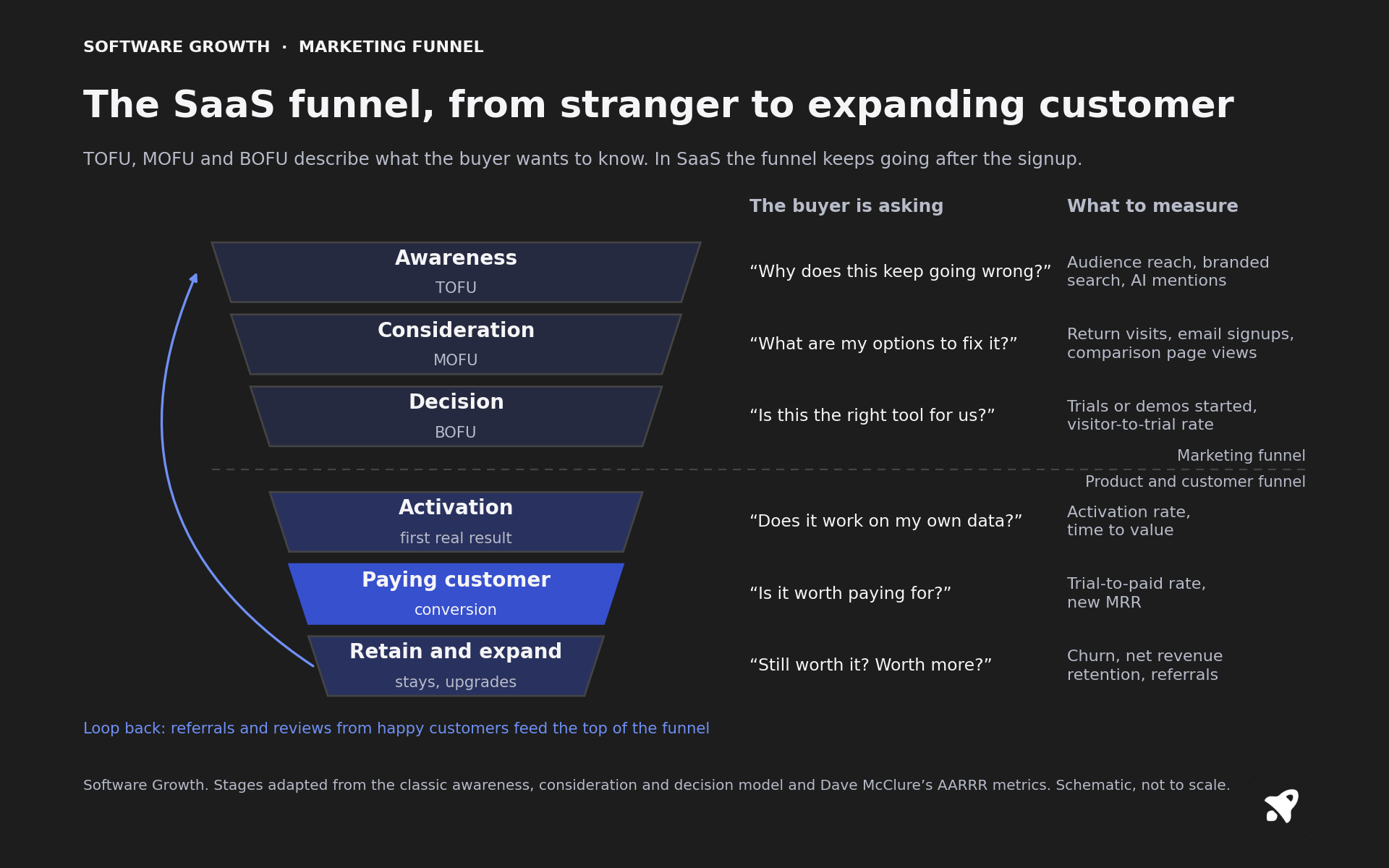
It comes after the top of funnel (awareness) and the middle of funnel (consideration), the stages often shortened to TOFU, MOFU and BOFU. In SaaS the funnel keeps going after the decision, through activation, payment and retention; the marketing funnel guide covers those stages with a worked example.
BOFU pages every SaaS needs
The BOFU buyer is asking "is this the right tool for us?". They want specifics, not inspiration:
- Pricing. Plain-text prices, what each plan includes and what happens at the limits.
- Versus and alternatives pages. Honest comparisons with the tools buyers are switching from, with checkable claims.
- Migration guides. How to move data and workflows over, and how long it takes.
- Integration pages. One page per important integration, with what it actually does.
- Security and trust. Answers for whoever has to approve the purchase.
- The trial, demo or signup itself. The last BOFU step is the product.
Example: a prospect looking for an alternative to their billing tool needs to know how records import, which payment workflows are supported and the total price. A clear migration page does more for them than a broad article explaining what billing software is.
Why a new SaaS should start here
For a young product, the bottom of the funnel is where to build first. People here already have the pain and are looking for a fix, so they convert with the least effort and teach you the most about who your customer is.
The bottom of the funnel is very 1:1
Asia Orangio / MicroConf, Actionable tactics to land your first 100 customers (January 26, 2022)
Her approach: find out what prospects did right before they signed up (searched Google, read reviews on G2 or Capterra), show up in exactly those places, and use customers' own words in the copy. Then work up to the middle and top. Paid search on high-intent keywords is a common BOFU channel, and Jason Cohen's ARPU/25 rule gives a bootstrapper a ceiling on what to pay per click.
When interested buyers still don't buy
BOFU intent doesn't remove objections. Larger buyers may still need security approval, legal review and agreement from colleagues. And sometimes a prospect genuinely likes the product, has the budget and still says "call me in nine months".
Urgency is the missing ingredient.
Jason Cohen / Product Purgatory: When they love it but still don't buy (May 4, 2025)

Cohen's point is that every buyer has two or three top priorities, and you are not one of them. The fix is to narrow your ideal customer profile to people who need it right now, because of a regulation, a deadline, a growth push or an emergency, and aim your BOFU pages at those situations. Don't manufacture urgency with fake scarcity or misleading comparisons; it brings in customers who churn.
How to measure it
- Visitor-to-trial or visitor-to-demo rate on pricing, versus and migration pages. See conversion rate.
- Trial-to-paid rate. Kyle Poyar's survey of 200 B2B products (February 4, 2026) found a median free-to-paid rate of 8%, and 30% for trials that require a credit card. See trial conversion rate.
- Demo-to-close and win rate for sales-assisted deals, and the length of the sales cycle.
- Retention of BOFU-acquired customers. A page that converts well but brings in poor-fit customers is a churn problem in disguise.
Small changes on these pages can have outsized effects, so test them carefully; see conversion rate optimization.
What changed in 2026: comparisons feed AI answers
When buyers ask an AI assistant "Tool A or Tool B?", the answer is built from pages like yours and your competitors'. Ross Hudgens of Siege Media told Rob Walling that versus articles are an underrated tactic: among Siege's B2B SaaS clients, sites with the most versus pages had the most traffic from AI assistants. That's a correlation, not proof, and it's worth having these pages anyway.
It's a down funnel content type you should have on your website.
Ross Hudgens / Startups for the Rest of Us, episode 853 (October 6, 2026), from 11:06
Accuracy matters as much as presence. Aja Frost writes (September 16, 2026) that AI assistants were quoting HubSpot's prices wrongly, because its pricing pages were rendered with JavaScript and the bots took prices from outdated third-party sites. Plain-text blog posts describing each product's pricing improved accuracy for five of six products. If your pricing page is hard for a crawler to read, check what the assistants say about your prices. See answer engine optimization.
Common mistakes
- Building top-of-funnel content before the pricing, comparison and migration pages exist.
- Hiding prices, or showing them only as images or in scripts crawlers can't read.
- Comparison pages with claims a competitor can disprove.
- Pushing urgency with fake deadlines instead of finding buyers who already have it.
- Counting a signup as the finish line, without checking whether those customers activate and stay.
Listen, watch and read next
- Watch: How to Become the SaaS That AI Recommends, Rob Walling with Ross Hudgens, Startups for the Rest of Us, episode 853 (October 6, 2026). Versus articles from 11:06 and handling competitor pushback from 14:14.
- Read: Product Purgatory: When they love it but still don't buy, Jason Cohen (May 4, 2025). Why warm prospects stall, and how to find the ones who need it now.
- Read: A new look at free-to-paid conversion, Kyle Poyar (February 4, 2026). Free-to-paid data from 200 B2B products, by trial type.
- Watch: The BEST Sales Funnel For Your SaaS (new data changed my advice), Rob Walling (July 6, 2025). Trial funnel choices for bootstrapped SaaS, backed by MicroConf survey data.
- Read: Bootstrapped CPC rule of thumb: ARPU/25, Jason Cohen. How much a bootstrapper can pay for a high-intent click.
Related terms
- Marketing funnel
- Top of funnel (TOFU)
- Middle of funnel (MOFU)
- Sales funnel
- Sales cycle
- Conversion rate optimization (CRO)
Sources
- Actionable tactics and strategies to land your first 100 customers, MicroConf (talk by Asia Orangio), January 26, 2022
- Product Purgatory: When they love it but still don't buy, Jason Cohen, A Smart Bear, May 4, 2025
- Bootstrapped CPC rule of thumb: ARPU/25, Jason Cohen, A Smart Bear, April 29, 2013
- A new look at free-to-paid conversion, Kyle Poyar, Growth Unhinged, February 4, 2026
- Inside 12 months of AI search experiments, Aja Frost, Growth Unhinged, September 16, 2026
- Episode 853: How to Become the SaaS That AI Recommends, Rob Walling with Ross Hudgens, Startups for the Rest of Us, October 6, 2026 (video)
- The BEST Sales Funnel For Your SaaS (new data changed my advice), Rob Walling, July 6, 2025