Top of Funnel (TOFU)
The awareness stage of the marketing funnel: people with a problem who aren't yet looking for a product, reached with useful content.
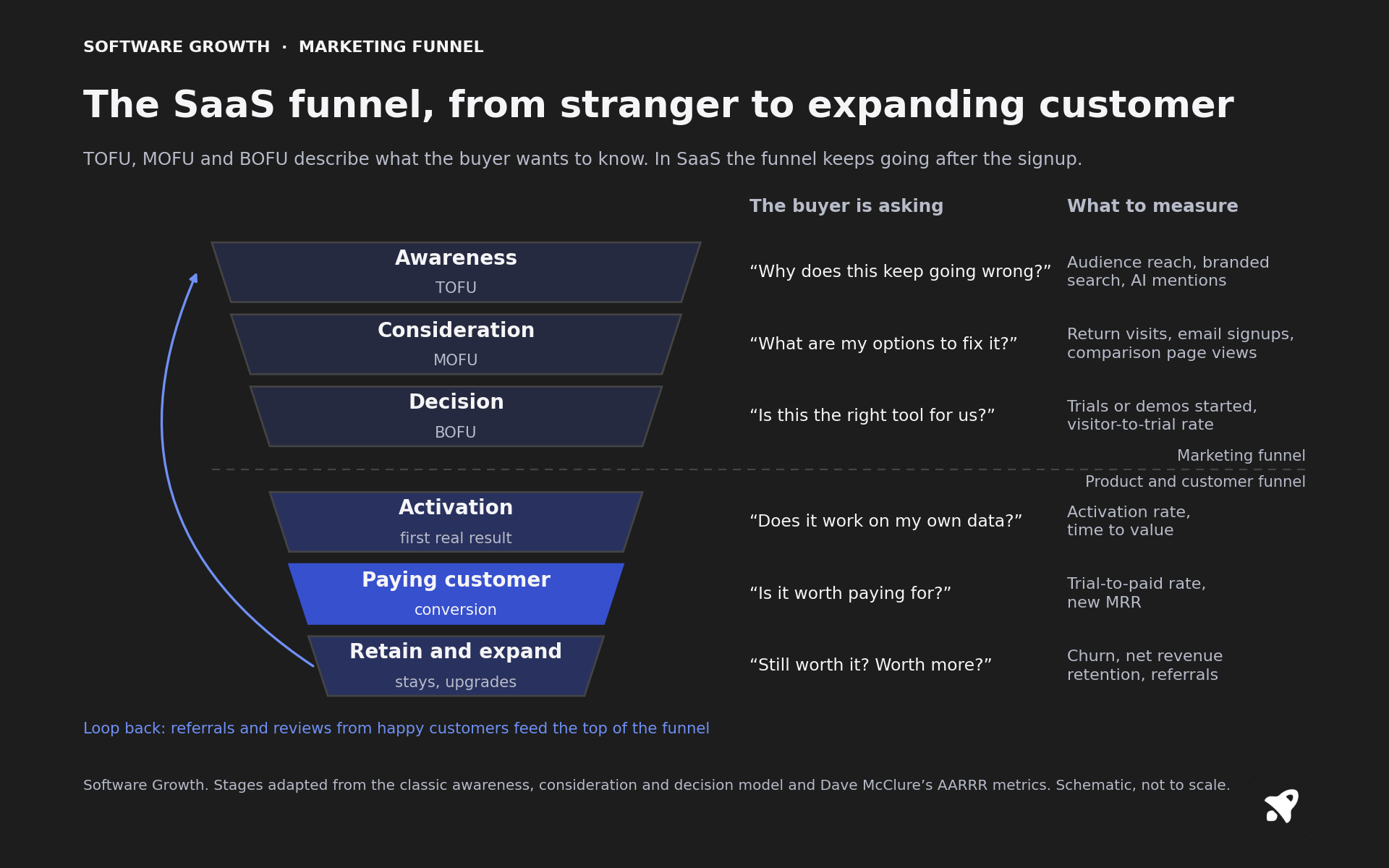
Top of funnel (TOFU) is the awareness stage of the marketing funnel: people who have a problem or a question but aren't yet looking for software like yours. The one-line rule: TOFU work earns attention and memory from the right people, so you are on their list when the need turns urgent.
It sits above the middle of funnel (comparing ways to solve the problem) and the bottom of funnel (choosing a product). Together they are often shortened to TOFU, MOFU and BOFU. For the full model, the SaaS stages after signup and a worked example with numbers, see the marketing funnel guide.
What top of funnel looks like for SaaS
The TOFU reader is asking "why does this keep going wrong?" rather than "which tool should I buy?". Content that fits answers the problem honestly, whether or not the reader ever buys:
- Educational guides and articles about the problem your product solves.
- Podcasts, YouTube videos and talks, where people spend real attention on you.
- Free tools, templates and calculators that solve a small part of the problem.
- Answers in communities, forums and newsletters where your buyers already are.
- Original research or data your market wants to cite.
Example: a fleet-management SaaS publishes a practical guide to reducing missed vehicle inspections. Operations managers learn how to fix a process before they think about software. The guide introduces the company to them and later links to an evaluation guide for when they need a tool.
How to measure it
Large reach does not guarantee useful demand. A popular article on a loosely related trend can attract an audience that will never buy. Judge TOFU work on three layers:
- Relevant reach. Views, listens and subscribers among the people you sell to, not everyone.
- Memory. Branded search volume, direct visits and how often AI assistants name you for questions in your category. Wistia CEO Chris Savage discusses brand search as a leading indicator with Amanda Natividad (from 28:19 in the video below).
- Later progression. How many readers or listeners eventually start a trial, measured by cohort and by asking new customers "How did you hear about us?".
Expect a delay. Aja Frost, a former marketing leader at HubSpot, describes the YouTube, podcast and newsletter content the company shifted toward:
This content was higher-funnel, so it converted more slowly
Aja Frost / Inside 12 months of AI search experiments (September 16, 2026)
She adds that it was also more unique and built deeper brand loyalty, which is the point of TOFU work. Last-click attribution will undercount it; see marketing attribution.
Don't start here
For a young SaaS, the top of the funnel is usually the wrong place to begin. MicroConf's write-up of Asia Orangio's talk on landing the first 100 customers calls starting at the top the biggest mistake new founders make.
Top of the funnel is one to infinity.
Asia Orangio / MicroConf, Actionable tactics to land your first 100 customers (January 26, 2022)
Her advice is to start with people at the bottom who already have the pain, learn from them which channels and words work, then work upward. TOFU content is easier to aim once you know who converts. She is clear that you will need the top over time; it just shouldn't come first.
What changed in 2026: AI answers sit at the top
Much of the top of the funnel now happens inside AI assistants and Google's AI summaries, where a reader can get an answer without visiting anyone's site.
- In a Pew Research Center analysis (July 22, 2025), Google users who saw an AI summary clicked a regular result in 8% of visits, against 15% for those who didn't.
- Kevin Indig's look at Similarweb data (October 26, 2026) shows US organic search visits down 13.2% over two years, with publishers, whose product is the content itself, losing the most. He thinks bigger ad blocks and algorithm updates explain part of the drop.
- Frost writes that some of HubSpot's lost blog traffic came from topics that drew visits but not conversions. The broad, low-intent TOFU articles are the first traffic AI answers absorb.
Content still matters, but its first reader is increasingly a model. Recapping two AI SEO talks at MicroConf Europe, Derrick Reimer put it this way:
It's like the agents are reading it to form their opinions
Derrick Reimer / Startups for the Rest of Us, episode 856 (October 27, 2026), from 13:30
In practice that means writing TOFU content that answers real questions buyers ask, with specifics a model can repeat, and being present on the places assistants read, such as reviews, roundups, Reddit and YouTube. Amanda Natividad's "zero-click marketing" ladder (seen, understood, remembered, preferred, sought out) is a useful way to judge content that may never earn a click. For the full playbook, see answer engine optimization.
Common mistakes
- Starting with TOFU before anything converts at the bottom.
- Chasing traffic on topics your buyers don't care about.
- Expecting every visit to convert, then cutting the channel after a month.
- Measuring only clicks, when much of the value is now in being named in answers you can't see.
- Publishing generic, AI-written explainers that add nothing a model doesn't already know.
Listen, watch and read next
- Read: Inside 12 months of AI search experiments, Aja Frost on Growth Unhinged (September 16, 2026). How HubSpot responded when its top-of-funnel blog traffic fell, experiment by experiment.
- Watch: What Zero Click Marketing Actually Is, Amanda Natividad (March 10, 2026). Her ladder for judging content without clicks starts at 07:10.
- Watch: A CEO On Marketing in a Zero-Click, AI-Driven World, Amanda Natividad with Chris Savage (September 15, 2026). Brand search as a leading indicator from 28:19.
- Listen: Episode 856: Key Learnings from MicroConf Europe 2026, Startups for the Rest of Us (October 27, 2026). The AI SEO recap from 13:30.
- Read: Actionable tactics and strategies to land your first 100 customers, MicroConf. Why to build the bottom of the funnel before the top.
Related terms
- Marketing funnel
- Middle of funnel (MOFU)
- Bottom of funnel (BOFU)
- Content marketing
- Demand generation
- Answer engine optimization (AEO)
Sources
- Actionable tactics and strategies to land your first 100 customers, MicroConf (talk by Asia Orangio), January 26, 2022
- Inside 12 months of AI search experiments, Aja Frost, Growth Unhinged, September 16, 2026
- Organic traffic is down, but it's not all AI, Kevin Indig, Growth Memo, October 26, 2026
- Google users are less likely to click on links when an AI summary appears in the results, Pew Research Center, July 22, 2025
- Episode 856: Key Learnings from MicroConf Europe 2026, Rob Walling and Derrick Reimer, Startups for the Rest of Us, October 27, 2026 (video)
- What Zero Click Marketing Actually Is, Amanda Natividad, March 10, 2026
- A CEO On Marketing in a Zero-Click, AI-Driven World, Amanda Natividad with Chris Savage, September 15, 2026