Marketing Funnel
A model of the stages a buyer moves through, from awareness to purchase. In SaaS it continues through trial, activation, retention and expansion.
A marketing funnel is a model of the stages a potential customer moves through, from first noticing a problem to paying for a product that solves it. Fewer people make it through each stage, so the shape narrows, and the one-line rule follows: new customers = people at the top × the conversion rate of every stage below it.
The classic version has three stages: awareness, consideration and decision, often shortened to TOFU, MOFU and BOFU (top, middle and bottom of funnel). A SaaS funnel keeps going after the signup, through trial, activation, payment, retention and expansion. This guide covers both versions, the metrics for each stage, a worked example with numbers, where funnels fall short compared with loops and flywheels, how a bootstrapped founder builds a first funnel, and how AI search is changing the top of it in 2026.
The stages of a marketing funnel
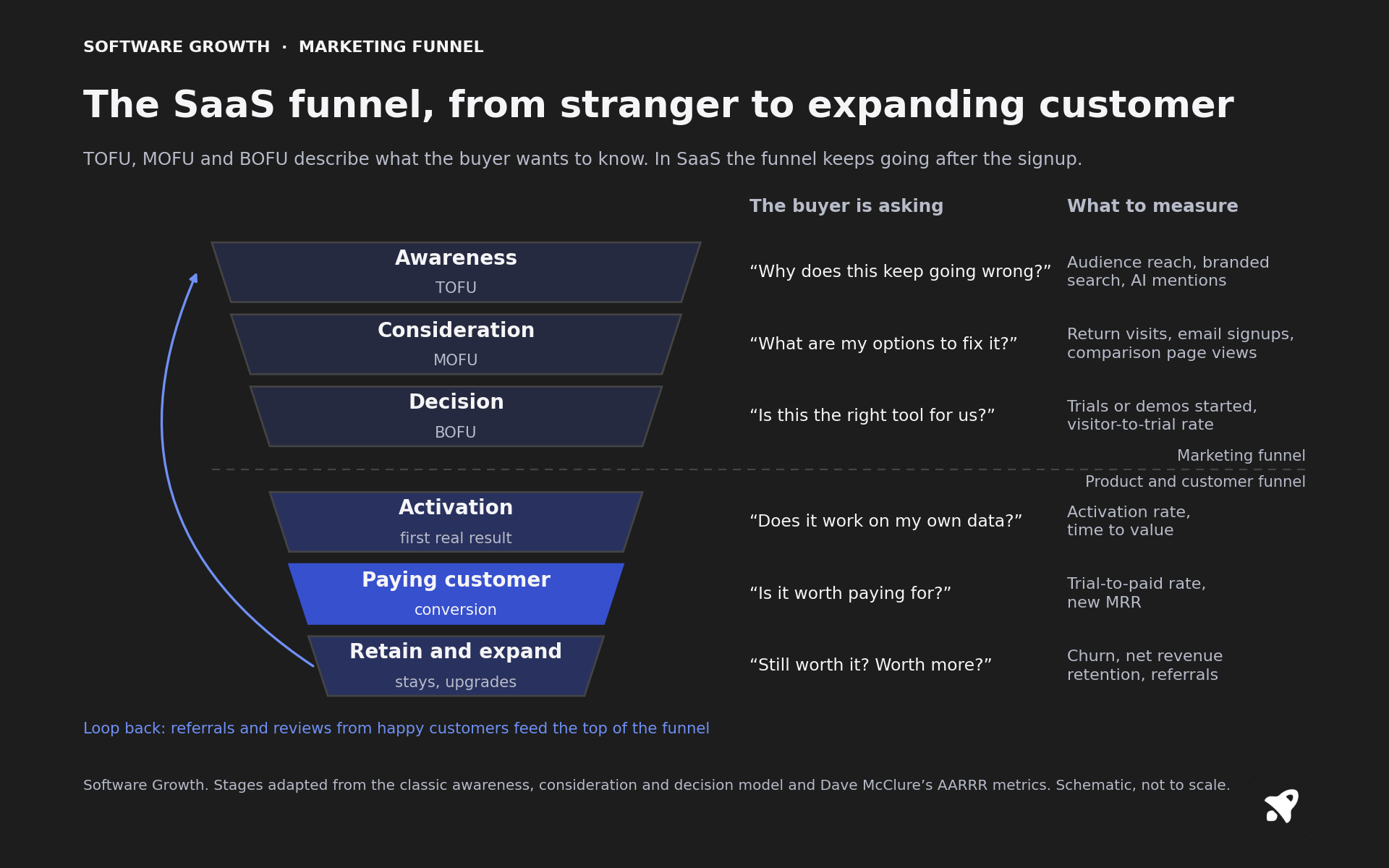
The funnel is old. The AIDA model (attention or awareness, interest, desire, action) is commonly attributed to the advertising pioneer E. St. Elmo Lewis around the turn of the 20th century, and Wikipedia's history of the purchase funnel credits William W. Townsend's 1924 book Bond Salesmanship with first drawing those steps as a funnel. Modern marketers usually collapse it to three stages, each named for what the buyer is trying to work out:
- Top of funnel (TOFU): awareness. The person has a problem or a question but isn't looking for software yet. Your job is to be useful and to be remembered. See top of funnel.
- Middle of funnel (MOFU): consideration. They know the problem and are comparing ways to solve it. Your job is to help them understand the options, including yours. See middle of funnel.
- Bottom of funnel (BOFU): decision. They are choosing between specific products. Your job is to answer the last questions about price, fit, migration and risk. See bottom of funnel.
A marketing funnel is not the same as a sales funnel, though people use the terms loosely. The marketing funnel covers how strangers become interested leads, which is the work of demand generation and lead generation. The sales funnel covers what happens once a lead talks to someone or starts a trial: qualification, demos, proposals and closing. Keeping a lead warm between the two is lead nurturing.
The SaaS funnel: trial, activation, retention and expansion
For subscription software, the sale is the start, not the end. A customer who signs up and leaves after a month is worth little, so SaaS teams extend the funnel into the product. The best-known version is Dave McClure's AARRR "pirate metrics" (acquisition, activation, retention, referral, revenue). A practical SaaS version looks like this:
- Visitor. Someone lands on your site, from search, an AI assistant, a referral, a podcast or an ad.
- Signup or trial. They start a free trial, create a free account or book a demo.
- Activation. They reach a first real result with the product on their own data, the aha moment.
- Paying customer. They convert to a paid plan.
- Retention. They keep paying month after month.
- Expansion and referral. They upgrade, add seats, and tell others, which sends new visitors back to the top.
Products sold both self-serve and through sales often run two funnels side by side; see dual funnel.
Metrics for each stage
Measure each stage as a conversion rate from the stage before it, for the same group of people over the same window. Published benchmarks are rough and vary widely, so treat them as a sanity check, not a target.
- Awareness: reach in the audience you actually sell to, branded search volume, mentions in AI answers, email subscribers.
- Consideration: return visits, views of comparison and pricing pages, newsletter or webinar signups that later start a trial.
- Visitor to trial or demo: trials or demos started ÷ unique visitors.
- Activation: users who reach your activation milestone ÷ users who signed up. In a survey of 500+ products by Lenny Rachitsky and Yuriy Timen (October 25, 2022), SaaS products averaged 36%, with a median of 30%. See activation rate.
- Trial or free to paid: new paying customers ÷ trials or free signups. Kyle Poyar's survey of 200 B2B products (February 4, 2026) found a median of 8%, with trials that require a credit card converting at 30%. See trial conversion rate.
- Retention and expansion: churn rate and net revenue retention.
Jason Cohen's rule of thumb for bootstrapped SaaS, when you have no data yet, is that about 1% of website visitors become paying customers.
You need 100 visitors to make 1 sale.
Jason Cohen / Bootstrapped CPC rule of thumb: ARPU/25 (April 29, 2013)

He uses it to set a ceiling on ad spend: if a customer is worth about 20 months of revenue and you allow a fifth of that to acquire them, you can pay up to four months of revenue per customer, which works out to a maximum cost per click of ARPU ÷ 25. A $50/month product can afford $2 a click. If your own funnel converts at half his 1%, the ceiling halves too. That's the practical value of funnel math: it tells you what each stage is worth.
Worked example
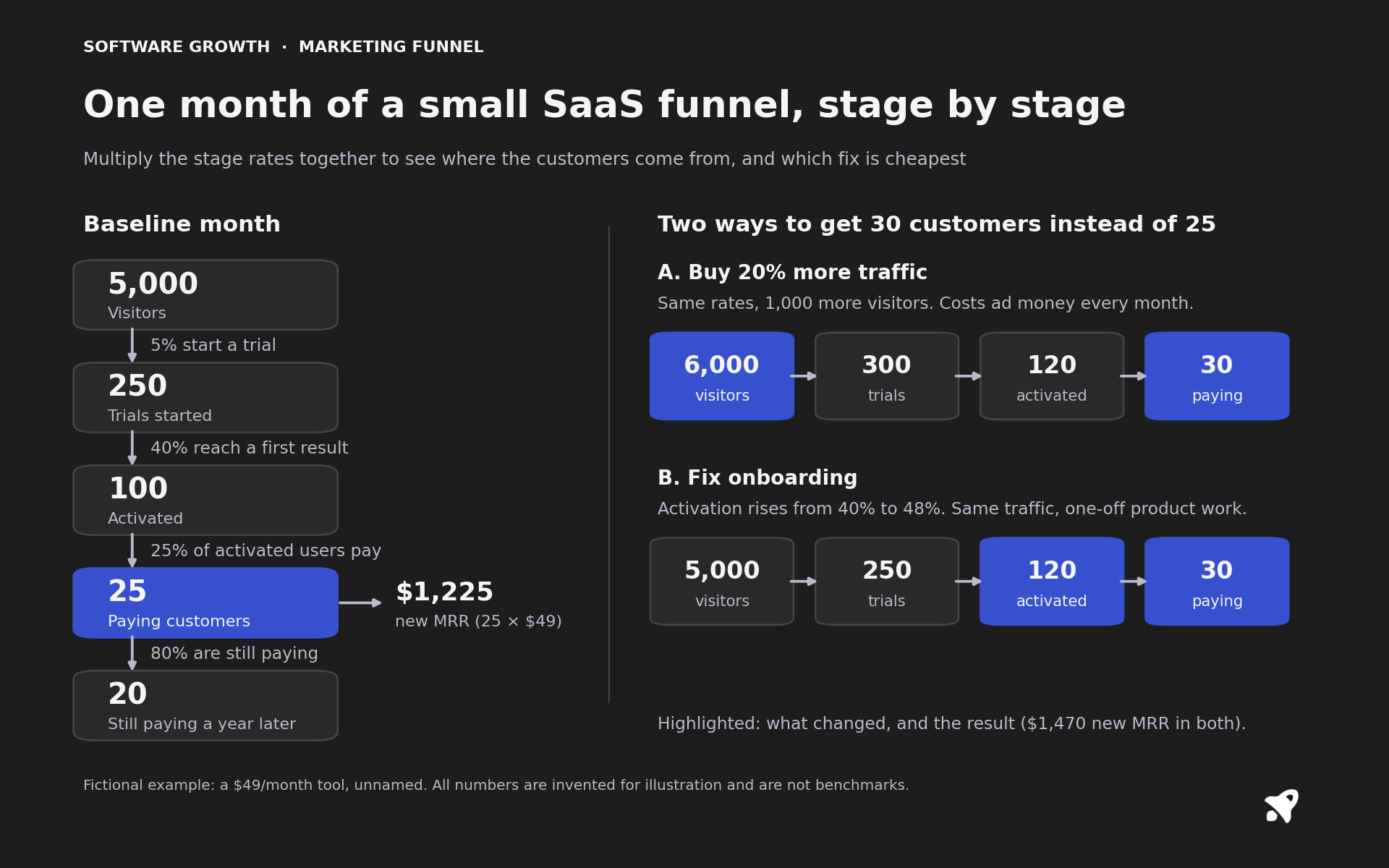
Fictional example. A two-person SaaS sells a scheduling tool for $49 a month with a 14-day trial. Here is one month:
- Visitors: 5,000.
- Trials: 5% start one. 5,000 × 5% = 250.
- Activated: 40% of trial users import their calendar and book a real appointment. 250 × 40% = 100.
- Paying: 25% of activated users pay; almost nobody who never activated does. 100 × 25% = 25 customers, or 25 × $49 = $1,225 in new MRR.
- A year later: 80% are still paying. 25 × 80% = 20.
The overall visitor-to-paid rate is 25 ÷ 5,000 = 0.5%, and trial-to-paid is 25 ÷ 250 = 10%. Multiplying the stage rates gives the same answer: 5% × 40% × 25% = 0.5%.
The founders want 30 customers a month. They could buy 20% more traffic: 6,000 × 5% × 40% × 25% = 30. Or they could get activation from 40% to 48%: 5,000 × 5% × 48% × 25% = 30. Both add $245 of new MRR a month (5 × $49), but the traffic option has to be paid for every month, while the onboarding fix is mostly one-off work. That's why the first job with any funnel is to find the leakiest stage before pouring more in at the top.
Cohen's formula tells the same story from the ad side. At $49 a month, the allowed acquisition cost is 4 × $49 = $196. At this funnel's 0.5% visitor-to-paid rate, that's $196 × 0.5% = $0.98 per click. At Cohen's assumed 1%, it would be $1.96.
Funnels, loops and flywheels
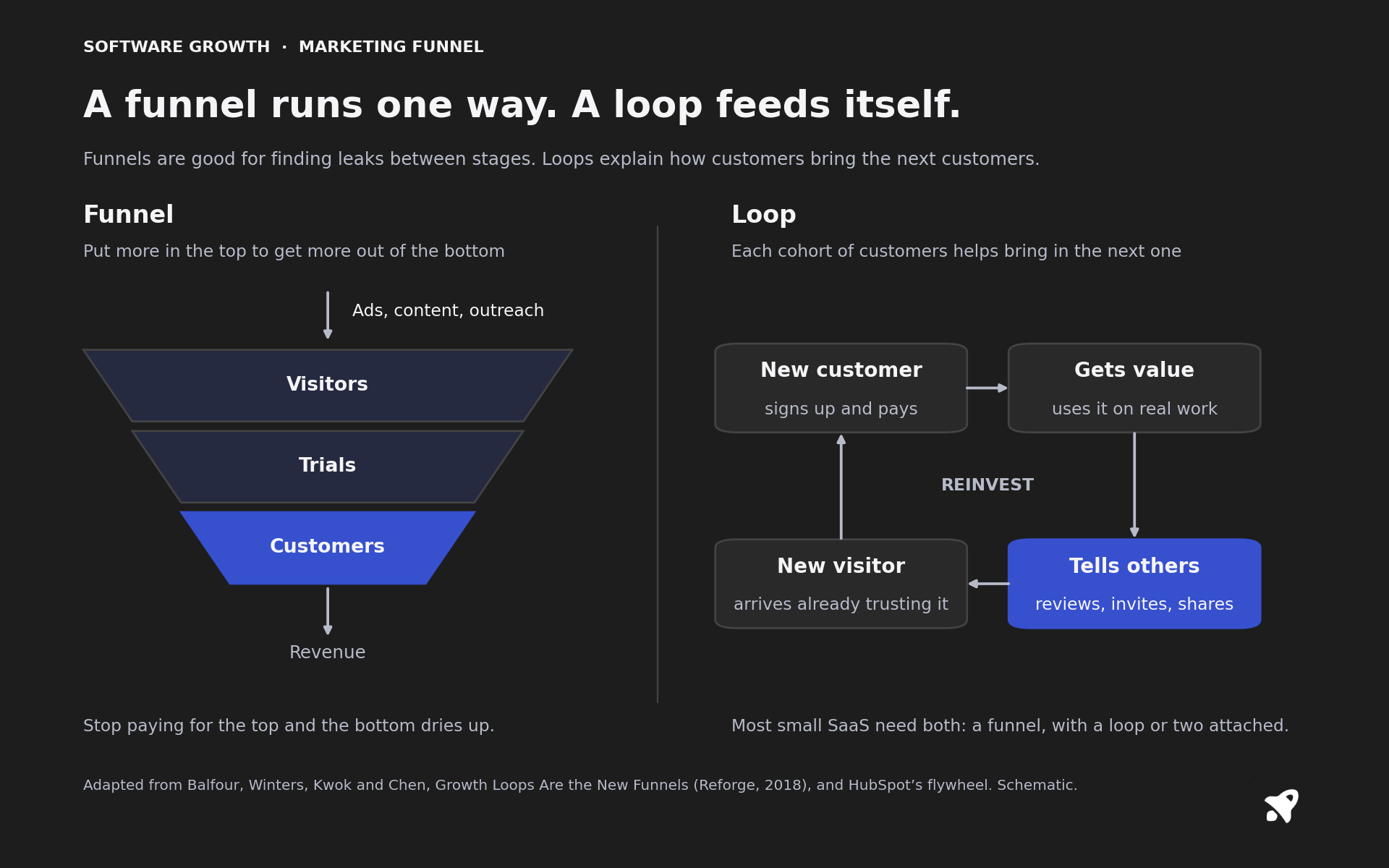
The funnel's main weakness is built into its shape: nothing comes back out of the bottom to refill the top.
Funnels operate in one direction.
Brian Balfour, Casey Winters, Kevin Kwok and Andrew Chen / Growth Loops are the New Funnels (July 31, 2018)
The Reforge authors argue that a growth loop, where the output of one cycle (a new user's content, invite or review) becomes the input for the next, describes how the fastest products grow. They also point out that funnels push teams into silos: marketing owns the top, product owns the middle, sales owns revenue, and each can hit its number at the others' expense. HubSpot made a similar case when it replaced its funnel with a flywheel, arguing that a funnel treats customers as the end of the process rather than the force that brings the next ones.
Both critiques are fair, and both have limits:
- Loops are harder to build than to draw. Many small B2B products don't have a strong built-in loop. Customers of a payroll or compliance tool rarely share its output. For them, a funnel with word of mouth attached is the honest picture.
- A funnel is still the best way to find leaks. The Reforge piece itself says the funnel explains a step within a loop. HubSpot's own flywheel page says funnel charts aren't going away.
- Real buyers don't move in a straight line. They read a comparison, leave, hear about you on a podcast, ask a colleague and come back months later. Use the funnel to measure cohorts, not to describe any single buyer's path.
A sensible default for a bootstrapped SaaS: measure a funnel, and deliberately build one or two loops into it, such as reviews, referrals, shared reports or invites.
How a bootstrapped SaaS builds its first funnel
MicroConf's write-up of Asia Orangio's talk on landing the first 100 customers gives the order most founders get backwards: start at the bottom. People at the bottom of the funnel already have the pain your product solves, so they are the easiest to convert and the fastest to teach you who your customer is.
- Define five events. Visit, signup or demo request, activation, first payment, still paying after 90 days. Track them per weekly or monthly cohort, even in a spreadsheet.
- Build the bottom first. A clear pricing page, comparison pages against the tools people switch from, an onboarding flow that gets users to a first result. See bottom of funnel.
- Talk to the people who converted. Ask what they were doing before they searched, where they looked and what they compared you with. Their answers tell you which channels and messages to use further up.
- Fix the leakiest stage. As the worked example shows, a better activation rate is often worth more than more traffic.
- Then add the middle and top. Guides that compare approaches, then educational content and community work for people who don't have the problem yet but look like your customers.
Content for each stage
Funnel labels describe the reader's intent, not a content format. A webinar can be top, middle or bottom of funnel depending on what it covers. As a starting map for a SaaS:
- Top: educational guides on the problem, podcasts and video, free tools and templates, community answers. Goal: be found and remembered by the right people.
- Middle: comparisons of approaches, "best X for Y" roundups, case studies, email courses and webinars. Goal: help the buyer frame the decision.
- Bottom: pricing, versus and alternatives pages, migration guides, integration and security pages, demos and the trial itself. Goal: remove the last reasons not to start.
The three stage pages go deeper on each: TOFU, MOFU and BOFU.
What changed in 2026: AI search and the top of the funnel
The biggest recent change to the funnel is at the top. More buyers now start their research by asking an AI assistant, and the assistant answers in place of sending them to ten websites.
- Fewer clicks from search. In a Pew Research Center analysis of 900 US adults' browsing (July 22, 2025), people who saw a Google AI summary clicked a regular result in 8% of visits, against 15% for those who didn't. They clicked a link inside the summary in 1% of visits.
- Organic traffic is down, but not only because of AI. Kevin Indig's analysis of Similarweb data for 10,000 domains each in the US and France (October 26, 2026) shows US organic search visits down 13.2% from August 2024 to August 2026, with publishers hit hardest. He argues bigger ad blocks and algorithm updates explain part of the drop, and that AI referrals are still only about 0.5% of total visits.
- AI search became a core channel. In Kyle Poyar's 2026 State of B2B GTM report (October 14, 2026), 39% of 300 go-to-market leaders called AI search a core channel, up 11 points in a year.
- Founders are seeing it first-hand. In episode 856 of Startups for the Rest of Us (October 27, 2026, from 13:30), Rob Walling says several first-time MicroConf attendees told him ChatGPT had recommended the event. He also says cold search traffic has been worth far less to MicroConf and TinySeed than someone who found them through a YouTube video.
AI traffic is a red herring.
Kevin Indig / Organic traffic is down, but it's not all AI (October 26, 2026)
Indig's point is that the clicks from AI are too few to judge the channel by. What matters is whether your product is named when buyers research your category. That changes the funnel in three ways:
- Part of the top and middle now happens where you can't see it. A buyer can go from "what's the best scheduling tool for a small clinic?" to a shortlist inside one chat. Some arrive at your pricing page already in the decision stage; many never visit at all.
- Awareness metrics need to include AI mentions. Track how often assistants name you for a fixed set of category questions, and add "AI assistant" to your "How did you hear about us?" question. See answer engine optimization.
- Low-intent traffic matters less. Aja Frost writes (September 16, 2026) that some of HubSpot's widely reported blog traffic loss was in topics that "generated traffic but not conversions", which the team had already stopped updating. The traffic that AI takes first is often the traffic that converted least.
Common mistakes
- Measuring stage conversion without cohorts, so this month's trials are divided into last month's signups.
- Pouring money into the top before the bottom converts. More visitors into a leaky funnel mostly buys more churn.
- Counting every download or webinar signup as a qualified lead.
- Rewarding each team for its own stage, so marketing brings in cheap signups that never activate.
- Stopping the funnel at the first payment and ignoring retention and expansion.
- Judging top-of-funnel work by last-click attribution, especially now that much of it happens inside AI answers.
- Treating the funnel as a literal path. Buyers loop back, skip stages and involve colleagues.
Listen, watch and read next
- Read: Growth Loops are the New Funnels, Brian Balfour, Casey Winters, Kevin Kwok and Andrew Chen, Reforge (July 31, 2018). The clearest case for where funnels fall short.
- Read: Bootstrapped CPC rule of thumb: ARPU/25, Jason Cohen. Funnel math turned into an ad budget, with a formula you can plug your own numbers into.
- Watch: The BEST Sales Funnel For Your SaaS (new data changed my advice), Rob Walling (July 6, 2025). Ten minutes on trial funnels and free trial versus freemium, using data from MicroConf's State of Independent SaaS report.
- Listen: Episode 856: Key Learnings from MicroConf Europe 2026, Startups for the Rest of Us (October 27, 2026). The AI SEO talks recap from 13:30 is the most current founder view of the new top of the funnel.
- Read: Organic traffic is down, but it's not all AI, Kevin Indig (October 26, 2026). Three years of traffic data and a sober take on what AI is and isn't taking.
- Read: What's working in B2B GTM in 2026, Kyle Poyar (October 14, 2026). Which channels 300 GTM leaders rely on now, and which ones are saturated.
Related terms
- Top of funnel (TOFU)
- Middle of funnel (MOFU)
- Bottom of funnel (BOFU)
- Sales funnel
- Lead generation
- Demand generation
- Lead nurturing
- Conversion rate
- Growth loop
- Flywheel
- Answer engine optimization (AEO)
Sources
- Bootstrapped CPC rule of thumb: ARPU/25, Jason Cohen, A Smart Bear, April 29, 2013
- Growth Loops are the New Funnels, Brian Balfour, Casey Winters, Kevin Kwok and Andrew Chen, Reforge, July 31, 2018
- The Flywheel Model, HubSpot
- Purchase funnel and AIDA (marketing), Wikipedia
- Actionable tactics and strategies to land your first 100 customers, MicroConf (talk by Asia Orangio), January 26, 2022
- What is a good activation rate, Lenny Rachitsky and Yuriy Timen, Lenny's Newsletter, October 25, 2022
- A new look at free-to-paid conversion, Kyle Poyar, Growth Unhinged, February 4, 2026
- What's working in B2B GTM in 2026, Kyle Poyar, Growth Unhinged, October 14, 2026
- Inside 12 months of AI search experiments, Aja Frost, Growth Unhinged, September 16, 2026
- Organic traffic is down, but it's not all AI, Kevin Indig, Growth Memo, October 26, 2026
- Google users are less likely to click on links when an AI summary appears in the results, Pew Research Center, July 22, 2025
- Episode 856: Key Learnings from MicroConf Europe 2026, Rob Walling and Derrick Reimer, Startups for the Rest of Us, October 27, 2026 (video)
- The BEST Sales Funnel For Your SaaS (new data changed my advice), Rob Walling, July 6, 2025