Middle of Funnel (MOFU)
The consideration stage of the marketing funnel, where buyers compare ways to solve a problem before choosing a product.
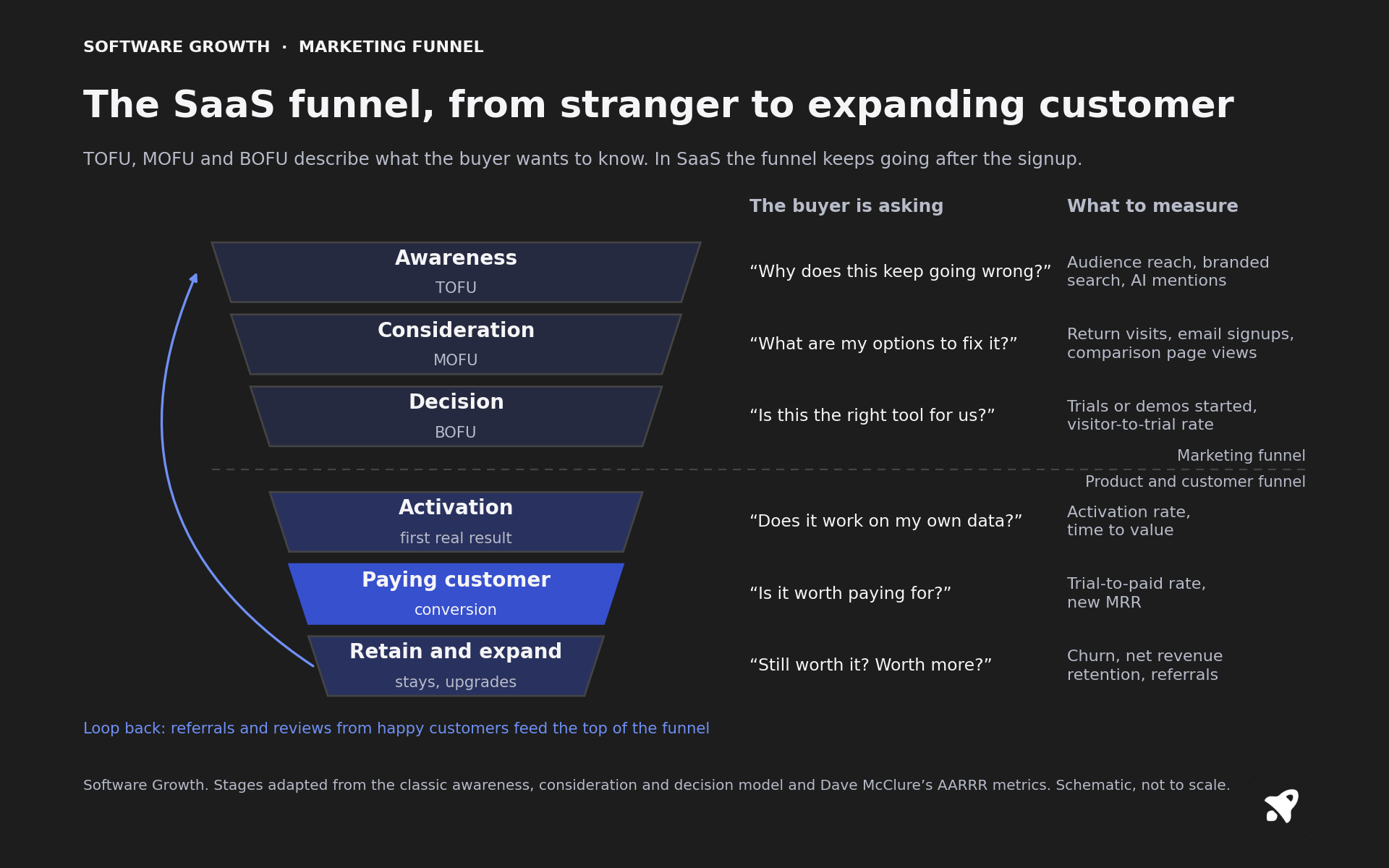
Middle of funnel (MOFU) is the consideration stage of the marketing funnel: the buyer knows they have a problem and is comparing ways to solve it, before choosing a specific product. The one-line rule: MOFU work helps the buyer decide what a good solution looks like, ideally in terms that make your product an obvious candidate.
It sits between the top of funnel (awareness of the problem) and the bottom of funnel (choosing a product), the stages often shortened to TOFU, MOFU and BOFU. For the whole model, the SaaS stages after signup and a worked example with numbers, see the marketing funnel guide.
What the buyer needs in the middle
The MOFU buyer is asking "what are my options to fix this?". They are learning the vocabulary of the category, the trade-offs between approaches and what to watch out for. They are rarely ready to talk to sales, and many are researching on behalf of a team.
Example: a customer-support SaaS publishes a guide comparing shared inboxes, ticketing systems and live chat. A support manager can work out which model fits the team's volume and responsibilities. The company then offers a short product walkthrough for that model, instead of treating every reader as ready to sign a contract.
Strong consideration content answers hard questions even when the honest answer is that your product isn't the best choice. Buyers notice, and the ones who do fit trust the rest of what you say.
MOFU content that works for a SaaS
- Approach comparisons. "Spreadsheet vs dedicated tool", "per-seat vs usage-based", "build vs buy". These frame the decision before brand names come in.
- "Best X for Y" roundups. An honest list for your category that includes competitors and claims the segment you really win.
- Case studies. Proof that a business like the reader's solved the problem. In episode 852 of Startups for the Rest of Us (September 29, 2026, from 13:45), Ruben Gamez says his team now asks for the case study during the sale, in exchange for a discount.
- Templates, calculators and email courses. Useful on their own, and a reason to stay in touch. Following up with useful material over weeks is lead nurturing.
- Webinars and live demos of a workflow. Funnel labels describe intent, not format: a webinar can be top, middle or bottom depending on what it covers.
That's when you have the most leverage.
Ruben Gamez / Startups for the Rest of Us, episode 852 (September 29, 2026), on asking for a case study while the customer is buying
How to measure it
MOFU is the hardest stage to measure, because people move back and forth and rarely convert in the same session.
The customer journey isn't linear.
MicroConf / Actionable tactics and strategies to land your first 100 customers (January 26, 2022)
- Return visits from people who first came for top-of-funnel content.
- Email and newsletter signups, followed by cohort: what share start a trial within 30, 60 or 90 days?
- Views of comparison, case study and pricing pages by people who haven't signed up yet.
- Time from first visit to trial, which tells you how long your middle actually is.
Be careful with lead scores. A downloaded guide is interest, not intent, so don't count every download as a marketing qualified lead. Track what people learn and do next, and give them a clear path into a detailed evaluation. HubSpot's comparison of demand and lead generation is a useful primer on the difference; see also demand generation and lead generation.
What changed in 2026: the middle moved into AI answers
The MOFU question "what are my options?" is exactly what people now ask AI assistants. The assistant reads review sites, roundups, comparison pages, Reddit and YouTube, then hands back a short list. Ross Hudgens explains in episode 853 (October 6, 2026, from 6:33) why honest "best category" roundups are worth publishing for this reason. Two consequences for a small SaaS:
- Your consideration content has two readers. A buyer, and a model that will summarize you for buyers you never meet. Be specific about who you're for, what you cost and where you're weak.
- Messaging matters more. Kyle Poyar's 2026 State of B2B GTM report (October 14, 2026) names positioning and messaging as the next battleground, because every company sounds the same. Ploy co-founder Bryant Chou, quoted in the report, says the answer comes from customers.
The voice of your customer is your messaging.
Bryant Chou / quoted in What's working in B2B GTM in 2026 (October 14, 2026)
Use the words customers used in interviews and reviews in your comparison pages and guides. They are the words other buyers will use when they ask an assistant. See answer engine optimization for the tactics.
Common mistakes
- Jumping from a top-of-funnel article straight to "Book a demo", with nothing in between.
- Treating every download as a sales-ready lead.
- Comparison content that pretends you are best for everyone.
- Writing in your own internal jargon instead of the words buyers use.
- Letting roundups and comparisons go stale, with old prices and features.
Listen, watch and read next
- Watch: How to Become the SaaS That AI Recommends, Rob Walling with Ross Hudgens, Startups for the Rest of Us, episode 853 (October 6, 2026). Roundups from 6:33, the core of AI-era consideration content.
- Listen: Episode 852: Getting Big Name Customer Case Studies, Rob Walling with Ruben Gamez (September 29, 2026). How a small company gets well-known customers to agree to a case study, from 13:45.
- Read: What's working in B2B GTM in 2026, Kyle Poyar (October 14, 2026). Survey data on channels, plus the case for investing in positioning and messaging.
- Read: Actionable tactics and strategies to land your first 100 customers, MicroConf. A founder-sized way to build the funnel from the bottom up, including the customer research questions that feed MOFU content.
Related terms
- Marketing funnel
- Top of funnel (TOFU)
- Bottom of funnel (BOFU)
- Lead nurturing
- Buyer persona
- Positioning
Sources
- Actionable tactics and strategies to land your first 100 customers, MicroConf (talk by Asia Orangio), January 26, 2022
- Episode 852: Getting Big Name Customer Case Studies and More Listener Questions, Rob Walling and Ruben Gamez, Startups for the Rest of Us, September 29, 2026 (video)
- Episode 853: How to Become the SaaS That AI Recommends, Rob Walling with Ross Hudgens, Startups for the Rest of Us, October 6, 2026 (video)
- What's working in B2B GTM in 2026, Kyle Poyar, Growth Unhinged, October 14, 2026
- Demand generation vs. lead generation, HubSpot