Lead Generation
Finding potential buyers and getting them to identify themselves. Judge it by cost per customer, not cost per lead: cost per lead ÷ the share of leads that become customers.
Lead generation is how a business finds people who might buy and gets them to identify themselves: a demo request, a trial signup, a reply to an email, an email address given in exchange for a useful resource. A lead is someone you can follow up with by name; a customer is someone who paid. The rule that keeps it honest: cost per customer = cost per lead ÷ the share of leads that become customers.
For a B2B SaaS founder, lead generation is the front half of growth. It decides who enters your funnel, what you pay to get them there and how much sales or onboarding work each one needs. The mistake is to treat it as a volume game. A thousand cheap leads that never buy cost more than twenty expensive ones that do. This guide covers what counts as a lead, inbound versus outbound, which channels fit which deal size, lead magnets, how to measure cost and quality, and what is working in late 2026.
What counts as a lead
A lead starts when an anonymous visitor becomes a known person. After that, most B2B teams sort leads into stages, and each stage is a decision someone makes about them:
- Lead. Gave you a name or email: filled in a form, downloaded a guide, booked a call, replied to outreach.
- Marketing qualified lead (MQL). Fits your ideal customer profile and has shown real interest, such as visiting the pricing page or coming back several times. Marketing judges they are worth sales time.
- Sales qualified lead (SQL). Someone in sales has talked to them and confirmed a need, a budget and some timing.
- Product qualified lead (PQL). Signed up for a free plan or trial and used the product in a way that predicts paying, such as inviting teammates or hitting a plan limit.
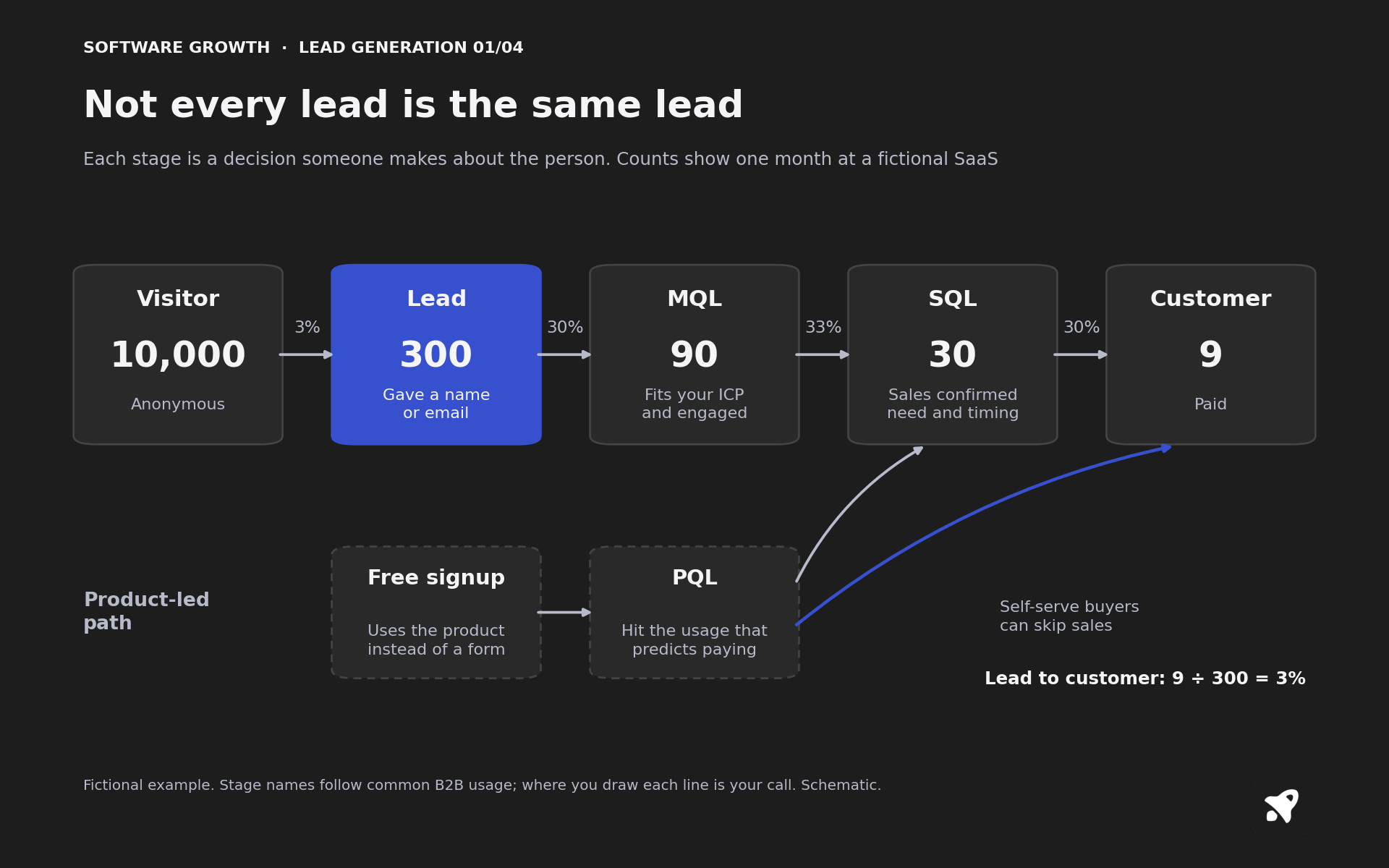
Where you draw each line is your call, and the definitions only help if they are written down. The process of sorting is lead qualification, and putting numbers on it is lead scoring. A solo founder needs only two lines: "worth a personal email" and "goes into the nurture sequence".
Lead generation is also narrower than demand generation. Demand generation makes more of the right people aware that the problem and your product exist. Lead generation captures the ones who are ready to raise a hand. You need both, but only lead generation shows up in a form submission report.
Inbound, outbound and product-led
There are three ways a lead can start:
- Inbound. The buyer finds you, through search, AI assistants, content, social posts, referrals or ads, and raises their hand. Leads cost less in human time and arrive already interested, but you can't turn the volume up on demand.
- Outbound. You pick the account and reach out first, through cold email, LinkedIn messages, calls, events or direct mail. You control who you talk to and how many, but each conversation costs real time, and most people say no or don't answer. See outbound sales.
- Product-led. The product is the lead magnet. People sign up for a free trial or free plan, and usage tells you who is worth contacting. Elena Verna wrote in September 2026 that giving the product away for free is one of the biggest growth levers at Lovable, even though every free use costs it money.
Most companies end up running more than one. In Kyle Poyar and Maja Voje's 2026 State of B2B GTM survey of 300 software go-to-market leaders, respondents had 5.5 core channels on average. The question is which one leads, and the biggest factor is your deal size.
Which channels fit which deal size
The more a customer pays you per year, the more human time you can spend to win each one. That one fact sorts most of the channel choices.
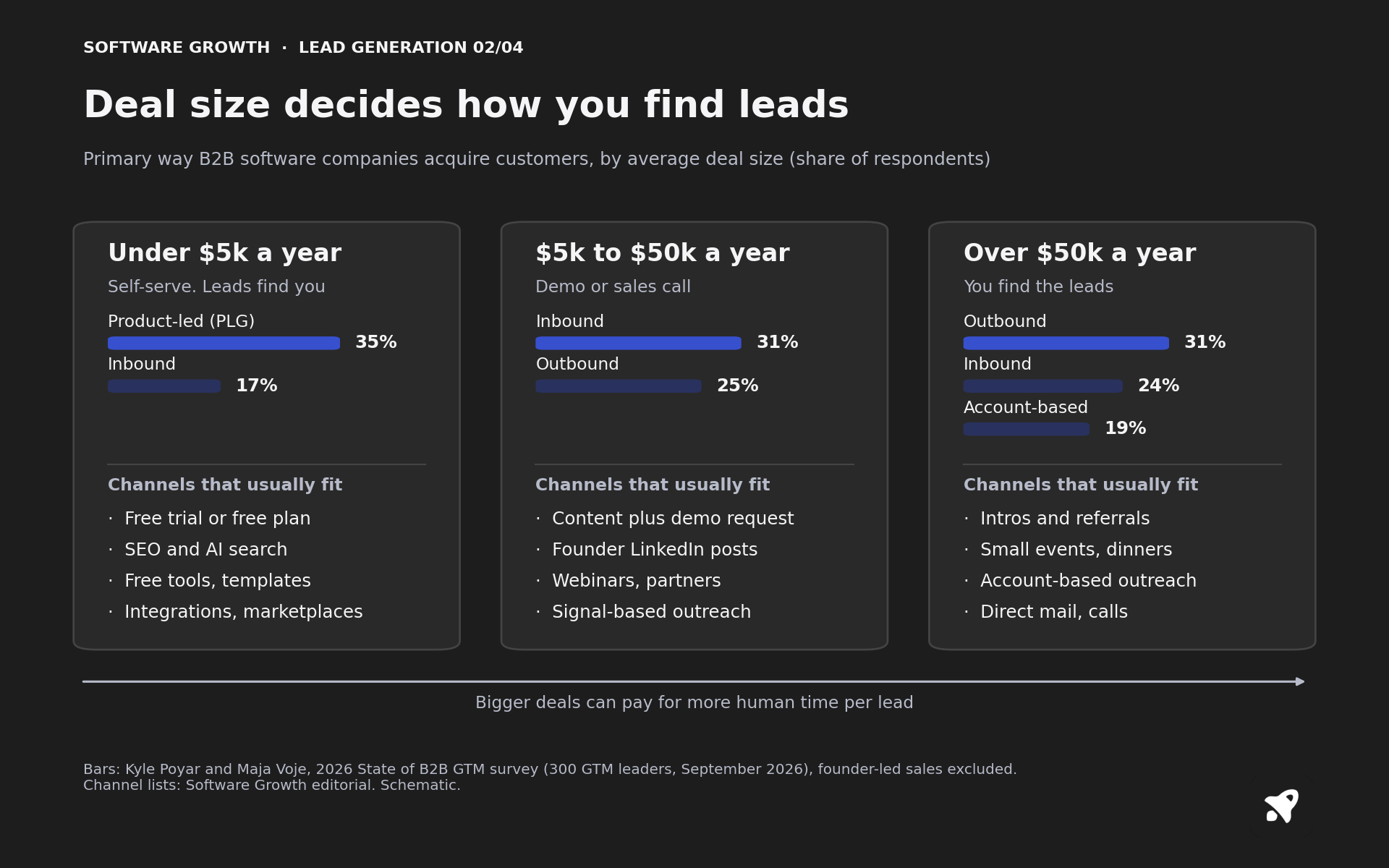
Poyar and Voje's data, which excludes founder-led sales, shows the pattern clearly. Companies with deals under $5k a year mostly lead with product-led growth (35%) or inbound (17%). Deals between $5k and $50k lean on inbound (31%) or outbound (25%). Deals over $50k lead with outbound (31%), inbound (24%) and account-based selling (19%).
In practice:
- Low price, self-serve (under about $300 a month). You can't afford a sales call per customer, so leads have to find you and convert without help. Lean on SEO, AI search, free tools and templates, integration marketplaces and the product itself. At MicroConf, founder John Ndege gives a rough line: under $300 a month in revenue per user points to content marketing, and over $300 means you can hire a sales team (per the talk's video description, at 10:35).
- Mid-market ($5k to $50k a year). A mix. Content and search bring in demo requests, founder posts on LinkedIn build trust, and targeted outreach fills gaps in a specific segment. This is where lead stages and a CRM start to pay off.
- Large deals (over $50k a year). You can afford to choose the accounts. Intros, small events, account-based marketing and even mailed gifts become rational because one deal pays for a lot of effort.
Rob Walling made the same point about direct mail in episode 846 of Startups for the Rest of Us (August 18, 2026, from 15:55): it can work, but "you need a high enough annual contract value to justify it". He adds that you need cash up front, because many letters or gift boxes won't work while you learn.
The bootstrapper's version
For founders without outside funding, Walling's advice runs against the instinct to add channels. When a listener with eight channels and $65k MRR asked what to do next, Walling put "drive more leads" last. First, add a "how did you hear about us?" question at signup so you know which channels work. Then work on churn, because a high churn rate caps growth no matter how many leads you add. Only then pick the one or two channels with the most potential and get help to make them work better.
if you’re going to build SaaS, build your network, not your audience.
Rob Walling / Startups for the Rest of Us, episode 802 (October 14, 2025), from 6:46

He said it about affiliates: the partners who send you the most leads are people with audiences, and you reach them through relationships, not cold pitches. The 2026 survey data below points the same way. For the full set of options, see growth channels.
What's working in 2026
Poyar and Voje ran their survey in September 2026, and the typical respondent had $1 million to $10 million in ARR and an average contract value of $5k to $50k. Their findings, published October 14, 2026, are the most current picture of B2B lead generation:
- Networks and events beat everything. The single most effective channels were network and introductions (#1) and intimate events (#2). Network and intros was also the most common core channel, used by 62%.
- Cold outreach is "officially oversaturated". That is Poyar's verdict, adding that AI SDRs haven't lived up to the early hype. Cold calling fell to the bottom of the list, and Poyar wonders whether that makes it less crowded for the few who still do it.
- AI search went mainstream. 39% now call AI search a core channel, up 11 points in a year, the biggest jump of any channel. Companies with deals under $5k and those above $50M ARR see the best results. SEO is still core for 51%.
- Founders on LinkedIn. Posting by founders and employees is core for 50%.
- Founder-led sales lasts. It was the leading motion overall and the main one for 44% of companies under $1M ARR.
- Signals are popular but messy. The buying signals teams act on most are content engagement (52%), website visits (42%) and product usage (40%).
Popular doesn’t mean effective, and sometimes GTM channels lose ROI once everyone adopts them.
Kyle Poyar / What's working in B2B GTM in 2026 (October 14, 2026)
Seth Godin made a similar point a week later, writing about why everyone piles onto the same trend.
Just because someone organized a parade doesn’t mean you have to be in it.
Seth Godin / The relentless math of bandwagoning (October 23, 2026)
For lead generation, that means two things. When every competitor runs the same automated sequence, a warm intro or a dinner with ten buyers stands out. And AI search is the new inbound channel to learn. In episode 853 (October 6, 2026), Ross Hudgens of Siege Media walks Walling through it: publish "best tools for X" roundups that position you as best for one specific segment, write comparison pages against competitors, ask customers for reviews on sites like G2, and track how often assistants name you with a prompt tracker. The answer engine optimization guide covers the details.
One caution about AI search as a lead source: many buyers will see your name in an answer, never click, and arrive later by typing your URL. Amanda Natividad's talk at MicroConf 2026 on zero-click marketing argued that attribution is more broken than ever, as Walling and Derrick Reimer recapped in episode 830 (April 28, 2026). Expect more leads to show up as "direct" and ask people how they heard about you.
Lead magnets
A lead magnet is something useful you offer in exchange for contact details. It is the most common inbound lead source for B2B SaaS, and the easiest one to get wrong.
Lead magnets that tend to work are close to the job your product does:
- Templates and checklists the buyer will use this week (a payroll compliance checklist, a project brief template).
- Free tools and calculators that solve a small version of the problem, such as a pricing calculator, a grader or a generator.
- Benchmarks and original data from your own customers or a survey. These can also earn links and AI citations.
- Webinars and workshops, which suit higher-priced products where a live conversation builds trust.
- The product itself, through a free plan or trial. For self-serve SaaS, this is usually the best one.
Two decisions matter most. First, gate or not: a form gets you an email address but cuts how many people read the content, and AI assistants can't read what sits behind a form. Many teams now publish the core content openly and gate only the take-away version, such as the editable template or the full dataset. Second, what happens next: a download with no follow-up is a wasted lead. Plan the lead nurturing sequence before you launch the magnet, and decide which actions turn a downloader into an MQL.
How to measure cost per lead and lead quality
Lead generation needs three numbers per channel, measured over the same period:
- Cost per lead (CPL) = channel cost ÷ new leads. Count ad spend, tools, contractors and your own time.
- Lead-to-customer rate = new customers from those leads ÷ those leads. Give leads enough time to close: a few weeks for self-serve, a full sales cycle for larger deals.
- Cost per customer = CPL ÷ lead-to-customer rate. This is your customer acquisition cost for that channel.
To know what you can afford, start from the most you can pay per customer and work backward. Jason Cohen's rule of thumb for bootstrapped SaaS, from his essay on bootstrapped cost per click, is that the cost to acquire a customer should be no more than four months of revenue. Combine that with your lead-to-customer rate and you get a maximum cost per lead.
You need 100 visitors to make 1 sale.
Jason Cohen / Bootstrapped CPC rule of thumb: ARPU/25 (April 29, 2013)

Cohen's 1% visitor-to-customer figure is a pre-data guess for young companies, and he says to replace it with your own numbers as soon as you have them. The same goes for the four-month ceiling: funded companies often accept 12 months or more.
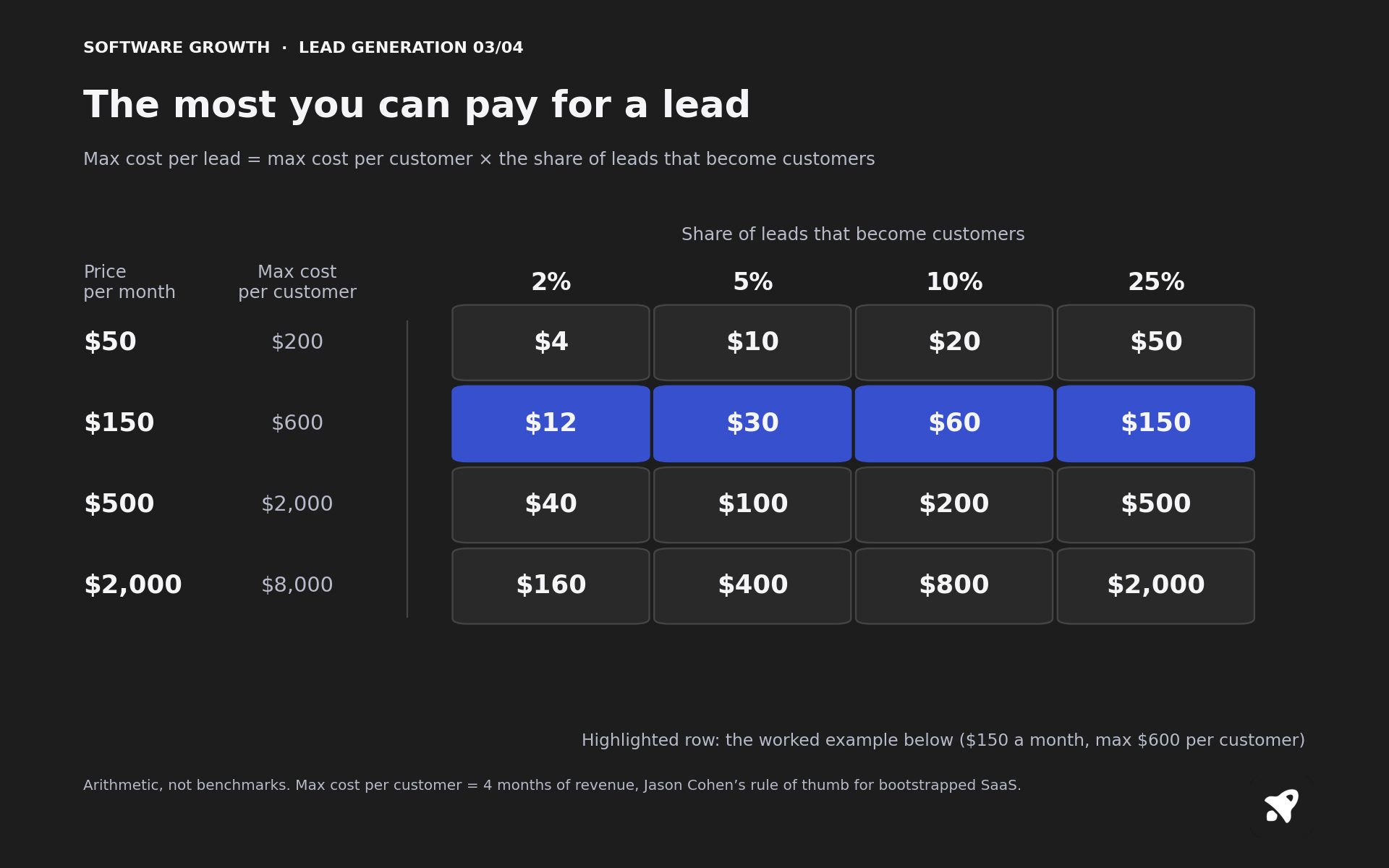
Cost tells you half the story. To judge lead quality, track these by channel:
- Fit rate: the share of leads that match your ideal customer profile. Low fit means the channel is reaching the wrong people, however cheap it is.
- Stage conversion: lead to MQL, MQL to SQL, SQL to customer. A drop at one stage points to the problem: targeting, messaging or sales.
- Revenue per lead: new MRR from the channel ÷ leads. This catches channels that bring smaller customers.
- Retention by source: a channel that brings customers who cancel in month three is worse than its CAC suggests. Check churn rate by acquisition source once you have a few months of data.
- Disqualification reasons: read why leads were rejected. "Student", "competitor", "too small" and "no budget" each call for a different fix.
If you grow leads month over month, lead velocity rate tracks the trend, but only count leads that pass your quality bar.
Worked example: four channels, one budget
A fictional booking tool for physiotherapy clinics charges $150 a month. Using Cohen's ceiling, the most it can pay for a customer is 4 × $150 = $600. In one month the founder runs four channels and counts their own time at $100 an hour:
- Gated checklist promoted with LinkedIn ads. $2,000 in ad spend brings 200 leads, so CPL = $2,000 ÷ 200 = $10. Two become customers: 2 ÷ 200 = 1%. Cost per customer = $10 ÷ 1% = $1,000.
- Google search ads to a demo form. $2,400 brings 40 leads: CPL = $60. Six customers: 6 ÷ 40 = 15%. Cost per customer = $60 ÷ 15% = $400.
- Cold email. $300 in tools and data plus 8 hours of founder time ($800) = $1,100. Ten positive replies: CPL = $110. One customer: 10%. Cost per customer = $1,100.
- Intros and one local physio association event. $600 for the event plus 12 hours ($1,200) = $1,800. Twelve leads: CPL = $150. Four customers: 4 ÷ 12 = 33%. Cost per customer = $1,800 ÷ 4 = $450.
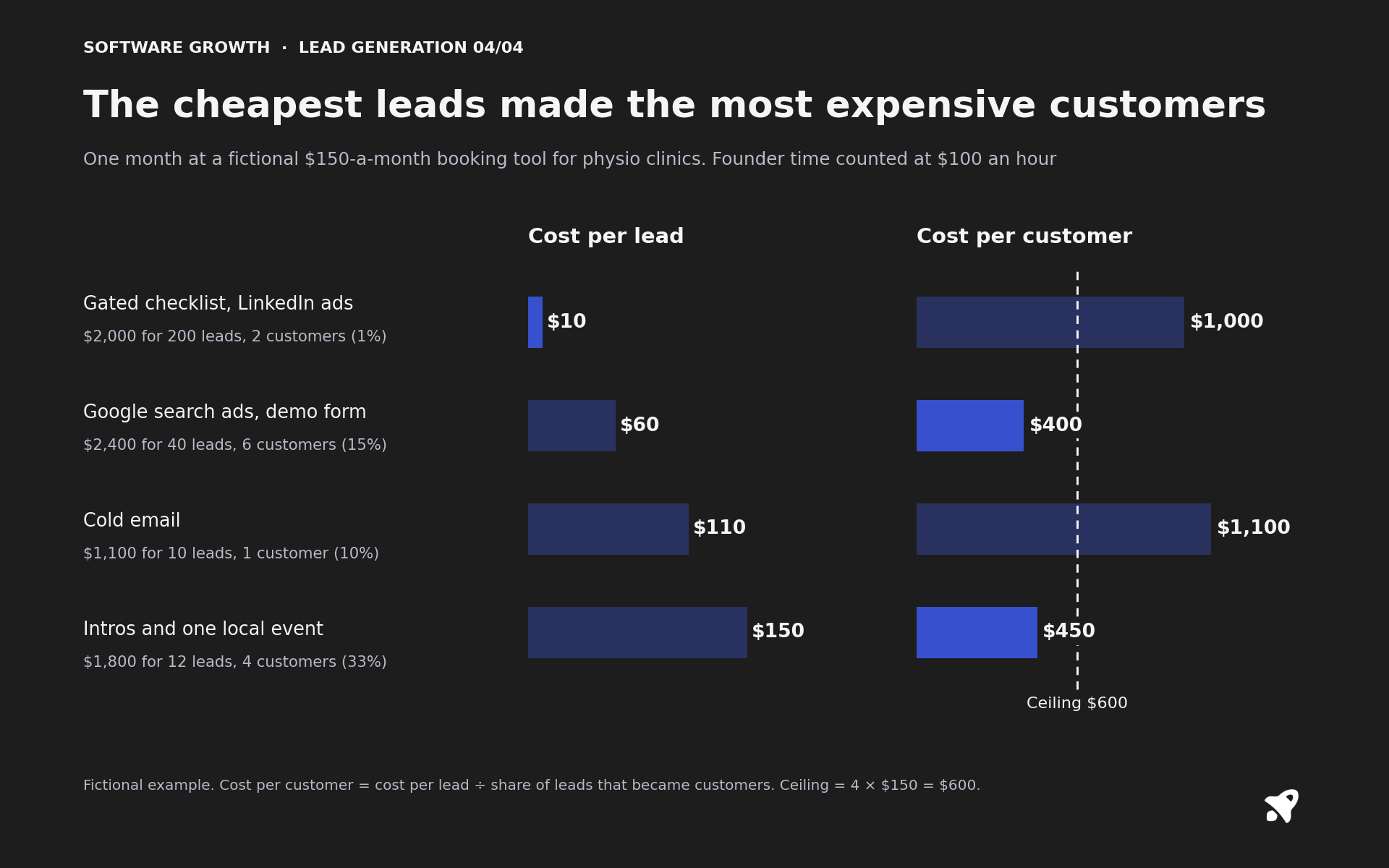
The channel with the cheapest leads produced the most expensive customers. On a CPL report, the checklist looks six times better than search ads. Measured per customer, it costs two and a half times as much and sits well above the $600 ceiling. Blended across all four channels, the month looks fine: $7,300 ÷ 13 customers = $562 per customer. That average hides two channels that lose money.
What the founder should do next:
- Shift budget toward search ads and intros, the two channels under the ceiling, and check whether they still hold at higher spend.
- Give the checklist leads time. Check again at 90 days with a nurture sequence running. If the rate stays near 1%, the most it can pay is $600 × 1% = $6 per lead, so the ads would need to get 40% cheaper or the checklist would need to attract better-fit people.
- Cut or rework cold email. At a 10% close rate the maximum CPL is $60, and it costs $110.
With one or two customers per channel, these numbers are noisy. Treat a single month as a hypothesis and confirm it over a quarter before moving most of the budget.
Common mistakes
- Reporting leads instead of customers. Lead counts are easy to inflate. Report cost per customer by channel, with lead numbers as the supporting detail.
- Leaving your own time out of CPL. Cold email, events and community work look free until you price the hours.
- Running too many channels at once. Each channel takes months to learn. Pick one or two that fit your deal size and get good at them.
- Copying the channel everyone talks about. If every competitor runs the same automated sequence, yours gets ignored with theirs.
- Gating everything. A form on every page cuts reach and keeps your best content out of AI answers.
- No follow-up plan. Interest fades when nobody replies. Decide who follows up, how and when, before you launch a campaign.
- Buying lists. Purchased contacts hurt email deliverability, may break privacy law in your buyers' countries, and rarely contain people looking for your product.
Listen, watch and read next
- Read: What's working in B2B GTM in 2026, Kyle Poyar with Maja Voje (October 14, 2026). The survey behind the channel rankings in this guide. The free 40-page report has the breakdown by deal size.
- Listen: Episode 802: Marketing not scaling, where to publish content, and more, Startups for the Rest of Us (October 14, 2025). Walling's answer to a founder with eight channels and a plateau, from 6:46.
- Watch: Not sure how to market your SaaS? Start here, Rob Walling (March 29, 2026). Five B2B SaaS marketing approaches he has seen work and how AI is changing each one.
- Watch: How one daily habit took MRR from $230 to $10K, John Ndege at MicroConf (published September 21, 2026). Sales math and the $300-a-month rule at 10:35.
- Listen: Episode 853: How to become the SaaS that AI recommends, Rob Walling with Ross Hudgens (October 6, 2026). The newest inbound channel, with first steps for small teams at 25:38.
- Read: Bootstrapped CPC rule of thumb: ARPU/25, Jason Cohen. The arithmetic for what you can afford per customer, per lead and per click.
Related terms
- Lead magnet
- Lead qualification
- Lead nurturing
- Cost per lead (CPL)
- MQL (Marketing qualified lead)
- SQL (Sales qualified lead)
- PQL (Product qualified lead)
- Demand generation
- Growth channels
- Cold email
- Outbound sales
- AEO (Answer engine optimization)
Sources
- What's working in B2B GTM in 2026, Kyle Poyar, Growth Unhinged, October 14, 2026 (survey with Maja Voje, GTM Strategist)
- Episode 802: Marketing Not Scaling, Where to Publish Content, and More Listener Questions, Rob Walling, Startups for the Rest of Us, October 14, 2025
- Episode 846: Snail Mail, Cold Calling, Regulating Your Nervous System, and More Listener Questions, Rob Walling, Startups for the Rest of Us, August 18, 2026
- Episode 853: How to Become the SaaS That AI Recommends, Rob Walling with Ross Hudgens, Startups for the Rest of Us, October 6, 2026
- Episode 830: Breaking Through Plateaus, Zero-Click Marketing, and More from MicroConf 2026, Rob Walling and Derrick Reimer, Startups for the Rest of Us, April 28, 2026
- B2B SaaS Sales: How One Daily Habit Took MRR From $230 to $10K, John Ndege, MicroConf (recorded at MicroConf US 2023, published September 21, 2026)
- Bootstrapped CPC rule of thumb: ARPU/25, Jason Cohen, A Smart Bear, April 29, 2013
- How to give away free product and make money doing it, Elena Verna, September 8, 2026
- The relentless math of bandwagoning, Seth Godin, October 23, 2026