Lead Qualification
Deciding which leads get a sales call, the self-serve path or nurturing, based on fit and intent. Covers BANT, CHAMP, MEDDIC, PQLs, routing and first-call questions.
Lead qualification is deciding which potential customers deserve which next step: a sales call, a nudge toward the self-serve product, more nurturing, or a polite no. The one-line rule: qualify on fit (would they succeed with your product and pay enough) and on intent (are they trying to buy now), and spend human time only where both are high.
Done well, qualification helps both sides. The buyer gets a fast answer and the right path, and you stop spending founder hours on calls that were never going to close. This guide covers fit and intent signals, qualifying against your ideal customer profile, product signals and PQLs, routing between self-serve and sales, the common frameworks (BANT, CHAMP, MEDDIC and a newer demand-based lens), what to ask on a first call, and a worked example.
Fit vs intent
Most qualification mistakes come from mixing two different questions. Fit asks who the lead is: do they match the customers who succeed with you? Intent asks what they are doing: are they trying to solve the problem now? Score the two separately and act on the combination.
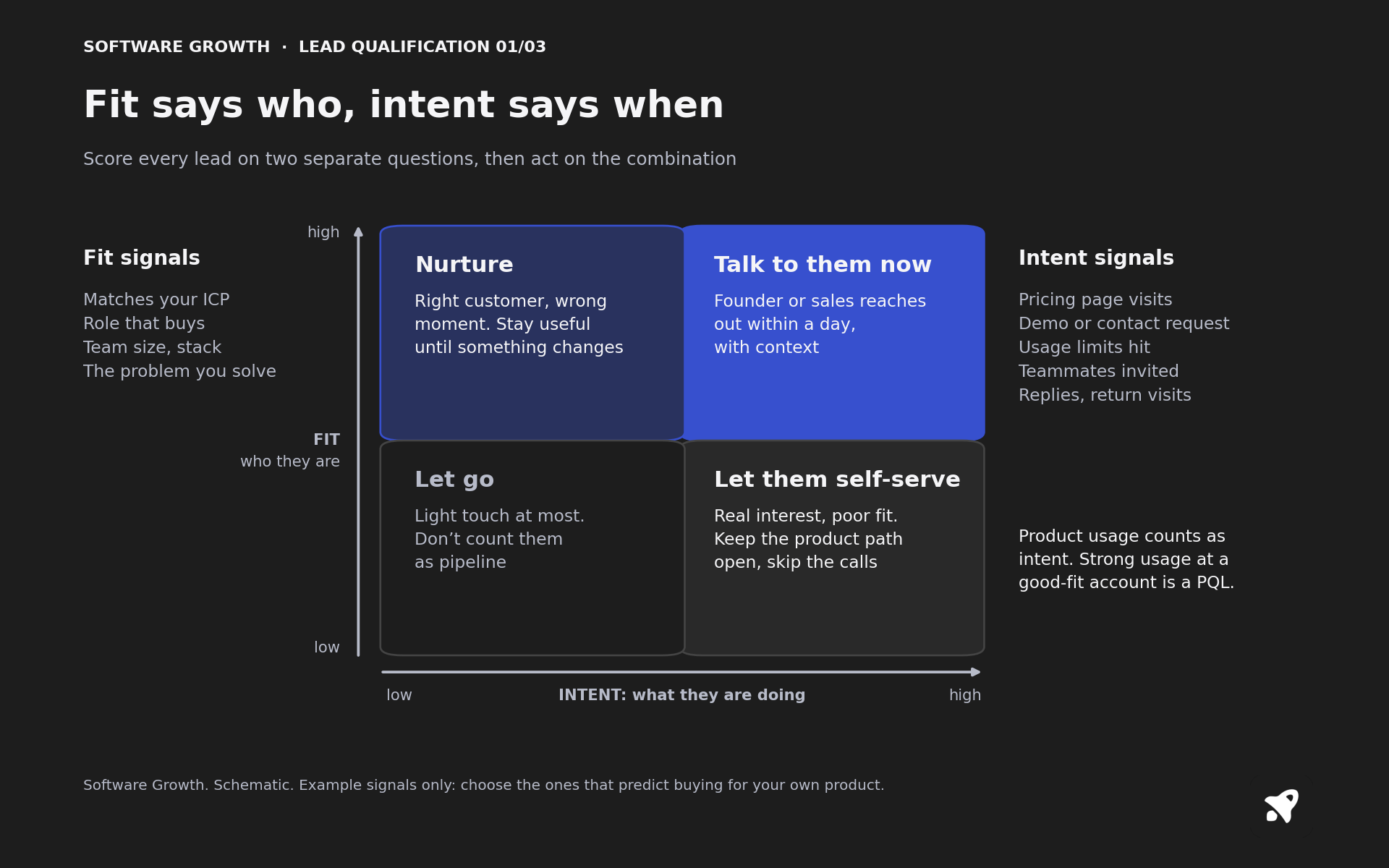
- High fit, high intent: reach out quickly and personally. These are your sales-qualified leads.
- High fit, low intent: the right customer at the wrong moment. Put them into lead nurturing and watch for a trigger.
- Low fit, high intent: they want it, but they aren't who you built it for. Let them use the self-serve product; don't spend sales time.
- Low fit, low intent: don't count them as pipeline. A newsletter is plenty.
The signals teams actually act on are mostly intent signals. In the 2026 State of B2B GTM report (300 GTM leaders, surveyed in September 2026), the most common were content engagement (52% of respondents), website visits (42%) and product usage (40%). Product usage was acted on more by companies with deals under $5,000 a year (Kyle Poyar, October 14, 2026). If you turn signals into points, that is lead scoring; qualification is the decision you make with the score.
Qualifying against your ideal customer profile
Fit only works if you have written down who fits. Your ideal customer profile should come from your best existing customers (high retention, upgrades, referrals) rather than from the market you hope to sell to.
Jason Cohen offers two useful tests. First, ask whoever sells: they can usually finish the sentence "any time someone says ______, I know we're going to close the sale" (January 7, 2024). That phrase is a qualification question. Second, describe fit by situation and use case rather than by company size or industry, unless the product truly only works inside that boundary (September 7, 2025). At WP Engine, his small-business product was bought by teams inside very large companies for the same reasons small businesses bought it.
Rob Snyder adds a stricter filter. For most target-market definitions (who has the biggest pain, who gets the most value) "buying is optional", so those buyers buy slowly and churn. He argues that the people worth pursuing are those with a project they must do now, can't keep doing the old way, and can't do with their current options (October 2, 2026).
Write down disqualifiers too. Common ones: a must-have integration you don't support, a team size your pricing can't serve, or a compliance requirement you can't meet. Agreeing on these reasons lets marketing improve targeting and shows product which gaps keep coming up.
Product signals and PQLs
In a product-led business, the strongest intent signal is what people do in the product. A product-qualified lead (PQL) is a user or account whose usage shows buying intent. Kyle Poyar wrote in 2022 that PQLs often convert at 15–30%, far above MQLs (January 12, 2022).
His September 2026 list of usage signals worth watching at the account level (September 20, 2026):
- 3+ active users from the same company, even with disconnected accounts
- 2+ users hitting limits in the product
- 1+ user with a Director-level title or above
- 1+ active user, combined with the company viewing the pricing page
Combine them with fit. Usage at a company outside your ICP is a self-serve customer; the same usage at a good-fit account is a reason to reach out.
One change makes this harder: personal email addresses. Poyar puts them at 75–90% of new signups for AI products in his experience, and the usual response was to block them or leave them out of the pipeline.
These almost always got ignored by the sales team.
Kyle Poyar / 4 GTM plays that combine first-party and third-party data (September 20, 2026)
His suggested fix: match personal-email signups to the company they work at, roll users from the same company into one account view, and ask for role and company in the onboarding survey. Elena Verna also covers using onboarding to profile users in her episode on product-led sales (Lenny's Podcast, 2023, from 1:12:04).
Routing between self-serve and sales
Qualification decides who gets human time. Everyone else should keep a good self-serve path, so routing is about sending each lead to the cheapest path that will still close them.
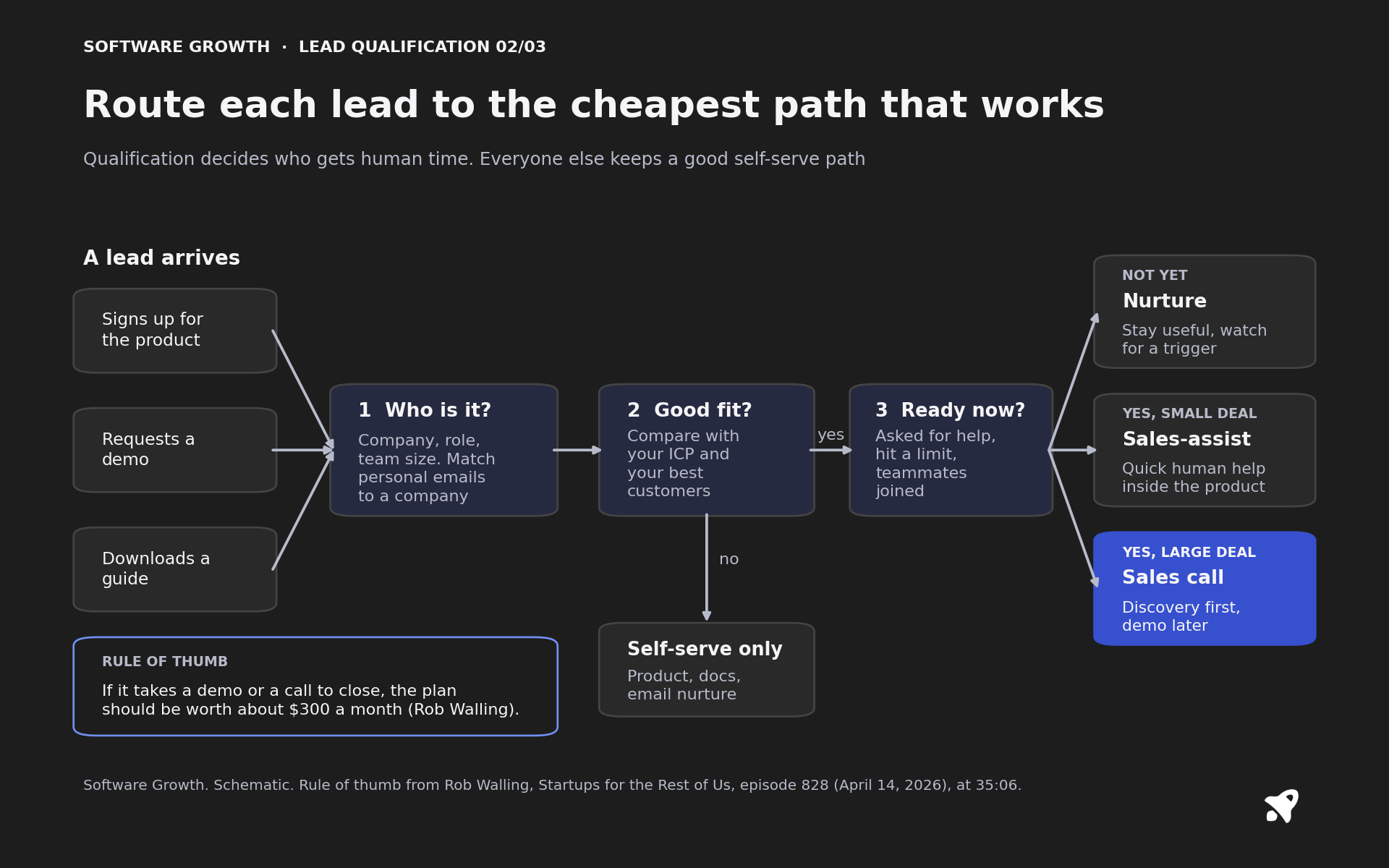
Price is the first filter. Rob Walling's rule of thumb is that if a sale needs a demo, or at least one call to close, the plan probably needs to be around $300 a month to be worth it, while plans of $50 to $100 a month should be able to self-serve (episode 828, April 14, 2026, at 35:06). In the same episode he suggests putting the qualification in the call to action itself for a product with both consumer and business buyers: "Are you a financial planner? Request a demo now." (at 27:26).
Walling also makes the case for running both paths at once, a dual funnel: self-serve customers bring steady growth while the occasional large deal closes.

The problem with being all enterprise is that it can be a slog
Rob Walling / Startups for the Rest of Us, episode 828 (April 14, 2026), from 15:13
Routing can also happen inside onboarding. Ruben Gamez told Walling that SignWell asks new users a couple of questions to put them in the right bucket, and was testing a higher-touch path with an onboarding call for people from larger companies (episode 837, June 16, 2026, from 11:52).
Three paths cover most small SaaS companies:
- Self-serve for poor-fit leads and good-fit leads on small plans.
- Sales-assist for good-fit accounts that show intent on smaller deals: a quick human answer, often in the product, without a formal sales process.
- A sales call for large or complex deals: security reviews, several stakeholders, procurement.
The self-serve funnel can also feed the sales one. Poyar cites Anthropic's Head of Industries saying at SaaStr AI that 54% of Anthropic's new enterprise logos in 2026 came through the self-serve funnel (secondhand, via Poyar's September 20 post).
Qualification frameworks: BANT, CHAMP and MEDDIC
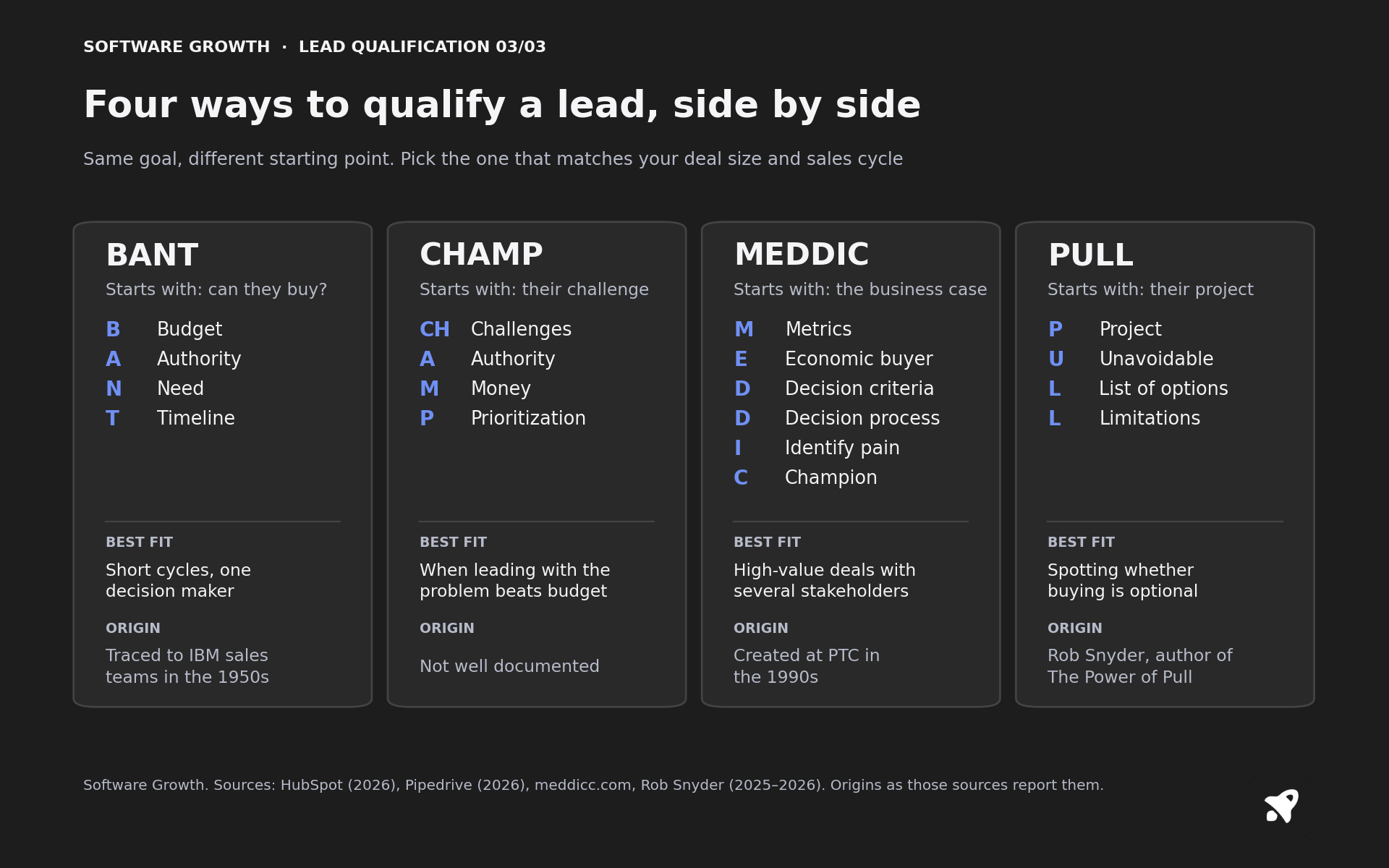
Sales teams use acronyms to make sure they collect the same information on every deal. None is right for every business; they differ in what they ask first and how much they assume about the deal.
BANT
Budget, Authority, Need, Timeline. Pipedrive traces the acronym to IBM's sales leaders in the 1950s, when software was bought outright and one executive usually made the decision (Pipedrive, 2026). HubSpot's 2026 guide calls it the "Old Faithful" of qualification and suggests it for early-stage qualification and transactional sales with shorter cycles (HubSpot, June 24, 2026). Pipedrive notes the model assumed a single decision maker, which in enterprise software is often no longer true. A former SDR writing on HubSpot's blog describes another trap: asking "What is your budget?" outright and wrongly ruling out prospects whose spending turned out to be more flexible (HubSpot, July 31, 2025).
CHAMP
Challenges, Authority, Money, Prioritization. It covers similar ground to BANT but starts with the prospect's challenges, and treats authority as a map of who is involved rather than a gate. HubSpot positions it for sales processes where leading with the problem works better than leading with budget. We found no reliable source for who created it.
MEDDIC
Metrics, Economic buyer, Decision criteria, Decision process, Identify pain, Champion. It was created at PTC in the 1990s. Sources differ on credit: MEDDICC, a company that teaches and certifies the method, names Dick Dunkel and dates it to 1996, and also credits Jack Napoli; HubSpot credits Napoli (meddicc.com). Later versions add Competition (MEDDICC) and Paper process (MEDDPICC), the steps from a decision to a signed contract. It suits high-value deals with several stakeholders and long cycles, and it is more than a $49-a-month self-serve product needs.
Other variants
HubSpot's guide also lists ANUM (Authority, Need, Urgency, Money), FAINT (which adds Interest) and GPCTBA/C&I, a longer framework developed at HubSpot for consultative sales. They are variations on the same questions.
A demand-first alternative
Rob Snyder's PULL framework (Project, Unavoidable, List of options, Limitations) comes at qualification from the buyer's side: does this person have a project they must do now, where their current options aren't good enough? He argues that standard qualification questions are premature until you know that.
Unless you have found PULL, these questions are annoying
Rob Snyder / 37 ways to ask about PULL (September 25, 2026)
A practical way to combine them: use a demand question to find out whether there is a real project, then use whichever checklist fits your deal size to fill in the rest.
What to ask on a first call
A first call has two jobs: find out whether there is a real, current project, and decide the next step. A sequence that works for small teams, drawing on Snyder's questions (September 25, 2026):
- "Why did you take the call?" Snyder treats this as required, even for inbound leads who filled in a form. For them, he asks what on the website stood out as relevant.
- One open question about the project. In his version, you ask whether, in the area you help with, there is something in particular they are trying to solve right now that they hope someone could help with. It asks about the project, urgency and options at once, instead of one letter at a time.
- Test it by inverting. Instead of asking why it's urgent, Snyder asks "Why not wait and do it next year?" and why doing it themselves isn't an option.
- Then the checklist questions. Who else is involved, how they decide, what the budget is for this project, what has to be true by when. Now they have something to attach to.
- Fit checks you can't skip. Required integrations, team size, security or compliance needs. If you find a hard mismatch, say so before scheduling a long evaluation.
- Agree the next step. A trial with a defined goal, a second call with the economic buyer, or a clear "this isn't a fit, here's who might help".
Jen Abel's guide to founder-led sales on Lenny's Podcast argues against demos on the first call (episode chapter at 49:20). Keep the demo for when you know which outcome to show.
Record the evidence, not just a yes or no. "Needs SSO by Q1, CTO signs, using spreadsheets today" is useful months later. "Qualified" isn't. And separate a genuine mismatch from missing information or timing: a buyer who understands the problem well may still be putting together a budget or a buying group.
Worked example
Fictional example. The product and all numbers are made up to show the arithmetic.
A B2B scheduling tool has two plans: Team at $79 a month (self-serve) and Business at $600 a month, which needs a call for SSO setup and a custom contract. The founder takes every demo request: 120 a month, 45 minutes each, or 90 hours. Nine become Business customers (7.5%), adding 9 × $600 = $5,400 in new MRR. That is $5,400 / 90 = $60 of new MRR per founder hour.
The founder adds qualification. The demo form asks for team size and current tool, and signups are matched to companies. A lead gets a call only if the team has 25 or more people (fit) and they either requested a demo or have three or more active users (intent). Everyone else is routed to a Team trial with a nurture sequence.
- Calls: 40 leads qualify, so 40 × 45 minutes = 30 hours. Eight close (20%): 8 × $600 = $4,800.
- Self-serve: of the 80 routed to the trial, six buy Team: 6 × $79 = $474.
- Total: $4,800 + $474 = $5,274 in new MRR, or $5,274 / 30 = about $176 per founder hour, with 60 hours freed up.
The cost: one Business deal ($600 MRR) that the old process would have closed went to self-serve and was lost. That is the price of any filter. Review a sample of disqualified leads each month, and loosen a rule if good customers keep getting caught by it. Note that the $600 plan clears Walling's rough $300 threshold for a sales call, and the $79 plan doesn't.
What changed in 2026
- Founders do the qualifying for longer. Founder-led sales was the leading go-to-market motion in the 2026 State of B2B GTM report: 44% of respondents under $1M ARR, and second among those between $1M and $10M (October 14, 2026). For most small SaaS companies, the qualification process is the founder's calendar.
- Signals are everywhere, agreement isn't. The same report found teams still experimenting with which signals matter, and Poyar's September 20 post argues that third-party signals like funding news and job posts have become a commodity, so the edge comes from combining them with your own data.
- Personal emails can no longer be ignored. With 75–90% of AI-product signups on personal addresses in Poyar's experience, qualification has to start by working out who the person is.
- Demand-first discovery went mainstream. Snyder's PULL framework got a full Lenny's Podcast episode (October 25, 2026) and his newsletter posts on asking about PULL and whether buying is optional.
- PLG companies keep hitting the same sales problems. Elena Verna wrote that PLG-to-enterprise growing pains repeat so often across companies that she made a bingo card of them (September 11, 2026). Deciding which self-serve accounts get a salesperson is one of them.
Common mistakes
- Opening with budget questions before understanding the problem.
- Treating every form fill or download as a sales lead. A downloaded guide is interest in a topic.
- Mixing fit and intent into one score, so a busy student and a quiet enterprise buyer look the same.
- Defining fit by company size alone when the real pattern is a situation or use case.
- Taking calls for plans too small to justify them instead of building a good self-serve path.
- Ignoring personal-email signups by default.
- Saying yes to poor-fit customers because the deal is large. Cohen describes a large customer outside the bullseye who turned out unprofitable and left anyway (January 7, 2024).
- Never checking the disqualified pile, so the filter quietly drifts.
Listen, watch and read next
- Listen: An 86-minute guide to finding PMF | Rob Snyder, Lenny's Podcast (October 25, 2026). Start at 26:41 for recognizing real buying intent and at 41:27 for how to run a first sales call.
- Read: 37 ways to ask about PULL, Rob Snyder (September 25, 2026). The exact wording for first-call questions, including fallbacks when the first one gets nothing.
- Read: 4 GTM plays that combine first-party and third-party data, Kyle Poyar (September 20, 2026). The product-usage signals and the personal-email problem in detail.
- Listen: Startups for the Rest of Us, episode 828, Rob Walling (April 14, 2026). From 12:21 on serving small customers and enterprise at once, the dual funnel and the enterprise sales process.
- Watch: The ultimate guide to founder-led sales | Jen Abel, Lenny's Podcast (November 24, 2024). From 30:58 on the first phone call, and 49:20 on why to avoid demos on it.
- Watch: The ultimate guide to product-led sales | Elena Verna, Lenny's Podcast (April 23, 2023). From 28:37 on PQAs, PQLs and MQLs, and 42:01 on the metrics that identify accounts worth a salesperson.
Related terms
- Lead scoring
- Lead nurturing
- Lead generation
- MQL (Marketing qualified lead)
- SQL (Sales qualified lead)
- PQL (Product qualified lead)
- ICP (Ideal customer profile)
- Dual funnel
- Sales-assisted growth
- Email marketing
- Win rate
Sources
- Your guide to PQLs, Kyle Poyar, Growth Unhinged, January 12, 2022 (opening section public)
- The ultimate guide to product-led sales | Elena Verna, Lenny's Podcast, April 23, 2023
- Selling to Carol: Why targeting an ICP brings 10x more customers than you expected, Jason Cohen, A Smart Bear, January 7, 2024
- The ultimate guide to founder-led sales | Jen Abel, Lenny's Podcast, November 24, 2024
- Your target market isn’t demographic, Jason Cohen, A Smart Bear, September 7, 2025
- How I use BANT to qualify prospects, HubSpot, July 31, 2025
- BANT meaning: how to use BANT in 2026, Syed Ali Nemath, Pipedrive, January 31, 2026
- Episode 828: Am I Building a SaaS?, Serving Both B2C and B2B, Pricing, and More Listener Questions, Rob Walling, Startups for the Rest of Us, April 14, 2026
- Episode 837: How Do You Learn Product? and Optimizing Your Trial Funnel (with Ruben Gamez), Startups for the Rest of Us, June 16, 2026
- Lead qualification: Gauging whether a lead aligns with your offering, HubSpot, June 24, 2026
- MEDDPICC sales methodology: acronym and meaning, MEDDICC
- Congrats, your sales problems in PLG are completely unoriginal, Elena Verna, September 11, 2026 (opening section public)
- 4 GTM plays that combine first-party and third-party data, Kyle Poyar, Growth Unhinged, September 20, 2026
- 37 ways to ask about PULL, Rob Snyder, The Physics of Startups, September 25, 2026
- Is buying optional?, Rob Snyder, The Physics of Startups, October 2, 2026
- What's working in B2B GTM: 2026 data from 300 leaders, Kyle Poyar, Growth Unhinged, October 14, 2026
- An 86-minute guide to finding PMF | Rob Snyder, Lenny's Podcast, October 25, 2026
- Marketing-qualified leads, HubSpot