Lead Nurturing
Staying useful to good-fit leads until they're ready to buy: email sequences, content by stage, behavior-triggered messages, timing and how to measure it.
Lead nurturing is staying in useful contact with people who fit your product but aren't ready to buy yet, so that you are the obvious choice when they are. The one-line rule: send the next helpful thing for where the lead is now, triggered by what they do, and stop when they buy, leave or ask you to.
In a SaaS business, nurturing covers more than marketing email. It includes the onboarding emails a trial user gets, the in-app nudge when they stall, a founder's personal note to a promising account, and what you send a new customer in their first month. This guide covers how nurturing works, how to build email sequences, what content fits each stage, behavior-triggered nurturing in a product-led SaaS, timing, a worked example, and how to measure whether any of it works.
How lead nurturing works
Nurturing sits between lead generation and the sale. Generation gets you a name, a signup or a download. Lead qualification sorts those leads by fit and intent. Nurturing is for the large group in the middle: people who look like your ideal customer but haven't shown they are ready.
Most SaaS nurturing runs on three tracks at once:
- Time-based sequences. A short series of emails sent on a schedule after someone subscribes, downloads a lead magnet or starts a trial. Easy to build, and fine for teaching.
- Behavior-triggered messages. Messages sent because the person did something (hit a limit, invited a teammate, visited pricing twice) or didn't (signed up and went quiet). These carry most of the weight in a self-serve product.
- Human touches. A personal email or call from the founder or a salesperson, reserved for the best-fit accounts that show intent. This is where nurturing hands off to sales.
Seth Godin described the standard nurturing has to meet in 2008, long before marketing automation tools made it easy to ignore:
anticipated, personal and relevant messages to people who actually want to get them
Seth Godin / Permission Marketing (January 31, 2008)
That last clause matters for compliance as well as results. Only email people who opted in, make leaving easy, and change the messages the moment someone buys.
Content for each stage
A lead's question changes as they move toward a purchase, so the content has to change with it. Sending a "book a demo" email to someone who is still deciding whether the problem is worth fixing wastes the email and some of their goodwill.
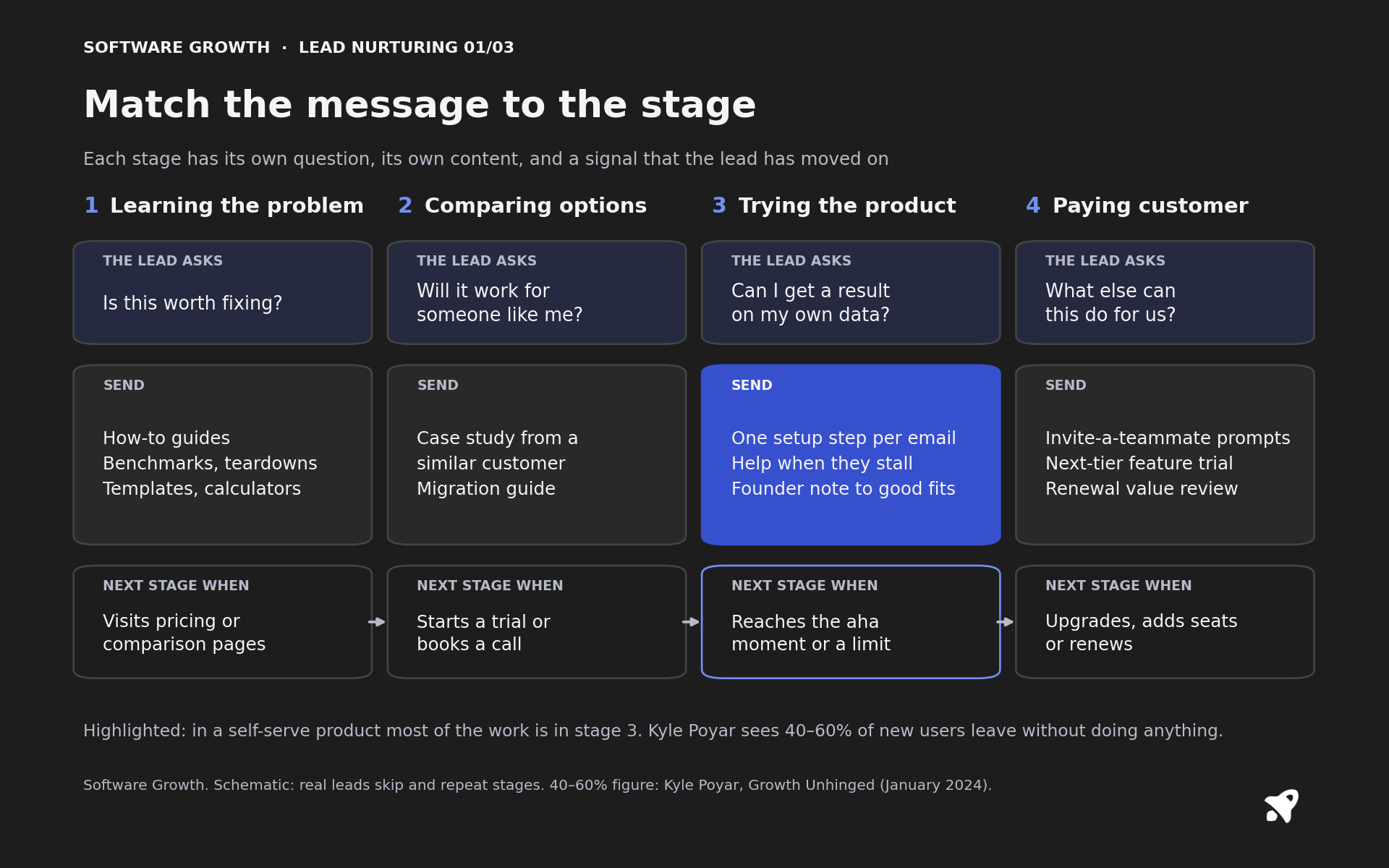
- Learning the problem. Teach. Guides, benchmarks, templates and calculators that are useful even if the reader never buys. Content marketing does most of the work here.
- Comparing options. Prove it works for someone like them. A case study from a customer in the same situation beats a feature list. Jason Cohen's test for whether two customers are in the same market is whether one would be swayed by the other's genuine testimonial (September 7, 2025).
- Trying the product. Get them to a first result on their own data. One setup step per email, help when they stall, and a personal note to accounts that fit well. This is the stage covered by user onboarding, and in a self-serve product it is where most leads are lost. Kyle Poyar has written that in his experience 40–60% of new users drop off without doing anything (January 3, 2024).
- Paying customer. Nurturing continues after the first payment: prompts to invite teammates, a trial of the next plan, and a value review before renewal. See the timing section below.
An example from the earlier version of this page still holds: a prospect evaluating reporting software is worried about replacing their spreadsheets. An import walkthrough, an example transition plan and an offer to look at their current workflow address the obstacle that is actually blocking the evaluation. Three identical "book a demo" reminders don't.
How to build a nurture email sequence
For most small SaaS teams the core of nurturing is a handful of email sequences. Rules that keep them useful:
- Start from the entry point. A trial signup, a guide download and a demo no-show need different sequences. Write one per entry point that matters, not one for everyone.
- One job per email. Each email asks for one action: connect your data, invite a teammate, read one case study. Link to that action and nothing else.
- Send from a person. Plain emails from the founder, with a real reply-to address, invite replies. Replies tell you what is blocking people, which is the most useful data a sequence produces.
- Short beats long. As a starting point (our suggestion, not a benchmark), five to seven emails over two or three weeks covers a typical trial. After that, move people to a lower-frequency newsletter instead of an endless drip.
- Exit rules. Remove people from a sequence when they complete the step it is pushing, when they buy, when they book a call, or when they unsubscribe. Most "spammy" nurturing is a missing exit rule.
- Branch on answers. A one- or two-question onboarding survey (role, what they are trying to do) lets you send different sequences to different people. Kyle Poyar suggests using onboarding-survey answers to fill out the profile of personal-email signups (September 20, 2026).
Behavior-triggered nurturing in a product-led SaaS
In a product-led business, the product itself produces the best nurturing signals. A fixed drip sends the same email on day 3 whether the user finished setup on day 1 or never came back. A triggered message reacts to what actually happened.
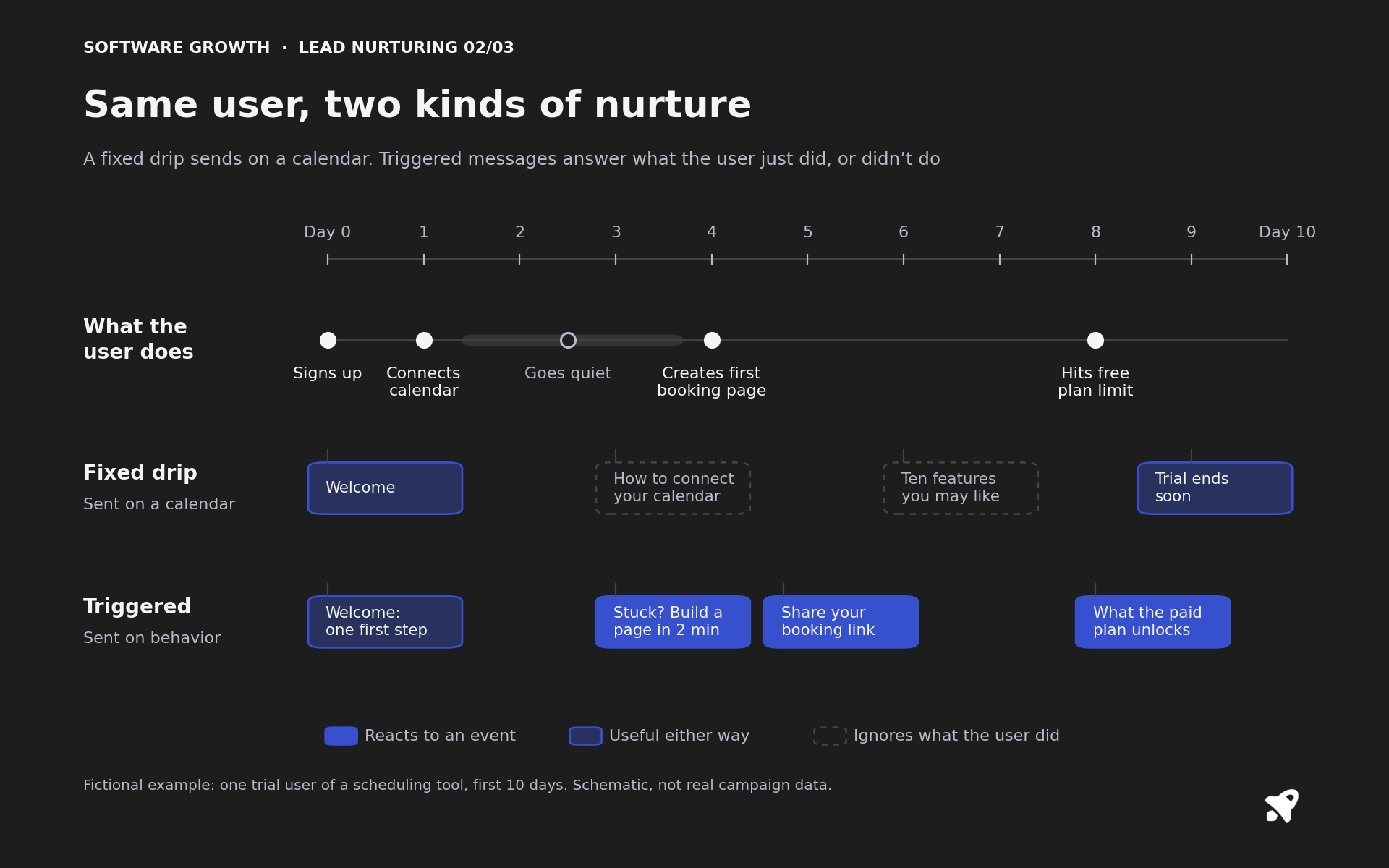
Triggers worth building first:
- Stalled setup. No key action within 24 to 48 hours of signup. Send the single next step, or a short video of it.
- First result. The user reached the aha moment. Suggest the next habit, such as sharing the output or inviting a colleague.
- Limit reached. A usage or plan limit is the moment the paid plan becomes concrete. Explain what upgrading unlocks, in their units.
- Team signals. Several people from the same company signing up separately, or one user inviting others. At a good-fit company this is a product-qualified lead, and a human should follow up.
- Return visits. A trial that lapsed but keeps visiting pricing or docs. A short personal note often works better than another automated email.
Not every product should push users through as fast as possible. Ruben Gamez runs two products with opposite approaches. For Bidsketch, proposal software where users are anxious about pricing and writing, the team educates before the trial and does more lead nurturing. For SignWell, his e-signature tool, the same friction lowered paid upgrades, so signup stays close to two clicks and a couple of questions route users to the right first step.
We don’t draw people off into the trial immediately.
Ruben Gamez / Startups for the Rest of Us, episode 837 (June 16, 2026), from 5:14
The rule that comes out of the comparison: the longer the time to value and the more anxious the buyer, the more nurturing before and during the trial pays off.
Timing: when nurturing matters most
Most teams treat nurturing as something that happens before the sale. Kyle Poyar's analysis of ChartMogul data from 4,029 software companies (September 30, 2026) shows that the weeks right after the first purchase matter just as much. Customers were up to 10 times more persuadable in their first 30 days than in months 4 to 11.
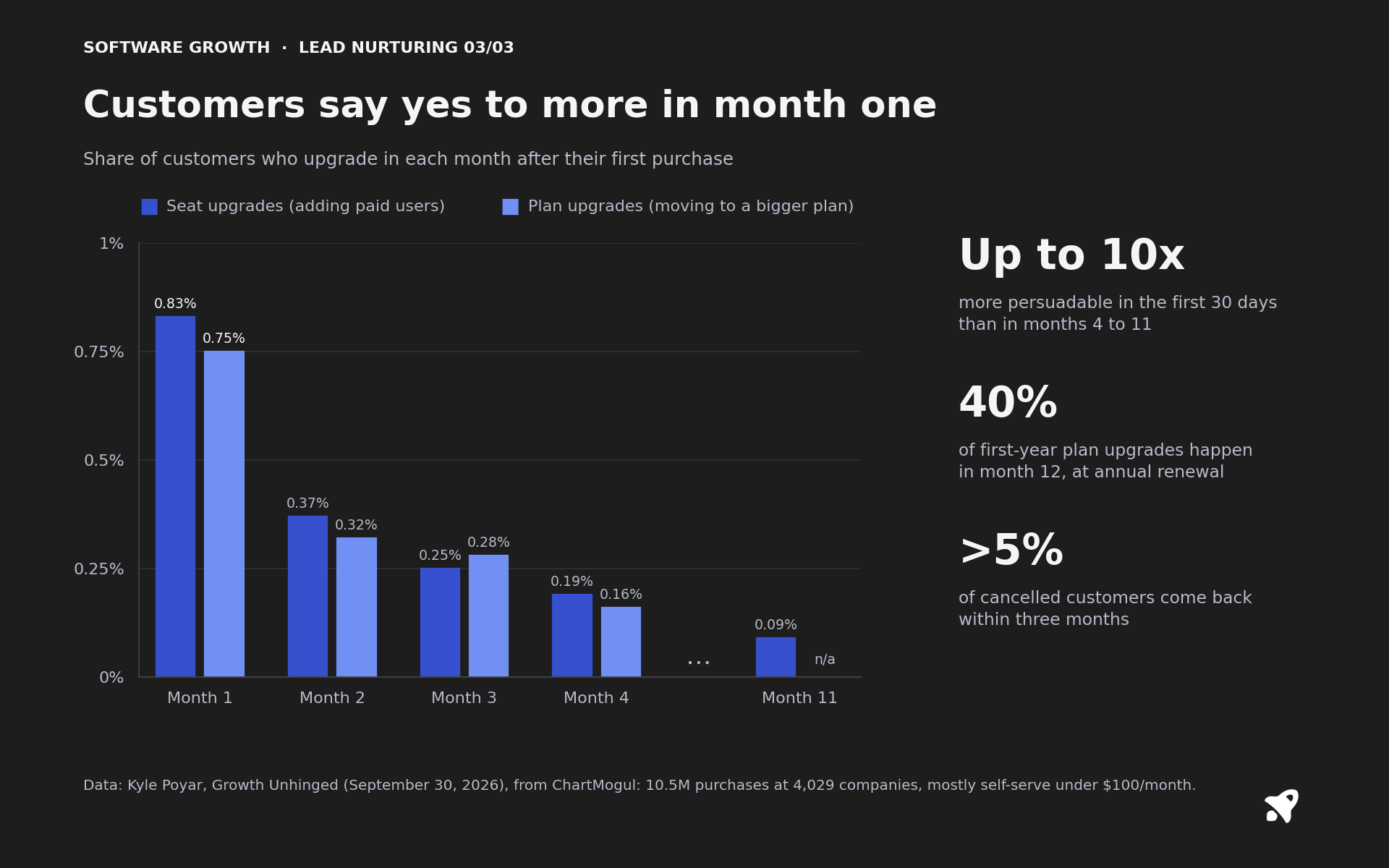
Most companies go quiet the moment someone becomes a customer
Kyle Poyar / The 30-day upsell window (September 30, 2026)
What the data suggests for a nurture calendar:
- First 30 days as a customer. Prompt team invites early, and consider Poyar's idea of a 30-day trial of the next plan soon after the first purchase. This is where upsell and expansion revenue start.
- Annual renewal. 40% of first-year plan upgrades happened in month 12. Poyar recommends combining the renewal reminder with a value review: what the customer achieved, how usage grew and what the next plan would add.
- After cancellation. More than 5% of churned customers came back within three months. His suggested win-back schedule is day 1, 30 and 60 after cancellation, with messages segmented by cancellation reason.
Before the sale, timing is mostly about urgency. Jason Cohen describes "product purgatory": prospects who like the product, have the budget and still don't buy, because it isn't one of their top priorities right now.

Urgency is the missing ingredient.
Jason Cohen / Product Purgatory: When they love it but still don’t buy (May 4, 2025)
Nurturing can't create urgency, but it can keep you in the room until something does: a new regulation, a new leader, a funding round, a security breach. Cohen lists triggers like these. Watching for them, and changing the message when one appears, is the difference between nurturing and simply sending email.
Lost deals deserve the same treatment. Poyar notes that only about one in four qualified opportunities becomes a customer, and that closed-lost deals are often left to a "follow-up in 9 months" CRM reminder. He suggests re-engaging them when a signal shows the original reason for the loss has changed, such as a funding round or a new CFO at a company that said no for budget reasons (September 20, 2026).
Worked example
Fictional example. The product and all numbers are made up to show the arithmetic.
A $29/month scheduling tool gets 1,000 trial signups a month. Every signup gets the same five-email drip. 55% finish setup, and 8% become paying customers: 80 customers, or 80 × $29 = $2,320 in new MRR a month.
The founder replaces the drip with triggered messages (stalled setup, first booking page created, limit reached) and keeps a random 200 signups on the old drip as a holdout. After one month:
- Triggered group (800): 520 finish setup (65%), 76 pay (9.5%).
- Holdout (200): 110 finish setup (55%), 16 pay (8%).
If the paid lift is real, rolling it out to all 1,000 signups means 95 customers instead of 80: 15 more a month, or 15 × $29 = $435 more new MRR from each monthly cohort.
Is it real? A rough check is the standard error of the difference between two rates, √(p₁(1 − p₁)/n₁ + p₂(1 − p₂)/n₂):
- Setup completion: √(0.65 × 0.35 / 800 + 0.55 × 0.45 / 200) ≈ 3.9 points. The lift is 10 points, about 2.6 standard errors. That is very likely real.
- Paid conversion: √(0.095 × 0.905 / 800 + 0.08 × 0.92 / 200) ≈ 2.2 points. The lift is 1.5 points, less than one standard error. Even after three months (2,400 vs 600 signups) the standard error is about 1.3 points, so the lift is still only about 1.2 standard errors.
The lesson for a small SaaS: at this volume you can confirm that nurturing improves setup within a month, but not that it improves revenue. Judge the change on the leading metric, keep the holdout running, and check paid conversion over a longer window.
How to measure lead nurturing
- Use a holdout. Keep a small random group on the old version (or no nurture). Without one you can't tell what the emails caused, because the leads who engage with email are often the ones who would have bought anyway.
- Measure progression, not opens. Track the step each sequence is meant to cause: setup completed, activation, trial-to-paid conversion, calls booked, upgrades in the first 30 days. Opens say little about buying.
- Watch the costs. Unsubscribes, spam complaints and replies that say "stop" are the price of each sequence. A rising unsubscribe rate usually means a missing exit rule or the wrong stage.
- Track handoffs. If nurturing passes leads to sales as MQLs or PQLs, measure how many become sales-qualified leads and customers. Many passed leads that sales rejects means the trigger is wrong.
- Read the replies. At low volume, the objections in replies are better data than any dashboard.
If you score leads, nurturing and lead scoring should share the same signals: the events that raise a score are usually the events that should trigger a message.
What changed in 2026
- Post-purchase timing has data behind it. Poyar's September 30 analysis puts numbers on what lifecycle marketers suspected: upgrade rates fall sharply after the first month, and renewal is a second window.
- Signals got cheap, and so did relevance. In the 2026 State of B2B GTM report, which surveyed 300 GTM leaders, the signals teams most often act on were content engagement (52%), website visits (42%) and product usage (40%) (Kyle Poyar, October 14, 2026). Poyar argues that third-party intent data has become a commodity and that the lasting plays combine it with your own first-party data, such as usage or a lost deal's history.
- Personal email signups. Poyar puts personal-email signups at 75–90% of signups for AI products in his experience. Nurturing that only targets business domains now misses most of the funnel; matching personal emails to companies is part of the job.
- Cold outreach is weaker, relationships stronger. The same report found network and introductions and small in-person events were the best-rated channels, and called cold outreach oversaturated. For small teams, that shifts effort toward nurturing the people who already know you.
Common mistakes
- Treating every download as a sales lead. A downloaded guide shows interest in a topic, not readiness to talk to sales.
- One sequence for everyone, regardless of how they arrived or what they need.
- No exit rules, so customers keep getting trial emails and people who booked a call keep getting "book a call" emails.
- Pushing the demo before the lead has seen anything that answers their question for this stage.
- Going quiet after the first payment, when Poyar's data says customers are most open to more.
- Judging nurturing by opens and clicks instead of the step it is meant to cause, and without a holdout.
- Making it hard to leave. Hidden unsubscribe links and cancellation dark patterns damage the trust you need for later win-backs (see cancellation flow).
For small and bootstrapped SaaS
You don't need a marketing automation platform to start. A reasonable order:
- One onboarding sequence for trial signups, written as plain emails from the founder, with exit rules.
- One stalled-setup trigger and one limit-reached trigger.
- A personal email from the founder to every signup that matches your ideal customer profile.
- A first-30-days customer sequence: invite your team, try the next plan.
- A renewal value review and a three-email win-back.
If you run both a self-serve and a sales path (a dual funnel), nurturing is how the two connect: product signals decide which self-serve accounts deserve a human.
Listen, watch and read next
- Read: The 30-day upsell window, Kyle Poyar (September 30, 2026). The data behind the timing section, with concrete plays for seat upgrades, plan upgrades and win-backs.
- Listen: Startups for the Rest of Us, episode 837, Rob Walling with Ruben Gamez (June 16, 2026). Start at 4:00 for why educating and nurturing before the trial works for one of his products and hurts the other.
- Read: Product Purgatory: When they love it but still don’t buy, Jason Cohen (May 4, 2025). Why good-fit prospects stall, and a list of trigger events that create urgency.
- Read: 4 GTM plays that combine first-party and third-party data, Kyle Poyar (September 20, 2026). Includes the closed-lost reactivation play and the product-usage signals worth watching.
- Watch: The Dinner Party Strategy: A SaaS Customer Onboarding Framework with Val Geisler, Rob Walling (April 3, 2020). Twelve minutes on structuring onboarding emails for trial users.
- Read: Permission Marketing, Seth Godin (January 31, 2008). The short post behind the idea that nurturing is a privilege the lead grants you.
Related terms
- Lead qualification
- Lead scoring
- Lead generation
- MQL (Marketing qualified lead)
- SQL (Sales qualified lead)
- PQL (Product qualified lead)
- ICP (Ideal customer profile)
- Email marketing
- User onboarding
- Win-back campaign
- Dual funnel
Sources
- Permission Marketing, Seth Godin, Seth's Blog, January 31, 2008
- Your guide to better email, Kyle Poyar, Growth Unhinged, January 3, 2024 (opening section public)
- Product Purgatory: When they love it but still don’t buy, Jason Cohen, A Smart Bear, May 4, 2025
- Your target market isn’t demographic, Jason Cohen, A Smart Bear, September 7, 2025
- Episode 837: How Do You Learn Product? and Optimizing Your Trial Funnel (with Ruben Gamez), Startups for the Rest of Us, June 16, 2026
- 4 GTM plays that combine first-party and third-party data, Kyle Poyar, Growth Unhinged, September 20, 2026
- The 30-day upsell window, Kyle Poyar, Growth Unhinged, September 30, 2026
- What's working in B2B GTM: 2026 data from 300 leaders, Kyle Poyar, Growth Unhinged, October 14, 2026
- The Dinner Party Strategy: A SaaS Customer Onboarding Framework with Val Geisler, Rob Walling, April 3, 2020
- Demand generation vs. lead generation, HubSpot