Demand Generation
Marketing that makes buyers want to solve a problem and remember you before they buy. How it differs from lead generation, the 95-5 rule, and how to measure it.
Demand generation is the marketing work that makes people want to solve a problem, and remember you as the way to solve it, before they are ready to buy. It sits upstream of lead generation and demand capture, which turn that interest into contacts and customers once a buyer is actually shopping.
The rule of thumb behind it: at any moment only a small share of your market is buying, often around 5% in a quarter. Demand generation is how you reach the other 95% before they are, so your name is the one they remember when they start looking.
For a small SaaS this mostly means content, a founder people know, podcasts, communities and partners, measured with signals like branded search and "how did you hear about us?" rather than form fills. This guide covers how it differs from lead generation and demand capture, the research behind the 95-5 rule, what works for small teams, how to measure it, a worked example and what changed in 2026.
Demand generation vs lead generation vs demand capture
The three terms get used interchangeably, but they describe different jobs:
- Demand generation (or demand creation): making more people aware of the problem you solve and of you, mostly people who are not buying yet. Output: people who know and trust you. Examples: a newsletter, a podcast appearance, a useful answer in a community, a talk.
- Demand capture: being found and chosen by people who are already looking. Output: signups, trials and demo requests. Examples: ranking for "client portal for accountants", appearing in AI answers and review sites, ads on category and brand searches, a clear pricing page.
- Lead generation: collecting contact details so you can follow up. It can serve either job: a webinar signup can create demand, a "book a demo" form captures it.
The description of a 2023 interview with Chris Walker, then at Refine Labs, draws the line this way: demand creation drives awareness of and interest in a product, and demand capture converts the roughly 5% of the target market that is actively looking for a solution. Rand Fishkin of SparkToro makes the same point from the other side: before you spend, decide whether your problem is that not enough people know about you, or that the people who know you aren't getting nudged to buy. Each problem needs a different investment.
In funnel terms, demand generation is most of the top of the funnel, and demand capture is the bottom. The funnel picture can mislead, though, as the next section shows.
The 95-5 rule: most buyers are out of market
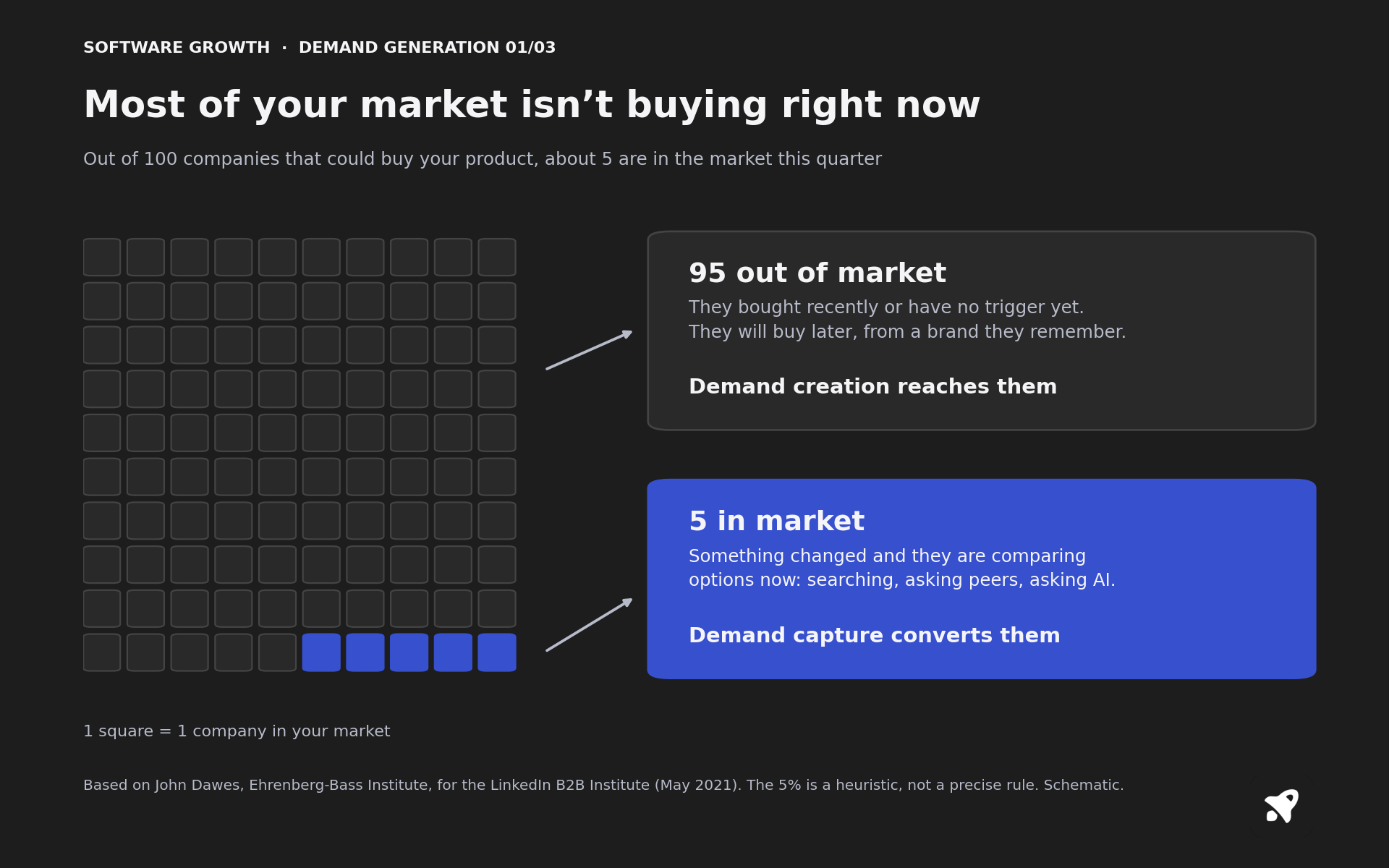
The rule comes from a 2021 report by Professor John Dawes of the Ehrenberg-Bass Institute, published with the LinkedIn B2B Institute. His reasoning is simple arithmetic. Companies change providers like their main bank or law firm about once every five years, so only about 20% of them are in the market over a whole year, and something like 5% in any quarter.
Two consequences matter for a founder:
- Marketing mostly reaches people who won't buy soon. Dawes argues it works by building memory links to your brand that switch on when the buyer comes into the market. If they don't know your name by then, a search ad has to win them cold, and Dawes cites research showing lesser-known brands are considered less often and get lower click-through rates.
- There is a ceiling on any one quarter. A campaign can win you a bigger share of the buyers who are in the market now. It can't bring you buyers who aren't. The LinkedIn summary puts it bluntly: ads don't move buyers into the market, buyers move themselves in when they need something.
The 95% figure is not meant to be a precise rule.
John Dawes / Advertising effectiveness and the 95-5 rule, Ehrenberg-Bass Institute (May 2021)
Dawes means it as a heuristic, and he shows how to work out your own number. Take the average time between purchases in your category. If it is two years, 50% of buyers are in the market over a year, or around 13% in a quarter. If you don't know the gap, ask customers how often they switch or buy this kind of tool. A SaaS tool people replace every few years behaves like the 95-5 case. A cheap tool people try on a whim has a bigger in-market share, and demand capture alone gets you further.
How a small SaaS creates demand
You won't run brand campaigns on TV. The channels that create demand for a bootstrapped SaaS are cheaper and slower, and most of them run on the founder's time:
- Useful content in public. Posts, a newsletter, teardown videos, original data. The goal is to be remembered for an idea about the problem, not to collect emails. Amanda Natividad of SparkToro calls this zero-click content: content that offers standalone value where people already are, with no need to click. See content marketing.
- A founder people know. Elena Verna, who leads growth at Lovable, started posting on LinkedIn with a simple rule: if she had said something three times in conversation, she posted it. Her following grew from a few thousand to 40,000 in a year. In her account of it (July 28, 2026) she writes, "Public credibility is a big deal in generating business pipeline." In October she added that having her own audience is "an immediate win for any company where I work".
- Podcasts. Guest spots on shows your buyers already listen to put you in their ears for an hour, and episodes keep getting found for years. They are almost impossible to attribute, which is why they get under-funded.
- Communities. Answering questions where your ideal customers talk to each other: Slack groups, subreddits, forums, industry associations. Helpful answers, not links.
- Partners and creators. Accountants who recommend software to their clients, agencies, integration partners, and the niche B2B newsletters your buyers read. Kyle Poyar's October 2026 guide to B2B newsletter ads notes that readers save good newsletters and come back months later when the problem lands on their plate. That delay is the 95-5 rule in action.
- Your network and small events. In Poyar's 2026 survey (below), network and introductions was the single most effective go-to-market channel, and intimate events came second.
Doing stuff in public creates opportunity.
Rob Walling / Startups for the Rest of Us, episode 848 (September 1, 2026)

Walling's example in that episode is Liquid Death. Before manufacturing any water, the founder made the brand and a video for a product that didn't exist yet, and watched the reaction. He created demand first and used it to decide whether to build. For SaaS founders this is the cheapest version of demand generation: talk about the problem in public before and while you build, and the audience you gather becomes your first customers and your validation.
Whatever you choose, demand generation only works if people can tell what you are and who you're for. That is positioning. A memorable idea attached to a vague product creates demand for someone else.
Demand is created in one place and captured in another
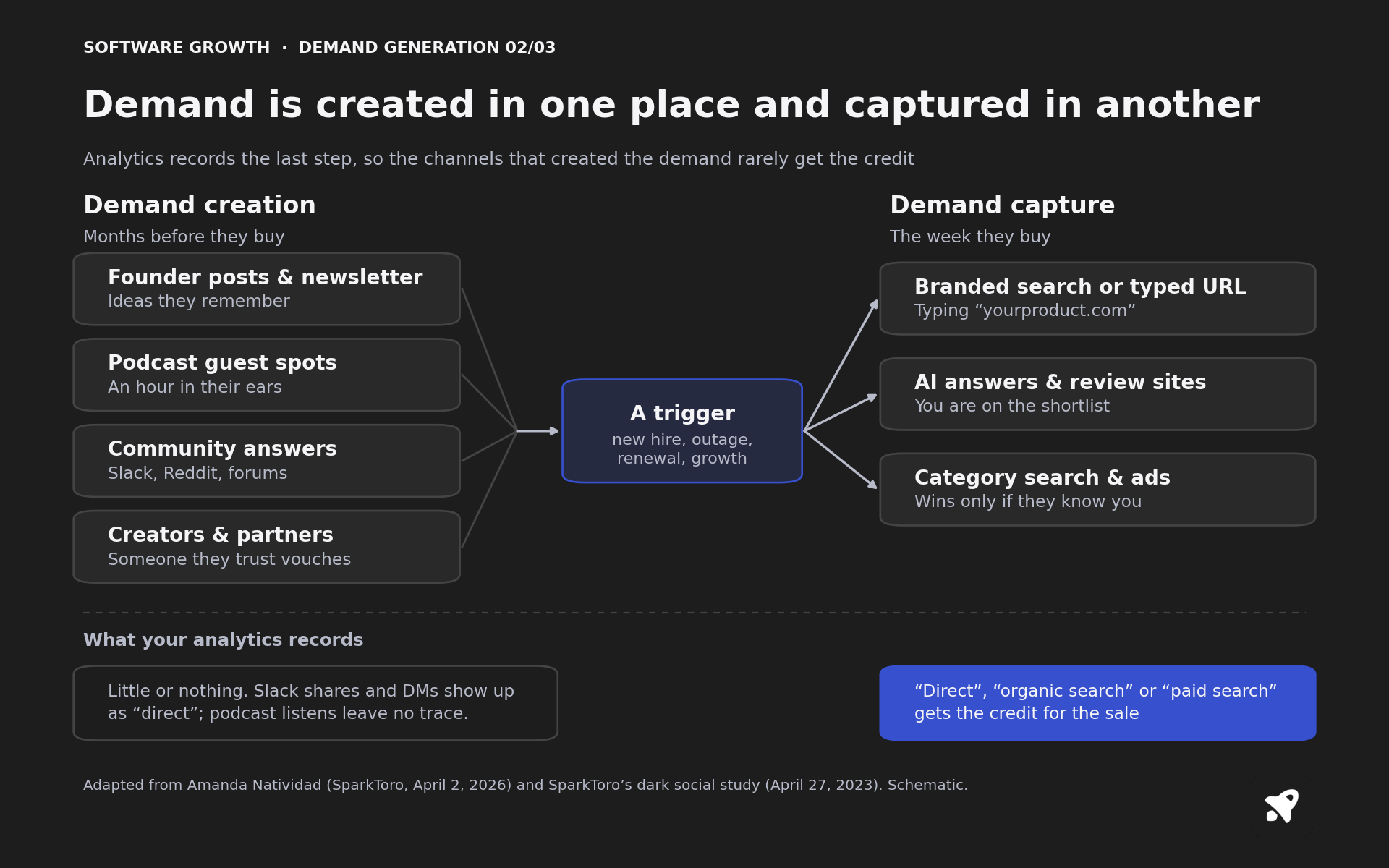
A buyer hears you on a podcast in March, sees a colleague share your post in Slack in May, and in September their old tool breaks. They type your name into Google, click, and sign up. Your analytics records a branded search. The podcast and the Slack share created the demand; search captured it.
the channel that captures demand is not always the channel that created it.
Amanda Natividad / If search captures demand, public evidence creates it (April 2, 2026)
Part of the gap is dark social: sharing that happens in private channels analytics can't see. In SparkToro's 2023 experiment, 1,113 tracked visits were sent from 11 networks. Every visit from TikTok, Slack, Discord, Mastodon and WhatsApp landed in Google Analytics as "direct" with no referral data, and so did 75% of visits from Facebook Messenger. SparkToro itself shows about 95% of its traffic as direct, which it knows is not true. The other part is zero-click behavior: people learn about you from an AI answer, a LinkedIn post or a podcast without ever clicking anything.
This is why last-click attribution systematically starves demand creation. The channels that capture demand get the credit, so they get the budget, and the pool of people who know you slowly stops growing.
Capturing the demand you create
Demand creation without capture leaks: people remember you, search for you, and end up with whoever answers best. Before you spend months on content, check the places where in-market buyers will look for you:
- Your brand name in Google. Search for it. Your site should be first, with a clear description. If a competitor bids on your name, consider bidding too.
- AI answers. Ask ChatGPT, Claude and Perplexity for the best tools in your category and what they know about you. Wrong or missing answers are fixed with clear pages on your own site and accurate third-party mentions. See answer engine optimization.
- Category searches. Comparison, alternatives and "best X for Y" pages, and SEO for the problem you solve.
- Review sites and communities where buyers check what peers think.
- Your website. Rand Fishkin argues in a recent whiteboard (August 14, 2026) that when someone actually wants to buy, they still have to come to your website, so it decides whether the demand you created turns into a customer.
How to measure demand generation
You won't get a clean ROI number. You can get a set of signals that move together when demand generation is working. Track them monthly and look at the trend over two or three quarters, not week to week.
Self-reported attribution
Add a required free-text field to signup or onboarding: "How did you hear about us?" We prefer free text to a dropdown, because people write things you would never list ("Sam's newsletter", "my accountant", "a podcast about practice management"). Group the answers each month.
Use it with care. Rand Fishkin lists three problems with the question: memory is unreliable, people don't know whether you mean where they first heard of you or what convinced them, and it is "bias in, bias out", because people who never heard of you can't tell you where you're missing. He still recommends asking, combined with interviews and wider audience research.
Branded search and direct traffic
- Branded search: impressions and clicks for your product's name in Google Search Console. More people searching for you by name is one of the clearest signs that demand creation is working.
- Direct traffic and direct signups: people typing your URL, plus the dark social that lands there.
- Branded mentions: how often people name you in communities, on social and in AI answers.
Leading indicators
- Audience you own: newsletter subscribers, podcast downloads, followers who engage.
- Inbound conversations that start with "I've been following your posts" or "I heard you on…".
- Share of new customers whose first touch was a branded search or direct visit.
- Pipeline and revenue, over a long enough window. Demand created this quarter may convert next year.
Compare these to a baseline from before you started, and change one big thing at a time so you can tell what moved them. Don't use a single correlation as proof: SEO, a launch or a competitor's outage can lift branded search too.
Worked example
Fictional example. A two-person SaaS sells a client portal to small accounting firms at $90 a month. There are about 2,400 firms in its ICP, and they switch portal tools about once every four years.
- In market per year: 2,400 ÷ 4 = 600 firms (25%).
- In market per quarter: 600 ÷ 4 = 150 firms (6.25%, close to the 95-5 heuristic).
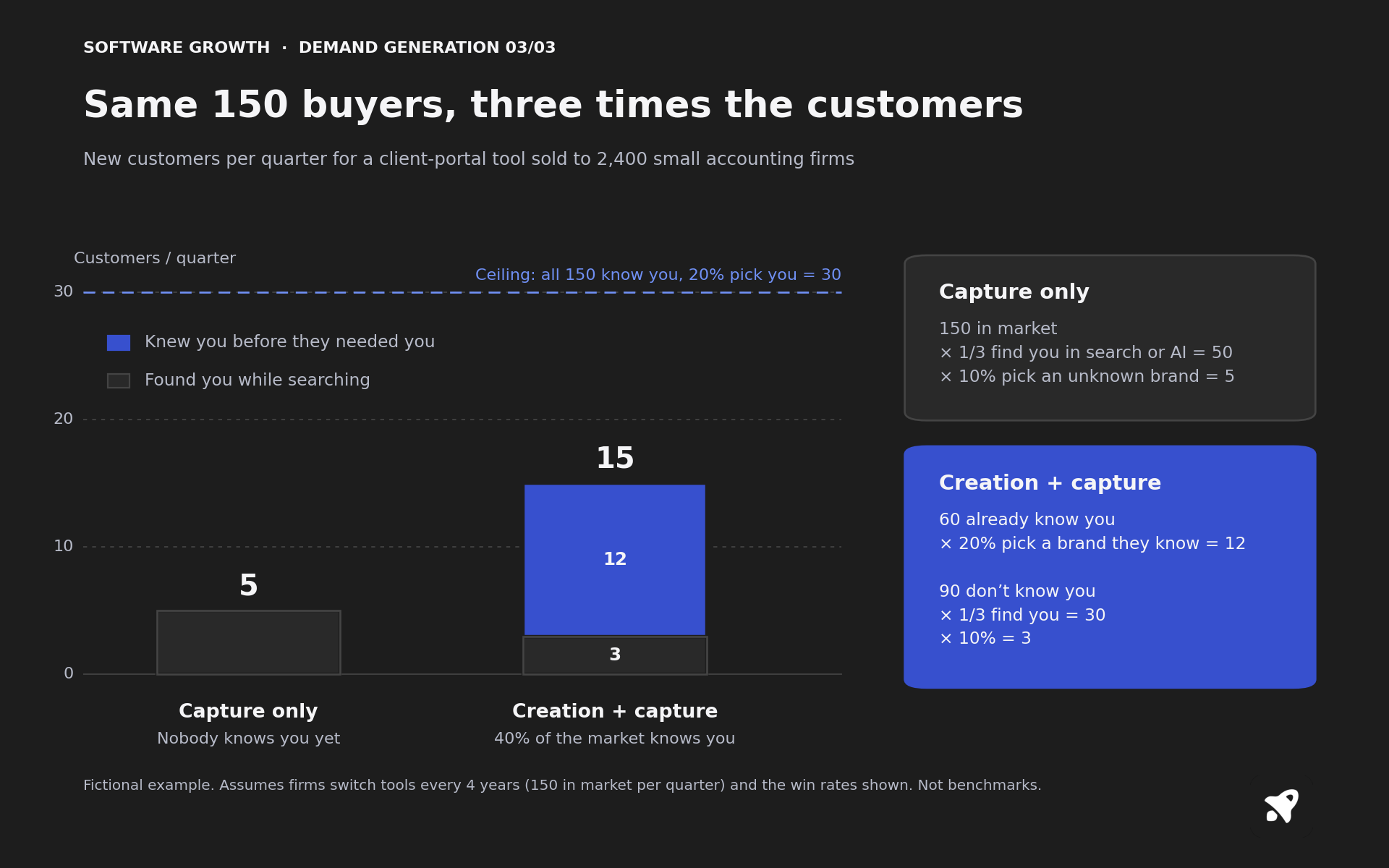
Capture only. Nobody knows the product yet. A third of in-market firms find it through search, AI answers or ads: 150 × 1/3 = 50. As an unknown brand it wins 10% of those: 50 × 10% = 5 new customers a quarter, or 5 × $90 = $450 of new MRR.
Creation plus capture. After a year of a weekly newsletter for practice owners, guest spots on two accounting podcasts and answering questions in an accountants' community, 40% of the market knows the founder and the product. Now 150 × 40% = 60 in-market firms already know it, and a familiar brand makes the shortlist more often, so it wins 20% of them: 60 × 20% = 12. The other 90 still find it at the same rate: 90 × 1/3 = 30, and 30 × 10% = 3. Total: 15 new customers, or 15 × $90 = $1,350 of new MRR a quarter, three times the capture-only result from the same 150 buyers.
Three things to notice:
- The ceiling. Even if all 150 knew the product and it won 20% of them, it would get 30 customers a quarter. Demand creation raises your share of each quarter's buyers; it doesn't create buyers who aren't in the market.
- The delay. The year of newsletters and podcasts produced almost nothing measurable in its first quarters. The 40% awareness built up slowly. Dawes calls building this kind of mental availability a multi-year task, even for well-established brands.
- The attribution trap. Most of the 12 would show up in analytics as "direct" or a branded Google search. A last-click report would say search drives the business and the newsletter does nothing. The "how did you hear about us?" answers are where the newsletter and podcasts show up.
What changed in 2026
Recent writing from people who track this closely points the same way: buyers trust people more than channels, and the channels that create demand are getting harder to measure.
- Relationships beat automation. Kyle Poyar and Maja Voje surveyed 300 go-to-market leaders in September 2026 for the 2026 State of B2B GTM report (published October 14). Network and introductions ranked as the single most effective channel and intimate events second. LinkedIn posting by founders and employees was a core channel for half of respondents. Cold outreach landed in the oversaturated quadrant. Founder-led sales was the leading motion for companies under $1M ARR (44%).
- AI search went mainstream. In the same survey, 39% called AI search a core channel, up 11 points in a year, the biggest increase of any channel. Poyar's advice is to track not just whether AI mentions you but whether it says the right things to the right people.
- But AI visibility behaves like a brand channel. On October 22, 2026, Rand Fishkin reviewed three new studies. In one, ChatGPT sent 0.62% of traffic across 100 sites. In another, Kevin Indig could not find a reliable link between AI visibility and branded search or direct traffic. Fishkin's conclusion, building on Mike King: treat AI visibility like a billboard, invest and measure it as brand, not as a traffic channel.
- B2B creators became a real channel. In his October 28 guide, Poyar argues that for high-ticket products, influence among target buyers matters more than the cost per thousand impressions, and sums up the pattern: "you land in brand marketing and expand in growth marketing."
- Operator-creators. Elena Verna argued on October 5 that the best business content creators still have day jobs, because hands-on work keeps the content credible. For founders, your day job is your content.
- Earn signals, don't chase them. Amanda Natividad, writing on September 23, 2026, points out that algorithms, search engines and AI tools all try to model what people find useful, so the durable work is making things people forward to a coworker or recommend unprompted. Her advice: "don’t confuse the proxy for the goal."
Lean into your network, intimate events, and LinkedIn instead.
Kyle Poyar / What's working in B2B GTM: 2026 data from 300 leaders (October 14, 2026)
Common mistakes
- Calling lead generation demand generation. A gated ebook that collects 500 emails from people who will never buy is not demand.
- Judging demand creation by last-click attribution, then cutting it because "it doesn't convert".
- Expecting results inside a quarter. Most people you reach this month aren't buying this quarter.
- Spreading thin. Five channels done badly create less demand than two done every week.
- Creating demand for the category instead of for you. If your positioning is vague, the reader remembers the problem and buys the best-known tool.
- Skipping capture. Check your brand search results, AI answers and pricing page before publishing more.
- Copying enterprise playbooks. Big brand campaigns and ABM programs assume budgets and sales teams a small SaaS doesn't have.
For small and bootstrapped SaaS
Some decision rules, partly ours and partly from the sources above:
- If your product is bought rarely and considered carefully (most B2B SaaS), start demand creation early, alongside capture. If it is cheap and bought on impulse, lean on capture first.
- Pick two or three channels and publish one or two pieces a week. That was Natividad's practical advice at MicroConf 2026, as Derrick Reimer summarized it on Startups for the Rest of Us episode 830, with a monthly review.
- Keep one channel you own, usually email, so you aren't only renting algorithms.
- Ask every new customer how they heard about you from day one, so you have a baseline before you need it.
- Give a channel at least two quarters before you judge it on branded search, self-reported answers and inbound conversations. This is our rule of thumb, not a benchmark.
- Use your founder brand. A small company's most credible channel is usually the person who built the product, talking about the problem in public.
Listen, watch and read next
- Read: Advertising effectiveness and the 95-5 rule, John Dawes, Ehrenberg-Bass Institute (May 2021). The primary source for the 95-5 rule, including how to calculate your own in-market share.
- Watch: Modernizing Your GTM Strategy: Demand Creation vs. Demand Capture, Chris Walker on Insightly's Closing Time (September 12, 2023). The demand creation vs demand capture section starts at 6:38.
- Listen: Startups for the Rest of Us, episode 830, Rob Walling and Derrick Reimer (April 28, 2026). From 12:48, a recap of Amanda Natividad's MicroConf talk on zero-click marketing and why attribution breaks.
- Watch: The 3 big problems with asking "How did you hear about us?", Rand Fishkin (September 20, 2023). Five minutes on what self-reported attribution can and can't tell you.
- Read: What's working in B2B GTM: 2026 data from 300 leaders, Kyle Poyar (October 14, 2026). Which go-to-market channels are working right now, by company stage and deal size.
- Read: If search captures demand, public evidence creates it, Amanda Natividad (April 2, 2026). Why search gets too much credit and what actually creates demand.
Related terms
- Lead generation
- Marketing funnel
- Top of funnel (TOFU)
- Content marketing
- Marketing attribution
- AEO (Answer engine optimization)
- Positioning
- ICP (Ideal customer profile)
- Growth channels
- MQL (Marketing qualified lead)
Sources
- Advertising effectiveness and the 95-5 rule: most B2B buyers are not in the market right now, John Dawes, Ehrenberg-Bass Institute, May 2021
- 95-5 Rule, LinkedIn B2B Institute
- Demand generation vs. lead generation: Everything you need to know, HubSpot
- Modernizing Your GTM Strategy: Demand Creation vs. Demand Capture, with Chris Walker, Insightly, September 12, 2023
- Demand creation vs. demand converting marketing, Rand Fishkin, SparkToro, April 8, 2025
- New research: dark social falsely attributes significant percentages of web traffic as "direct", Rand Fishkin, SparkToro, April 27, 2023
- The 3 big problems with asking "How did you hear about us?", Rand Fishkin, SparkToro, September 20, 2023
- If search captures demand, public evidence creates it, Amanda Natividad, SparkToro, April 2, 2026
- Zero-click content: the counterintuitive way to succeed in a platform-native world, Amanda Natividad, SparkToro, July 26, 2022
- Does your website still matter in the zero-click era?, Rand Fishkin, SparkToro, August 14, 2026
- Algorithms don't just happen to us, we train them, Amanda Natividad, SparkToro, September 23, 2026
- Is AI visibility a marketing boondoggle?, Rand Fishkin, SparkToro, October 22, 2026
- What's working in B2B GTM: 2026 data from 300 leaders, Kyle Poyar, Growth Unhinged, October 14, 2026
- B2B newsletter ads: a guide for brands and creators, Kyle Poyar, Growth Unhinged, October 28, 2026
- So, you want to be a content creator?, Elena Verna, July 28, 2026
- How to survive a double life as an operator-creator, Elena Verna, October 5, 2026
- Episode 848: What Liquid Death can teach us about B2B SaaS, Rob Walling, Startups for the Rest of Us, September 1, 2026
- Episode 830: Breaking through plateaus, zero-click marketing and more from MicroConf 2026, Rob Walling and Derrick Reimer, Startups for the Rest of Us, April 28, 2026